

Drive down Avenida del Cid into Valencia and you cannot miss it: a vast concrete shell on Avenida de les Corts Valencianes that has loomed over the western edge of the city since the late 2000s. For 16 years, it sat unfinished, a public reminder of everything that went sideways at Valencia CF. As of 2026, the cranes are turning again, and the club has put a date on its completion, but fans are cautiously optimistic. This is the story of how Nou Mestalla got stuck, why it is finally moving, and what it means if you are planning to live in Valencia.
Why the works took so long
Construction started in August 2007. The original design, by Reid Fenwick and the firm that became Fenwick Iribarren Architects, was for a 75,000-seat stadium on the western side of the city, with the historic Mestalla on Avenida de Suecia to be sold to property developers. The build was meant to take roughly two years and cost about 241 million euros.
Then 2008 happened. The global financial crisis hit Spain harder than most of Europe, and Valencia CF was particularly exposed: a club with high debt, a half-funded new stadium and no buyer in sight for the old one. In February 2009, the contractors walked off site. The concrete shell of the lower bowl, parts of the upper tier and the access ramps were already in place, and they stayed that way.
Successive boards announced restart plans that never materialised. Singaporean businessman Peter Lim took over the club in 2014 and repeatedly committed to finishing the stadium, but each target date came and went. By the early 2020s, the unfinished structure was visible from Avenida del Cid and the A-3 highway, a 16-year reminder of how a financial crisis can freeze a city skyline in place.
Why works resumed
The breakthrough came in January 2025, when contractors returned to the site. Behind the scenes, the club had been negotiating for months on the only thing that could realistically unfreeze the project: financing.
In June 2025, Valencia CF closed a 322-million-euro package backed by Goldman Sachs and a vehicle linked to La Liga's CVC partnership. As part of the deal, the new club president, Kiat Lim, made a public commitment to seeing it through. The Valencia city government applied steady pressure from above whilst long-suffering supporters and fan associations lobbied from below to complete the stadium's development.
The combination of fresh money, a clear deadline, and a city that was tired of looking at a concrete skeleton finally moved the project forward. Nothing about the financing or the politics is simple, but the practical effect is that the site is now alive again.
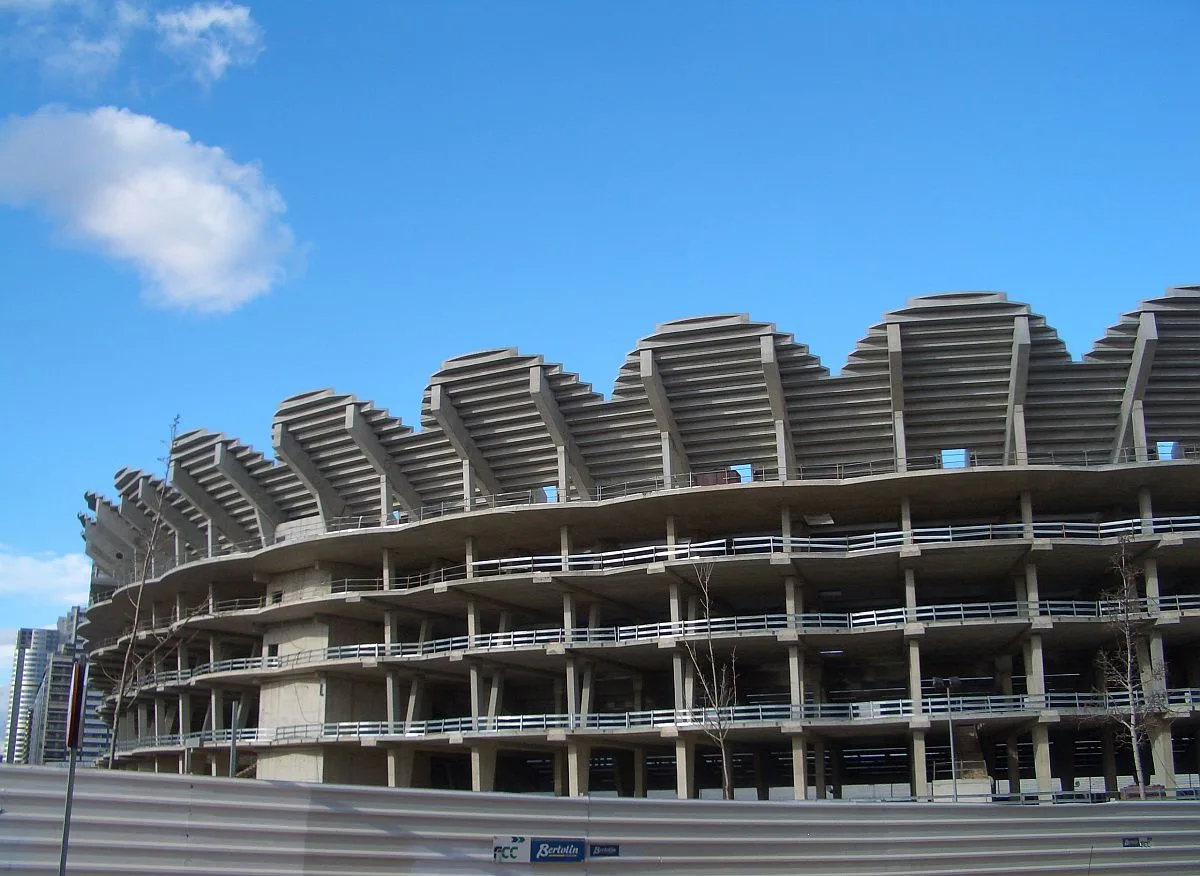
Photo: funky1opti, CC BY 2.0
What is being built
Final capacity will be 70,044 seats, all of them covered by a full roof. The redesign is again the work of Fenwick Iribarren Architects, the Madrid-based studio that handled the original brief, now updated to modern UEFA and FIFA Category 4 standards.
The headline target is summer 2027, in time for the 2027-28 La Liga season. The most visible piece of work in 2026 is the main roof: 50 compression-ring elements are being installed across the top of the bowl, the structural backbone that lets the rest of the canopy span the seating without internal columns. Once the ring is closed, the radial elements that form the roof itself can go in.
Beyond the roof, the building still needs facade cladding, full interior fit-out, hospitality areas, vertical circulation, internal mechanical and electrical systems, and the surrounding plaza and access works. None of that is trivial, but it is normal stadium construction, which is exactly the point: after 16 years of paralysis, Nou Mestalla is just a building site again.
According to Valencia Extra (August 2026), the access design includes 12 exterior staircase towers built specifically to cut entry and exit times for a near-70,000-seat crowd, and work is picking up pace with the main roof now being raised into place.
The sightline question
One angle that has caught fan attention is visibility from the upper tiers. The redesign reshaped the bowl compared with the 2007 plans, and supporter forums have asked sensible questions about how the views will hold up from the back of the stand and behind the goals.
The club has committed to a 3D seat-selection tool that opens to season-ticket holders between November 2026 and May 2027. The idea is straightforward: before you choose your seat, you can rotate a digital model of the bowl, sit in any position virtually, and see exactly what your view of the pitch will look like. It is a small detail, but it is the kind of transparency that fans of the old Mestalla, who know every blocked sightline by heart, will appreciate.
The 2030 World Cup angle
Spain co-hosts the 2030 World Cup with Portugal and Morocco. FIFA set its host-city deadlines while the Nou Mestalla site was still dormant, so Valencia did not make the original 11-stadium Spanish list. That stung, given the city's size and footballing history.
Two host slots remain open in the Spanish allocation due to withdrawals from Málaga and A Coruña, and Valencia is in the running alongside Vigo to replace them. Nothing is guaranteed, but the restart of Nou Mestalla, the firm 2027 opening target and the upgraded design quietly improve their odds. If FIFA does reopen the list, Valencia now has a credible answer.
Whether or not a World Cup match is ever played there, the pressure of being a candidate has implicitly ensured the stadium is built to a higher standard.
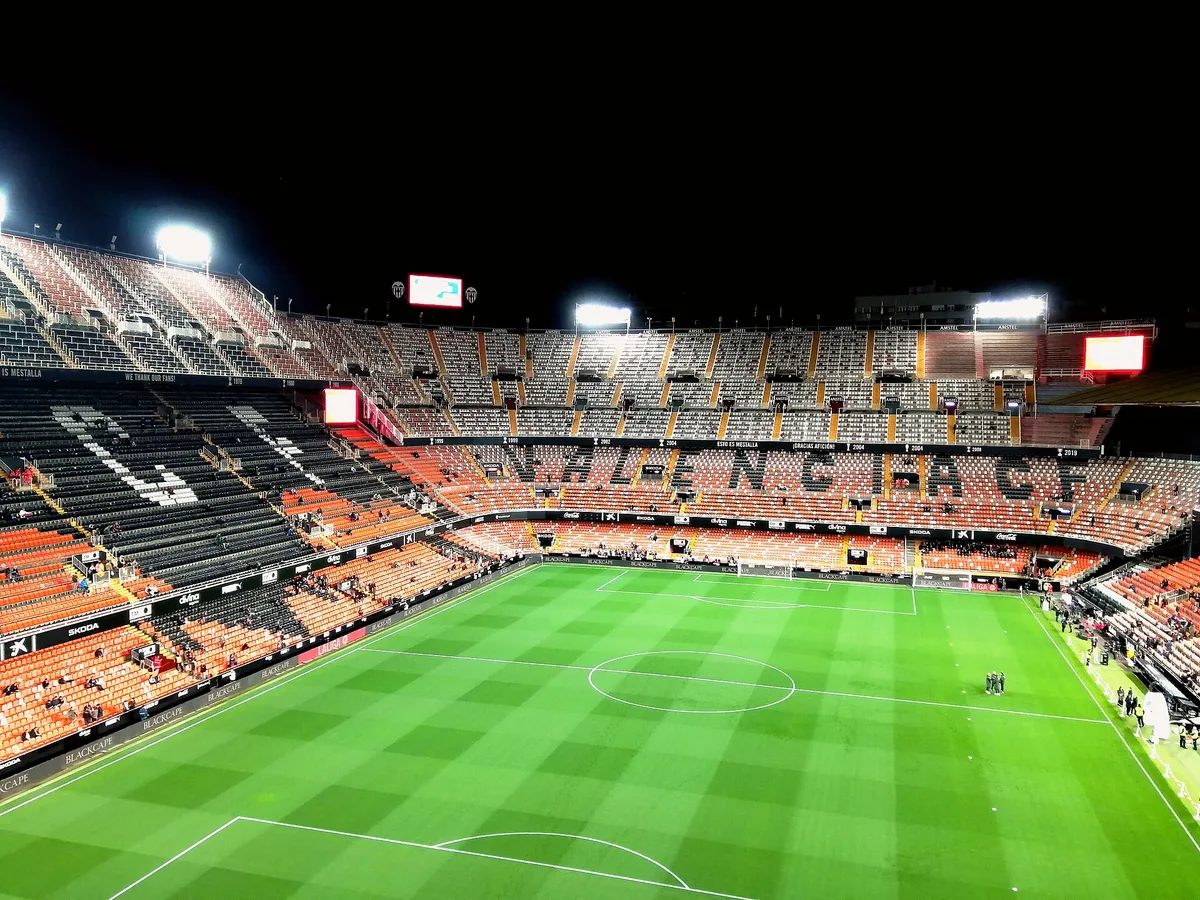
Photo: Anidae, CC BY-SA 4.0
What it means if you are moving to Valencia
From a relocation standpoint, here is what Nou Mestalla actually changes. Once it opens in 2027, the city gains a 70,000-seat venue that will host Valencia CF league matches, big-name concerts and major events that currently bypass the city. Spending a Saturday evening in Valencia gets a new shape.
The historic Mestalla on Avenida de Suecia, in use since 1923 and the heart of the Mestalla, Aragó and edge-of-Ruzafa barrios, will eventually be sold to property developers. That decision has been in the air for years and has already shaped how locals think about that pocket of the city. When it does happen, expect significant changes to the housing supply, the streetscape and the rhythm of the neighbourhood. Renters and buyers considering the area should monitor the timeline.
The redevelopment plan itself is now public. Per Valencia Extra (August 2026), the old stadium footprint between Avenida de Aragón and Calle Artes Gráficas is set to become a new residential pocket of 580 homes across seven buildings, the tallest reaching 29 storeys, alongside public space and green areas. Selling that land is one of the main funding sources for finishing the new stadium, which is part of why the two projects are tied together on any realistic timeline.
Practically, this is also a transport story. The Aragó metro stop on lines 5 and 7 currently serves the old ground; the new one sits closer to the Nuevo Centro and Avenida del Cid corridor, with its own bus and metro connections. The shift is unlikely to upend daily commutes for most residents, but it will reshape matchday flows and event traffic on the western side of the city.
Want to plan around all this? Our Things to Do in Valencia guide has a sports section featuring Mestalla, our neighbourhoods overview covers Mestalla, Aragó and Ruzafa in detail, and the renting in Valencia pillar is the practical place to start if you are weighing where to live next.
Planning a move to Valencia in 2026?
We help newcomers with visas, NIE, housing, schools and the day to day calls that turn a move into a real life here.
Contact Us
About the author
Michael Bastin
Founder, ValenciaMove - Valencia since 2016
Michael moved to Valencia in 2016 and has helped dozens of families relocate since. He writes every guide on this site personally and verifies every fact against Spanish government sources before publishing.
Buy Michael a coffeeNeed help with your move?
Contact us. We handle visa, admin, and housing so you can focus on the exciting part.