
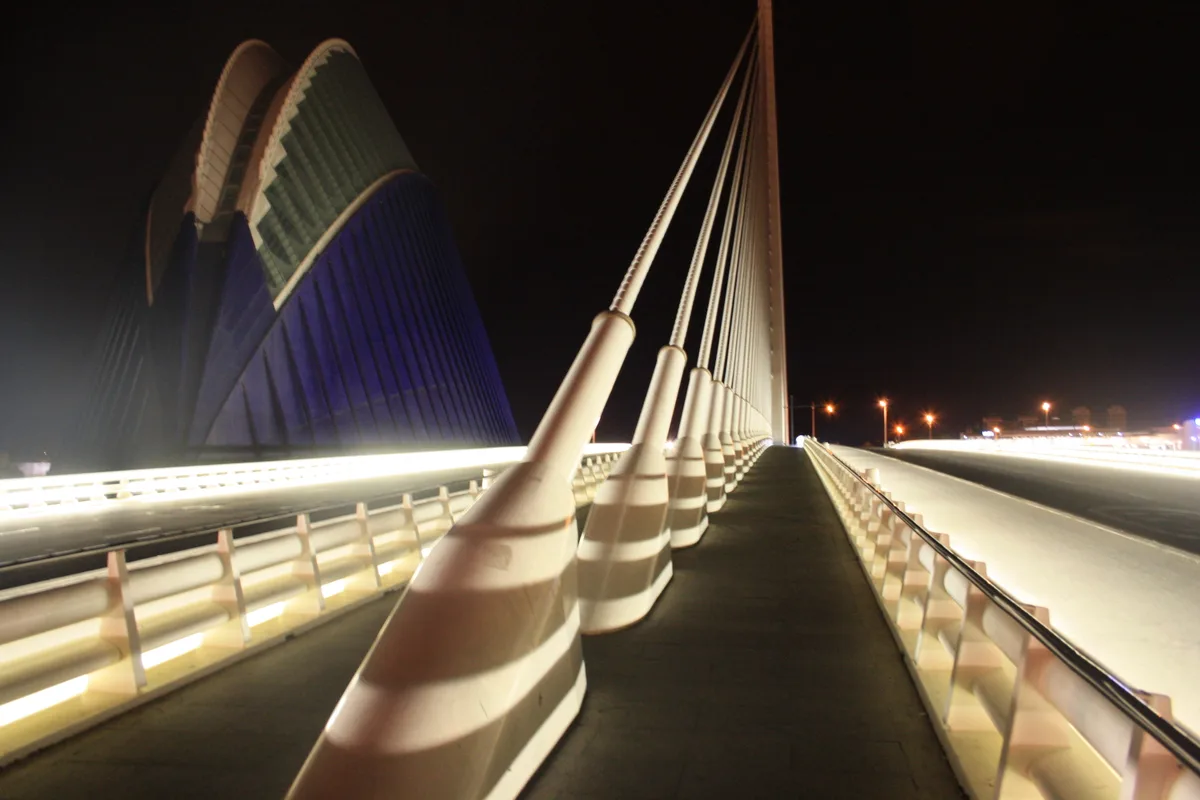
Photo: Frank Baulo, CC BY-SA 3.0
Living in Camins al Grau: a Valencia neighborhood guide
The 2010s newer-build belt between Ruzafa and the port
Living in Camins al Grau
Camins al Grau () is the bridge between old Valencia and the sea - geographically wedged between Ruzafa to the west and the port to the east, and developmentally a different planet. Where Ruzafa is 19th century with original tile floors and the occasional lift, Camins is 2010s with parking, double-glazed windows, and a building lobby with a real concierge. Officially it's district 12, made up of five sub-barrios you'll see on rental listings: Aiora (also spelled Ayora), Albors, La Creu del Grau, Camí Fondo, and Penya-Roja. Most of the newer stock and most of the expat interest sits in Penya-Roja and along Avenida de Francia.
Camins al Grau is the Valencian name and Caminos al Grao the Castilian one; both mean the roads to the Grau, after the old routes that crossed this huerta from the city to its port. According to the Ajuntament's municipal register, its five barrios had 67,939 residents on 1 January 2025.
The reason expats discover it: rent. A 90-square-metre 2-bedroom with parking, lift, and a balcony typically goes for 1,500 to 1,800 euros in Camins. The same flat in equivalent Ruzafa or Eixample is 1,650 to 2,000. Move-in cash is the bigger surprise though - on a 1,500 euro flat you should expect to wire roughly 4,500 to 6,000 euros at signature: one month rent, two months fianza (the legal minimum is one, but Penya-Roja landlords commonly ask for two), and either an agency fee of one month plus VAT or, on newer FSBO listings via Idealista, no commission at all. Bring three pay slips or six months of bank statements and your NIE - nine landlords out of ten won't even show the flat without it.
Transport is the unsung win. Metro lines 5 and 7 share three stations inside the barrio - Ayora, Amistat-Casa de Salud, and Marítim-Serrería - putting Plaça de l'Ajuntament at roughly 12-15 minutes door-to-door from Ayora, and Estació del Nord at 12-15 minutes. Tram line 6 from Marítim-Serrería gets you to Universitat Politècnica in 17 minutes. By bike, the Avenida del Puerto cycle lane (one of the smoothest in the city) puts you at Marina Real Juan Carlos I in 10 minutes flat, Cabanyal beach in 12-15, and Plaça de la Reina in around 15. The airport is a 20-minute drive or roughly 30 minutes on metro line 5 with no change needed. Mestalla stadium is one stop or a 15-minute walk north.
Day-to-day life clusters around three anchors. The first is Centro Comercial Aqua at Calle Menorca 19, a 36,000-square-metre mall with a Mercadona in the basement, a Cinesa cinema upstairs, and the usual Zara, H&M, Mango lineup - useful in August when 38-degree afternoons make air-conditioned shopping a survival tactic. The second is the El Corte Inglés on Avenida de Francia, the default for anything you can't find on Amazon. The third is the Ayora garden near Calle Santo Justo y Pastor, the local Sunday-morning gravity well for families with dogs and pushchairs. Casual eating happens on Avenida de Francia and the streets feeding it - Carrer d'Eivissa, Carrer Menorca, Carrer Luis Bolinches Compañ - where you'll find Bar Marvi for menú del día, Little Thai for a casual pad thai, Miss Sushi for date nights, and Dulce de Leche for a flat white at 9am.
The fabric shifts with the seasons. August is brutal and quiet - half the barrio decamps to the coast, the metros run empty, and you bless every euro of the air conditioning your 2010s building came with. Autumn (October-November) is the sweet spot: 22 degrees, full terraces along Avenida de Francia, and the Marina lit up at dusk. December is calm in a way central Valencia never is - no Christmas-market crowds spill this far east, and you can get a table anywhere. The one painful week is Fallas (mid-March): Camins is not a Falla heartland, but the spillover parking chaos and the 3am mascletàs carrying east on the wind will wake you. If you crave the Fallas immersion, you'll feel left out. If you want a quiet base to retreat to, you'll feel smug.
Who shouldn't live here: the heavy partier (Ruzafa and Cabanyal are where the night actually happens - the last metro leaves around 23:00 on weekdays but about 02:20 on Friday and Saturday nights, and Camins itself shuts by midnight on weekdays); the museum-and-cobblestones romantic (El Carmen or Ciutat Vella are 20 minutes away by metro, but you'll resent the daily round trip); anyone allergic to the glass-and-render mid-rise aesthetic (the 2008-2018 build wave dominates and won't soften with time); and Erasmus students looking to walk home from a bar at 4am (Benimaclet and Algirós are your barrios, not this one). Camins rewards a particular profile: foreign professionals on remote-work or hybrid schedules, families with school-age kids who need lifts and parking, and couples in their 30s-40s who've done the central-Valencia thing and want a calmer base 10 minutes from it.
What's not here: the postcard look. Camins doesn't photograph well. It's mostly mid-rise glass-and-render developments from the 2008-2018 wave, with cookie-cutter façades and the occasional surviving 1990s block at lower rents. If you care about coming home to a building with character, this isn't your barrio. If you care about a working dishwasher, central heating, a 4 m² (about 43 sq ft) terrace facing south, and rent that's roughly 10 percent below the equivalent Ruzafa flat, it's exactly your barrio.
The Camins al Grau district has five barrios: Aiora, Albors and Penya-roja, plus La Creu del Grau, the densest, named after a medieval wayside cross on the old road to the port, and little Camí Fondo, named after the old sunken road to the Grau.
What rent costs in Camins al Grau (September 2026)
Camins al Grau asks 19 EUR per m² a month on Fotocasa's rent index for September 2026, above the 18 EUR the city of Valencia averages. At that rate a 70 m² (about 753 sq ft) two-bedroom lists at around 1,330 EUR a month, before you negotiate. These are asking prices on new listings, not what sitting tenants pay.
Asking prices here are 22.4% above a year earlier, against 16.2% for the city as a whole.
One figure covers the whole Camins al Grau district here, which also takes in Aiora, Albors, Penya-roja, La Creu del Grau and Camí Fondo. The barrios inside it price differently street by street, so read it as the district average rather than a quote for any one of them.
Our renting guide explains what landlords ask for and what the fianza and agency fee add on signing day, and the upfront cost calculator runs the maths for any rent.
Living in the Camins al Grau district
Getting around
Ayora, Amistat and Maritim cover the district, and Avinguda del Port runs straight through it connecting the centre to the sea.
That avenue is the reason the district works: you can be in Ciutat Vella in 10 minutes and on the beach in another 10, from the same address.
What sets it apart
Camins al Grau is the corridor between the centre and the port, and it has the widest architectural spread of any district. Aiora is dense 1960s blocks. Penya-roja is glass towers built in the 2000s on former railway land.
That produces an unusually wide price range inside a single district, sometimes doubling between two barrios a kilometre apart.
Who it suits
Renters who want to sit exactly halfway between the centre and the beach with a metro at either end.
Penya-roja suits people who want a modern flat with a pool and concierge. Aiora suits people who want the same location for considerably less.
Barrios in Camins al Grau
Every barrio inside this district has its own guide. Rent, transport and character vary a lot from one street grid to the next, so start with the one closest to where you actually want to live.
Aiora
Family-friendly Camins al Grau pocket around the Jardín de Ayora with metro 5 connection
Explore AioraAlbors
Quiet Camins al Grau pocket next to Amistat metro, between Aiora and Penya-roja
Explore AlborsPenya-roja
Modernist America's Cup blocks at the marina, popular with digital nomads
Explore Penya-rojaLa Creu del Grau
A dense, everyday barrio between the Avinguda del Port and the Avinguda de França, named after a medieval wayside cross
Explore La Creu del GrauCamí Fondo
A small barrio of Camins al Grau where the old roads to the port began, with a few streets of low family houses
Explore Camí FondoNeighbouring districts
These districts share a boundary with this one. Worth a look if you are still deciding where to live, or want to compare with the area next door.
Public and concertado schools
Active public and concertado schools in this district, per the Conselleria d'Educació register.
The Conselleria's school guide doesn't allow direct links to an individual school's page, so each card below gives you the school's official code instead. Open the guide, paste the code into the search box and the school's page comes up. Like many Spanish public administration websites, it takes a little patience.
CEIP Angelina Carnicer
Carrer Puebla de Farnals 30
CEIP Antonio García López
Carrer Peris Brell 66
CEIP el Grau
Avinguda Baleares 64
CEIP Jaume I
Carrer Jerónimo Monsoriu 21
CEIP l'Albereda
Carrer Luis García-berlanga Martí 27
CEIP Miquel Adlert I Noguerol
Carrer Pepe Alba 21
CEIP Tomás de Montañana
Avinguda Baleares 40
CEP Aiora
Carrer Justo y Pastor 136
IES Baleares
Avinguda Baleares 66
IES Districte Marítim
Avinguda Baleares 62
Centre Privat Ave María de Peñarrocha
Avinguda Francia 3
Centre Privat Engeba
Carrer Aben-al-abbar 12
Centre Privat la Anunciación
Carrer Conserva 2
Centre Privat Santa Ana
Avinguda del Puerto 51
Centre Privat Trafalgar
Carrer Rodrigo Pertegaz 29
Public health centres (centros de salud) near this neighbourhood
Public primary-care centres of the Valencian health service. Distances are straight-line to the edge of the neighbourhood, not walking routes.
Centro de Salud Salvador Pau
Salvador Pau 42, 46021 Valencia
Health department: Clinico
Centro de Salud Trafalgar
Trafalgar 32, 46023 Valencia
Health department: Clinico
Which centre you are assigned to depends on your home address, so check it with the Generalitat's centre search before you register.
Generalitat health centre searchSource: Generalitat Valenciana open data (CC BY).
Where Camins al Grau Sits in Valencia
What Living in Camins al Grau Is Really Like
Pros: What Residents Love
- Modern flats with lifts, parking and proper insulation (rare in central barrios)
- Family-sized 90-110 m² layouts at roughly 10 percent below Ruzafa equivalents
- Three metro stations on lines 5 and 7 (Ayora, Amistat, Marítim-Serrería) plus tram lines 6 and 8 at Marítim-Serrería
- 10-minute bike to Marina, 12-15 to Cabanyal beach via Avenida del Puerto cycle lane
- Centro Comercial Aqua and El Corte Inglés on Avenida de Francia for daily errands
- Quiet residential streets ideal for remote work and families with school-age kids
Cons: What to Know First
- Glass-and-render 2010s aesthetic dominates - no architectural heritage to speak of
- Local dining density modest - most evenings out happen in Ruzafa or Cabanyal
- A handful of buildings still carry visible 2008-crisis stalled-project marks
- Identity less defined than Ruzafa or Cabanyal - takes 6-12 months to feel rooted
- Last metro around 23:00 on weekdays, about 02:20 Friday and Saturday - not a barrio for 4am walk-home nightlife
- Fallas spillover in mid-March brings noise and parking chaos without the cultural payoff
Typical Properties in Camins al Grau
Local Amenities
Cycling
Avenida del Puerto bike lane: Marina in 10 min, Cabanyal in 12-15, Plaça de la Reina in 15
Transport
Metro lines 5 and 7 (Ayora, Amistat, Marítim-Serrería) plus tram lines 6 and 8 - Ajuntament in 12-15 min
Daily life
Mercadona inside Centro Comercial Aqua (C/ Menorca 19); El Corte Inglés on Avenida de Francia
Parking
On-street and underground parking widely available - most modern blocks include a deeded space
Green space
Ayora garden near C/ Santo Justo y Pastor; Turia Park a 10-min walk north
Eating out
Avenida de Francia cluster: Bar Marvi (menú del día), Little Thai, Miss Sushi, Dulce de Leche
Population
67,939 residents in its five barrios (padrón, 1 January 2025)
More neighborhoods
La Creu del Grau
A dense, everyday barrio between the Avinguda del Port and the Avinguda de França, named after a medieval wayside cross
Explore La Creu del GrauCamí Fondo
A small barrio of Camins al Grau where the old roads to the port began, with a few streets of low family houses
Explore Camí FondoAiora
Family-friendly Camins al Grau pocket around the Jardín de Ayora with metro 5 connection
Explore AioraThinking about moving to Camins al Grau?
Get in touch with our Valencia relocation team. We will help you find the right apartment, navigate the paperwork, and get settled faster.

Resident in Valencia since 2016. Founder of BeTranslated. 25+ years in translation, interpretation and multilingual SEO.
Reviewed 5 September 2026 by Michael Bastin