
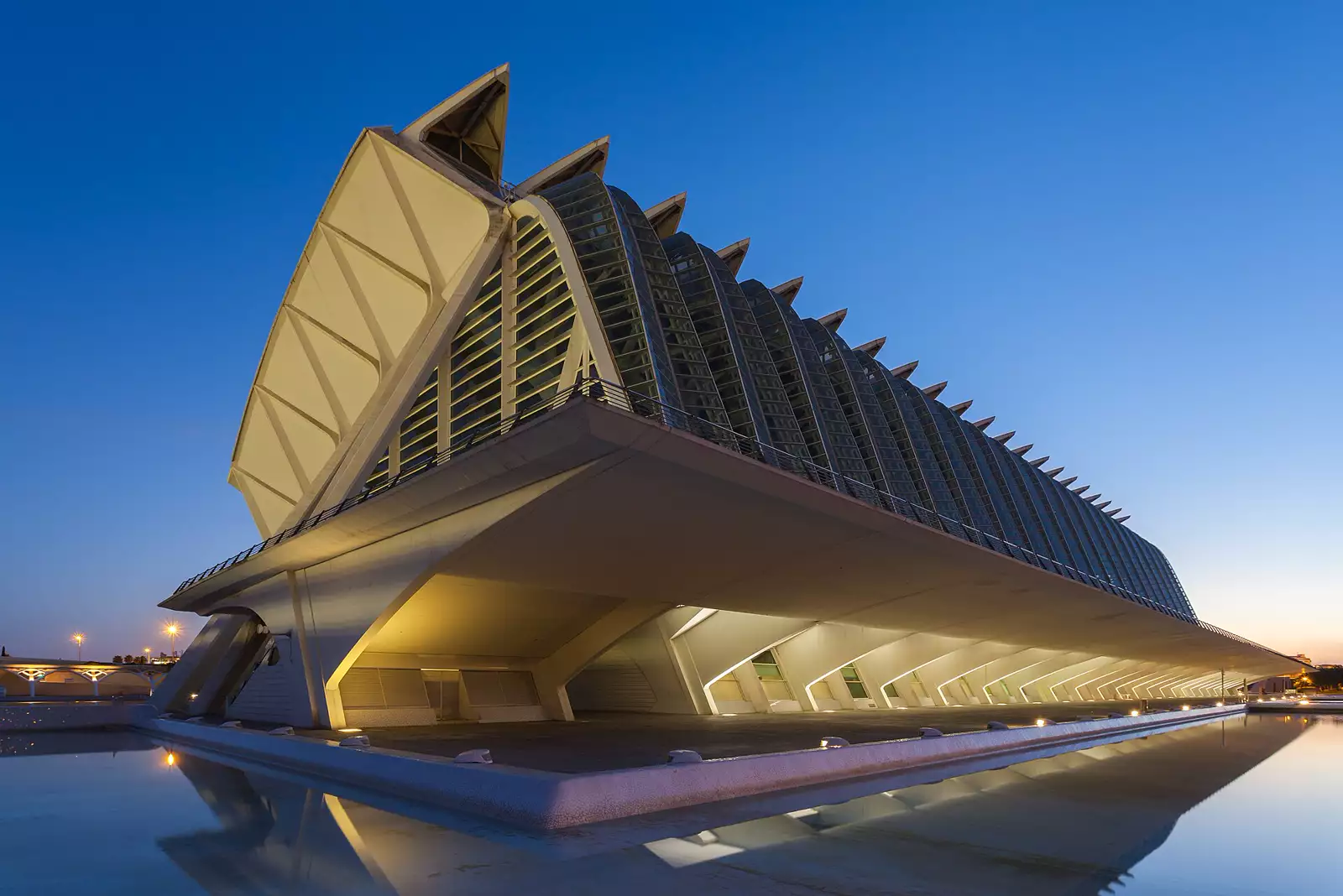
Photo: Diego Delso, CC BY-SA 3.0
Living in Quatre Carreres: a Valencia neighborhood guide
Vast southeast district from cheap Malilla blocks to glass towers around the City of Arts and Sciences
Living in Quatre Carreres
Quatre Carreres () is the giant southeast district that contains the City of Arts and Sciences, the Oceanografic, the old Malilla housing blocks, and a strip of new builds along Avenida Ausias March. The barrio is so large that talking about it as one place is misleading - rent in Malilla and rent next to the CAC can differ by 250 euros for the same square metres. Between Russafa and Montolivet sits En Corts, a dense 1960s grid named after a medieval fountain.
Quatre Carreres has the same name in Valencian and Castilian and means four roads; the district was named after the old huerta roads that crossed this land, though which four is not documented. According to the Ajuntament's municipal register, its seven barrios had 83,333 residents on 1 January 2025.
The flagship of the district is the City of Arts and Sciences complex itself. Living within a 15-minute walk gives you daily access to the Turia gardens' final southern stretch, the Hemisferic, the Palau de les Arts opera house, and a strip of waterfront the rest of Valencia visits on weekends. The CAC-adjacent sub-barrio of Mont-Olivet sits directly west of the complex with mixed 1970s and new-build stock. New builds along Ausias March and Carrer del Musico Gines tend toward modern 2-bedroom flats with terraces and gym access, listing in the 1200 to 1600 euro range in 2026.
Cross under the railway toward Malilla and the picture changes. The Malilla sub-barrio is mostly 1970s residential blocks with 80 to 100 square metre flats and rents in the 1,100 to 1,400 euro range. Quieter, more Spanish-speaking, with the new Hospital La Fe as the anchor employer. Transport is via metro line 10 (added in 2022, makes the southern half walkable to the centre) and EMT buses 14, 24 and 95.
Best fits depend on your sub-barrio choice. Near the CAC: professional families, design-conscious renters, anyone who wants the Hemisferic visible from their balcony. In Malilla: budget families, hospital staff, renters who want space and proximity to the new metro line without the centre-tax.
The Quatre Carreres district has seven barrios. Besides Mont-Olivet, En Corts, Malilla and La Punta, there is La Fonteta de Sant Lluís, an old huerta village named after a fountain; Na Rovella, home of the Fonteta pavilion and the Roig Arena; and Ciutat de les Arts i les Ciències, the fast-growing barrio around Calatrava's complex.
What rent costs in Quatre Carreres (September 2026)
Quatre Carreres asks 18 EUR per m² a month on Fotocasa's rent index for September 2026, level with the city of Valencia as a whole. At that rate a 70 m² (about 753 sq ft) two-bedroom lists at around 1,260 EUR a month, before you negotiate. These are asking prices on new listings, not what sitting tenants pay.
Asking prices here are 6% above a year earlier, against 16.2% for the city as a whole.
One figure covers the whole Quatre Carreres district here, which also takes in Mont-Olivet, En Corts, Malilla, La Punta, La Fonteta de Sant Lluís, Na Rovella and Ciutat de les Arts i les Ciències. The barrios inside it price differently street by street, so read it as the district average rather than a quote for any one of them.
Quatre Carreres is too big for one figure to describe. The blocks around the City of Arts and along Ausias March are newer, have terraces and let to professionals; Malilla behind the railway is 1970s stock at a very different rent; Penya-roja on the marina side is a market of its own again. The district average therefore tells you less than the sub-barrio does, and metro line 10 has been quietly narrowing the gap between them since it opened.
Our renting guide explains what landlords ask for and what the fianza and agency fee add on signing day, and the upfront cost calculator runs the maths for any rent.
Living in the Quatre Carreres district
Getting around
Metro line 10, opened in 2022, runs from Alacant through the district down to Natzaret, calling at Amado Granell, Quatre Carreres and Oceanografic.
It is the largest district by area, so the practical distance between Mont-Olivet and La Punta is closer to a bus ride than a walk.
What sets it apart
Quatre Carreres is the district changing fastest. It holds the City of Arts and Sciences, the new La Fe hospital and, at La Punta, some of the last working huerta plots inside the city boundary.
That range means a new-build tower at Amado Granell and a single-storey alqueria surrounded by orange trees sit inside the same administrative district.
Who it suits
Hospital staff, families who want new-build with parking, and anyone whose commute lines up with metro line 10.
Mont-Olivet suits people who want centre-adjacent value. Malilla suits families who want space. La Punta suits people who genuinely want the countryside.
Barrios in Quatre Carreres
Every barrio inside this district has its own guide. Rent, transport and character vary a lot from one street grid to the next, so start with the one closest to where you actually want to live.
Mont-Olivet
Walking distance to Ciutat de les Arts with mixed 1970s blocks and new builds
Explore Mont-OlivetEn Corts
A compact Quatre Carreres grid between Russafa and Montolivet, named after a medieval fountain
Explore En CortsMalilla
Emerging Quatre Carreres pocket with new hospital, big regeneration and rising rents
Explore MalillaLa Punta
Traditional huerta barrio between the port and the southern rice fields
Explore La PuntaLa Fonteta de Sant Lluís
An old huerta village in the south of Quatre Carreres, grown around a fountain and its church, cut off from the city by ring roads
Explore La Fonteta de Sant LluísNa Rovella
A triangle of 1970s housing blocks in Quatre Carreres, home of the old Fonteta basketball pavilion and the new Roig Arena
Explore Na RovellaCiutat de les Arts i les Ciències
The barrio around Calatrava's complex, between the Turia garden and the Ronda Sud, with new towers, the courts and a tram line
Explore Ciutat de les Arts i les CiènciesNeighbouring districts
These districts share a boundary with this one. Worth a look if you are still deciding where to live, or want to compare with the area next door.
Public and concertado schools
Active public and concertado schools in this district, per the Conselleria d'Educació register.
The Conselleria's school guide doesn't allow direct links to an individual school's page, so each card below gives you the school's official code instead. Open the guide, paste the code into the search box and the school's page comes up. Like many Spanish public administration websites, it takes a little patience.
CEIP Almudena Muñoz
Carrer Amado Granell Mesado 61
CEIP la Fonteta
Carrer Cura Palanca S/N
CEIP Les Arts
Carrer Blas Gámez Ortiz 2
CEIP Montolivet
Plaça Parque Monteolivete 3
CEIP Número 106
Carrer Riu Eresma 19
CEIP Pablo Neruda
Carrer Ingeniero Joaquín Benlloch 36
CEIP Rafael Mateu Cámara
Plaça Ceramista Gimeno S/N
IES Font de Sant Lluís
Avinguda Hermanos Maristas 25
IES Jordi de Sant Jordi
Carrer Alcalde Gisbert Rico 24
IES Malilla
Carrer Bernardo Morales San Martín S/N
Centre Privat Grupo Educativo San Luis
Carrer Zapadores 30
Centre Privat Liceo Corbi
Carrer Villahermosa 6
Centre Privat Martí Sorolla
Carrer Riu Eresma 3
Centre Privat Profesional Sorolla
Carrer Carrera Malilla 47
Centre Privat Salesianos-San Juan Bosco
Avinguda de la Plata 10
Centre Privat Santa Magdalena Sofía
Carrer Carrera del Riu 67
Public health centres (centros de salud) near this neighbourhood
Public primary-care centres of the Valencian health service. Distances are straight-line to the edge of the neighbourhood, not walking routes.
Centro de Salud Fuente de San Luis
C/ Arabista Ambrosio Huici 30, 46013 Valencia
Health department: Dr. Peset
Centro de Salud Luis Oliag - Monteolivete
Escultor José Capuz 13, 46006 Valencia
Health department: Dr. Peset
Centro de Salud Malilla
Carretera de Malilla 52, 46026 Valencia
Health department: Dr. Peset
Which centre you are assigned to depends on your home address, so check it with the Generalitat's centre search before you register.
Generalitat health centre searchSource: Generalitat Valenciana open data (CC BY).
Where Quatre Carreres Sits in Valencia
What Living in Quatre Carreres Is Really Like
Pros: What Residents Love
- Walking distance to City of Arts and Sciences, Oceanografic, Turia south
- Metro line 10 opened in 2022 connects the area to the centre in 8 minutes
- Wide rent range so you can dial in your budget by sub-barrio
- Plenty of new builds with terraces and modern services
- Hospital La Fe nearby, large EMT bus network
Cons: What to Know First
- Massive district - the experience differs wildly between Malilla and the CAC strip
- Walking to central Eixample is 30+ min from most parts
- Some 1970s Malilla blocks are noisy and lack insulation
- Tourist crowds around the CAC on weekends
Typical Properties in Quatre Carreres
Local Amenities
Culture
City of Arts and Sciences, Oceanografic, Palau de les Arts opera
Transport
Metro line 10 (since 2022), buses 14, 24 and 95
Green space
Southern Turia gardens, Parc de Manuel Granero, riverbed cycle path
Healthcare
Hospital La Fe (one of Spain's largest public hospitals)
Population
83,333 residents in its seven barrios (padrón, 1 January 2025)
More neighborhoods
Ciutat de les Arts i les Ciències
The barrio around Calatrava's complex, between the Turia garden and the Ronda Sud, with new towers, the courts and a tram line
Explore Ciutat de les Arts i les CiènciesNa Rovella
A triangle of 1970s housing blocks in Quatre Carreres, home of the old Fonteta basketball pavilion and the new Roig Arena
Explore Na RovellaLa Fonteta de Sant Lluís
An old huerta village in the south of Quatre Carreres, grown around a fountain and its church, cut off from the city by ring roads
Explore La Fonteta de Sant LluísThinking about moving to Quatre Carreres?
Get in touch with our Valencia relocation team. We will help you find the right apartment, navigate the paperwork, and get settled faster.

Resident in Valencia since 2016. Founder of BeTranslated. 25+ years in translation, interpretation and multilingual SEO.
Reviewed 5 September 2026 by Michael Bastin