


Resident in Valencia since 2016. Founder of BeTranslated. 25+ years in translation, interpretation and multilingual SEO.
Reviewed 20 August 2026 by Michael Bastin
Renting or buying in Valencia gets framed as a lifestyle question, but it is really a spreadsheet question wearing a lifestyle costume.
We have already verified the individual pieces elsewhere on this site: average rents, deposit rules, price per square metre, and the real closing costs on a purchase. What is missing is the part that ties them together, how many years of ownership it actually takes for buying to pay off, and what a non-resident mortgage really lets you borrow.
What renting actually costs
A one-bedroom apartment in central Valencia rents for roughly 900 to 1,400 EUR a month in 2026, with quieter barrios like Patraix or Benimaclet closer to 900 to 1,300 EUR. Standard leases run 5 years under the Ley de Arrendamientos Urbanos (LAU), 7 if the landlord is a company, and the legal deposit, the fianza, is capped by law at 1 month of rent.
In practice most landlords ask for more than that legal minimum. An extra 1 to 2 months as a private security deposit is common in competitive barrios, plus an agency fee, usually one month plus IVA, if you found the place through a portal rather than direct from the owner. Add it up and moving in typically costs 3 to 4 months of rent in cash, not the 1 month the law technically requires.
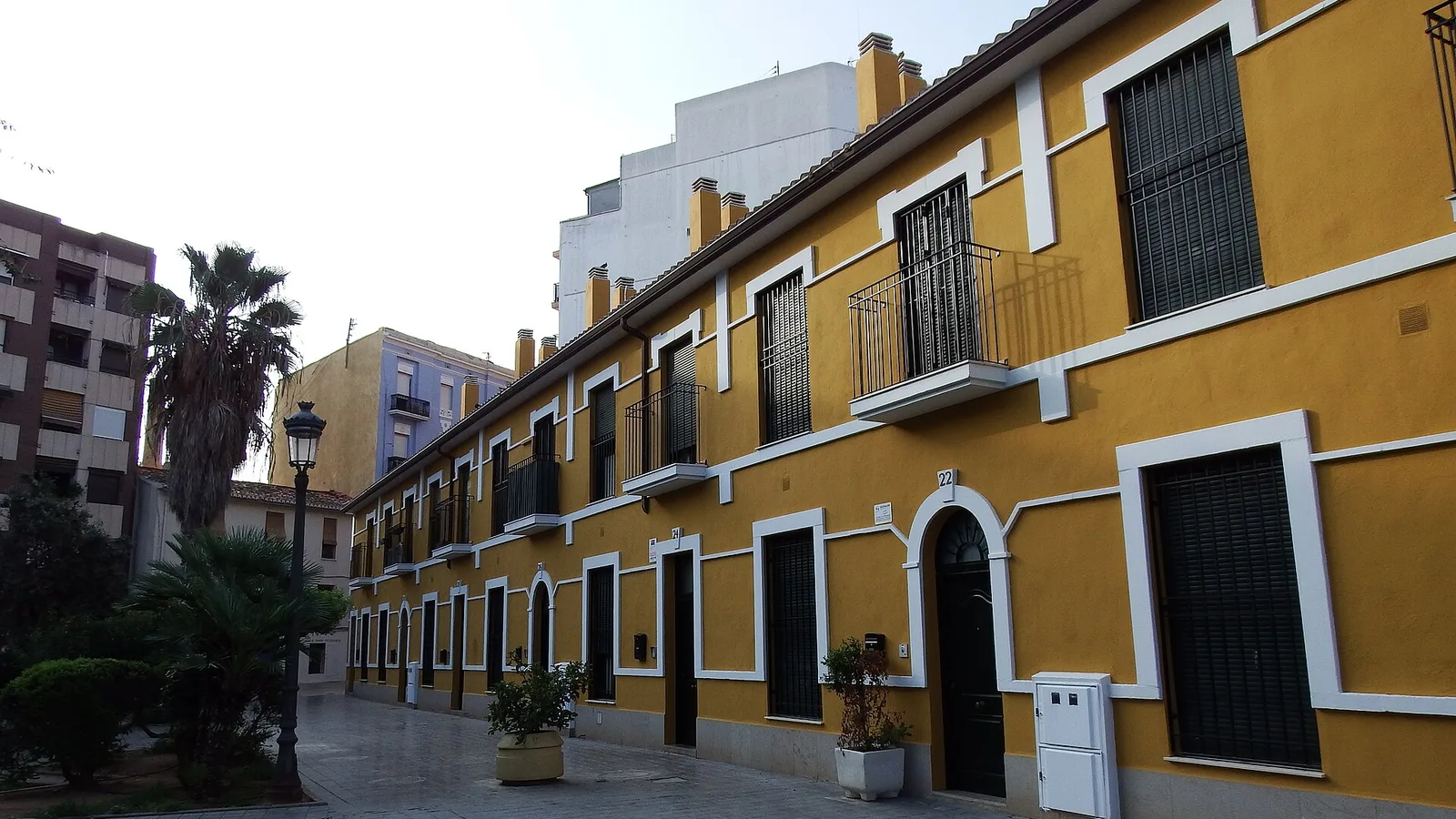
Photo: 19Tarrestnom65, CC BY-SA 4.0
What buying actually costs
Property in Valencia averages around 2,400 EUR per square metre, though that swings hard by barrio. The listing price is only the start, transfer tax, notary, registry and gestoría fees add up fast, and none of them show up in the number on the portal.
On a resale property, transfer tax (ITP) is 9%, cut from 10% by Ley 5/2025 de la Generalitat since 1 June 2026. New builds pay VAT (IVA) at 10% plus stamp duty (AJD) at 1.4% instead. Add notary fees around 0.5% of the price (minimum 600 EUR), land registry around 0.3% (minimum 400 EUR), a flat 400 EUR gestoría fee, and a 350 EUR bank valuation if you are mortgaging, and the total lands at roughly 10% above the price on a resale, and 12 to 13% on a new build.

The closing cost breakdown
Here is what actually adds up on top of the price, using the same 2026 Comunitat Valenciana rates our purchase calculator runs on:
Transfer tax (ITP), resale
9%
Cut from 10% by Ley 5/2025 de la Generalitat, effective 1 June 2026.
VAT (IVA) + stamp duty (AJD), new build
11.4%
10% IVA plus 1.4% AJD instead of ITP.
Notary fees
~0.5%
Minimum 600 EUR.
Land registry
~0.3%
Minimum 400 EUR.
Gestoría (admin filing)
400 EUR
Flat fee.
Bank valuation
350 EUR
Only if you are mortgaging.
The break-even question nobody answers
Every rent vs buy comparison eventually comes down to one question: how long do you need to stay before buying actually beats renting the same place? The closing costs above are the entry fee, and you do not get that 10 to 13% back when you sell, on top of whatever the sale itself costs in agent commission.
The honest framework is simple. Divide what those closing costs cost you in EUR by the monthly rent you would otherwise pay for an equivalent apartment. That tells you how many months of rent the entry fee is worth, the rough floor for how long you need to own before the maths even starts to work in your favour, before counting mortgage interest, community fees, maintenance, or whether the property gains or loses value.
A worked example
Take a 250,000 EUR resale apartment, the default our purchase calculator uses and in the range of a 2-bedroom central unit:
Transfer tax (ITP, 9%)
22,500 EUR
Notary, registry, gestoría, valuation
~2,750 EUR
Total closing costs
~25,250 EUR, about 10.1% of the price
Comparable rent for the same apartment
roughly 1,300 EUR a month
Closing costs expressed as months of that rent
about 19 months, a year and a half to two years
That is a floor, not a target ownership period. It assumes your mortgage payment lands close to what you would have paid in rent, and it says nothing about whether the apartment gains value, what maintenance and community fees add, or what an agent takes when you eventually sell. Rent, mortgage rates and property prices all move independently of each other, so treat this as a way to check your own numbers rather than a rule to follow.
What a non-resident mortgage actually allows
If you are buying before you have Spanish residency, the mortgage math changes on top of everything above. Non-resident buyers are typically capped at 60 to 70% loan-to-value, the bank lends against the purchase price or its own valuation, whichever is lower, and you cover the rest in cash.
EU and EEA citizens can usually reach the top of that range, up to around 70% LTV. Non-EU applicants are typically capped closer to 60%, sometimes as low as 50% depending on the bank and the applicant's profile. Terms are shorter too, non-resident mortgages are usually capped around 20 to 25 years, against the longer terms available to residents.
Put together, a non-resident buyer typically needs a down payment of roughly 30 to 50% of the price, on top of the 10 to 13% in closing costs above, not just the mortgage deposit most first-time buyers picture. On the 250,000 EUR example, that puts somewhere between about 100,000 and 125,000 EUR in cash on the table before the mortgage even starts, depending on the lender and your LTV. Exact terms vary by bank and applicant, so treat these as planning ranges rather than a quote from any specific lender.
So which one is right for you?
Neither answer is universally correct. These are the signals that tend to point one way or the other.
Renting usually makes more sense when
- You expect to stay under about two to three years, the closing costs alone can take that long to earn back in rent saved.
- Your visa or residency status is not settled yet, buying before you know you are staying long term adds risk on top of the transaction cost.
- You want the flexibility to change neighbourhoods once you actually know Valencia rather than committing from research alone.
- You would rather keep your cash liquid than tie up 40 to 50% of a purchase price in a down payment and closing costs.
Buying starts to make sense when
- You plan to stay five years or more, long enough for the closing costs to stop dominating the comparison.
- You already qualify as a resident, or you have priced in the tighter non-resident LTV and loan term above.
- You have the 30 to 50% down payment plus closing costs in cash without needing that money back soon.
- You want to lock in your housing cost against rising rents rather than staying exposed to renewal increases.
This decision is personal math, not a rule of thumb. Run your own price and rent figures through our purchase and upfront rental calculators, and if the picture is still unclear, write to us through the form and we will walk through the real numbers for your situation.
Not sure which one wins for your situation?
Rent vs buy depends on your timeline, your residency status and how much cash you want to keep liquid. Write to us through the form and we will run the real numbers against your situation, not the average one.
Book a consultationPlanning a renovation in Valencia?
Tell us about the job: a kitchen, a bathroom, a full renovation or an office fit-out. We check which permits and paperwork the work needs, then put you in touch with local builders or an architect for quotes.
About the author
Michael Bastin
Founder, ValenciaMove - Valencia since 2016
Michael moved to Valencia in 2016 and has helped dozens of families relocate since. He writes every guide on this site personally and verifies every fact against Spanish government sources before publishing.
Buy Michael a coffeeNeed help with your move?
Contact us. We handle visa, admin, and housing so you can focus on the exciting part.