
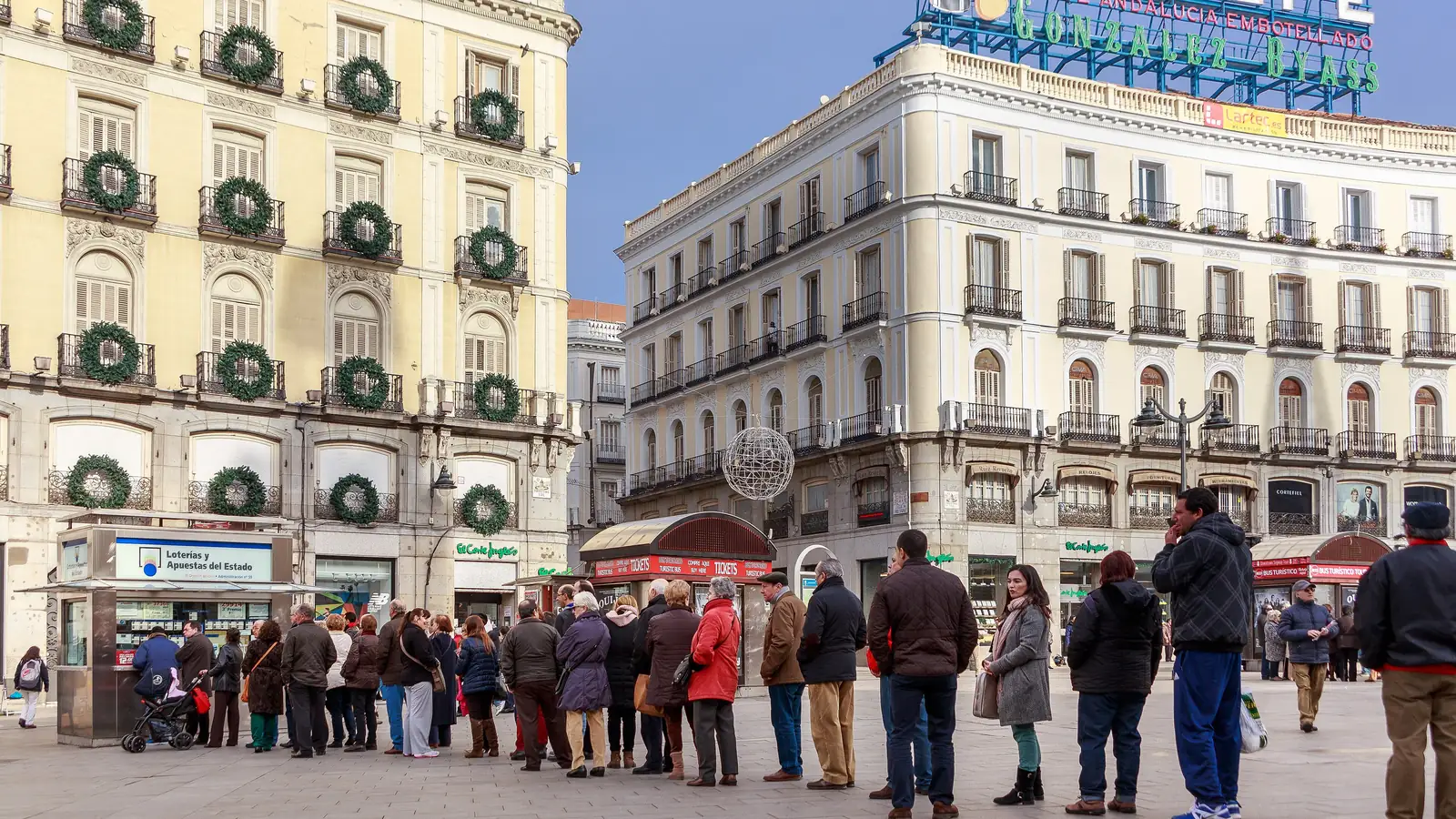
Every year on 22 December, Spain spends the morning listening to children sing numbers. The Lotería de Navidad (), the national Christmas lottery, is less a gamble than a shared ritual: colleagues, neighbours and families split the same ticket, and the top prize, el Gordo (), leads every news bulletin that day.
In 2026 the draw falls on Tuesday 22 December. This guide explains how it works if you did not grow up with it: what you actually buy, how the draw runs, how prizes are taxed and paid, and which scams to ignore. Where a figure applies only to the 2026 draw, we say so.
What the Spanish Christmas lottery is
The Sorteo Extraordinario de Navidad is part of the Lotería Nacional and is run by Loterías y Apuestas del Estado (SELAE), the state lottery company. Every number from 00000 to 99999 is on sale, and each number is printed in many identical series, so thousands of people can hold the same number.
For the 2026 draw, SELAE's official calendar lists 205 series of 100,000 numbers, with each full ticket priced at €200, an issue of €4.1 billion. According to the 2026 programme of prizes, 70% of that goes back to players as prizes, or €2.87 billion.
Billete, décimo and participación: what you actually buy
A full ticket, the billete (), covers one number in one series and is divided into ten parts. Almost nobody buys a whole one. The usual purchase is a single tenth, the décimo (), which costs €20 and carries a tenth of whatever that number wins.
A décimo is a bearer document, as the consumer organisation OCU reminds players every December: whoever physically holds it collects the prize. Photograph both sides when you buy it, and keep it somewhere safe until you have checked the results.
The other way in is through participaciones (), small shares of a décimo sold by clubs, associations, bars and workplaces. The seller keeps the décimo and hands out slips showing your share. OCU's advice for any shared ticket is that the person holding it gives every participant a signed copy with names, ID numbers and the amount each paid, and that everyone pays before the draw.
How the Christmas draw works at the Teatro Real in Madrid
Since 2012 the draw has been held at the Teatro Real, Madrid's opera house. It runs on the traditional system with two drums: one holds the numbers, the other the prizes. A child draws a ball from each at the same moment, and both are sung out loud, which is why the whole country knows the chant.
The singers are pupils of the Colegio de San Ildefonso in Madrid. The theatre opens its doors to the public at 08:00 on the 22nd and fills the seats in order of arrival. Everyone else follows the draw live on television and radio, where it runs for most of the morning.
The history of the Christmas draw, from Cádiz to television
SELAE dates the first Christmas draw to 1812, in Cádiz. The Teatro Real's own history of the draw adds the later milestones: first broadcast on television in 1957, girls among the singers from 1984, when the school became mixed, and prizes sung in euros since 2002.
The format, the chant and the morning in front of the television have barely changed since. That continuity is why the theatre calls the draw the prelude to the big days of Christmas.
Photo: Benjamín Núñez González, CC BY-SA 4.0
El Gordo, the pedrea and the other Christmas lottery prizes
The first prize is el Gordo, the fat one. Below it come a second and a third prize, then fourth and fifth prizes, and then la pedrea (), the long list of small prizes that fills most of the morning's singing. There are also prizes for the numbers either side of the top prizes and for numbers that share their final digits.
The prize everyone forgets is el reintegro (): if your number ends in the same digit as el Gordo, you get the price of your ticket back. Check every décimo for it before you throw one away.
Prizes are set per series, so a décimo collects a tenth of what its number wins in one series. The exact amount of each prize for 22 December 2026 is in SELAE's official programme of prizes: trust that rather than any figure you hear in a bar.
Where and how to buy a Christmas lottery décimo
Décimos are sold by lottery offices, the administraciones de lotería (), and by the other points of sale in SELAE's network. You can also buy on SELAE's official website and app, but registering there requires you to be over 18 and to hold a Spanish NIF or NIE, with details that match your DNI or residence card.
An online purchase gives you an electronic receipt, and OCU notes that it has full legal validity while the original décimo stays in the selling office's safe. Avoid unofficial resellers: a décimo passed from hand to hand gives you nothing to fall back on if it turns out to be fake.
The more Spanish way to play is social. Most people end up with a few décimos and participaciones from work, the local bar, a sports club or a neighbourhood association, and buying in is part of being included.
How lottery prizes are taxed in Spain: the €40,000 rule
Prizes from SELAE draws pay a special 20% tax, but only on the part above €40,000. The exemption works per décimo, not per person, and when a prize is shared the income tax law (additional provision 33) splits it between the co-owners in proportion to their share.
The tax is withheld when the prize is paid, so you receive the net amount and the prize does not go on your annual income tax return. As a worked example, a décimo that wins €100,000 is taxed on €60,000: €12,000 is withheld and €88,000 is paid out.
Most smaller prizes are therefore tax-free. Any interest or returns the money earns afterwards are taxed in the normal way.
How to claim a Christmas lottery prize, and the deadline
According to SELAE's guide to collecting Christmas prizes, prizes under €2,000 are paid at any of its points of sale. Larger prizes are paid at the banks SELAE authorises, with no commission and no need to hold an account there. If you bought online, smaller prizes are credited to your SELAE account automatically.
A shared prize needs every holder to identify themselves at the bank, unless the group appoints a representative in a document signed before a notary. Prizes expire three months after the draw, counted from the following day, so for the 2026 draw the window closes in late March 2027.
If a décimo is lost or stolen, report it to the Policía Nacional or the Guardia Civil straight away and tell SELAE. OCU explains that payment is then frozen until a judge decides who owns it, which is why the photographs you took on the day matter.
Christmas lottery scams to ignore
The classic one arrives by email, text or letter: you have won a SELAE prize in a draw you never entered, and you only need to pay a fee or send your bank details to release it. SELAE warns that these messages are completely false. Never pay to receive a prize, and never share personal or financial details with whoever sent it.
The second risk is the ticket itself. Buy décimos only from official points of sale or SELAE's own site, and be wary of anyone offering a lucky number at a mark-up in the street or online. Check your numbers against SELAE's official list of results, not a screenshot forwarded on a messaging group.
The Christmas lottery if you are new to Spain or just visiting
You do not need to live in Spain to play. Any adult can buy a décimo in person at a point of sale, and because a décimo is a bearer document, whoever holds a winning one can claim it, identifying themselves at the bank for larger prizes. Online play is the part that needs a Spanish NIF or NIE.
Non-residents are taxed under the same rule: the non-resident income tax law applies the same 20% levy above €40,000 per décimo, and the tax is withheld even where a tax treaty would exempt the prize. Your home country may tax the prize as well, so ask an adviser there.
If you are flying home for Christmas, take your décimos with you or leave them with someone you trust, and remember the three-month deadline. A participación depends on whoever holds the décimo, so keep the seller's contact details with your slip. Our guide to non-resident tax in Spain covers the rest of the system.
22 December in Valencia: the draw and the school holidays
In Valencia the draw lands on the first day of the school Christmas holidays: the 2026-2027 school calendar of the Comunitat Valenciana runs the break from 22 December 2026 to 6 January 2027. For most adults it is an ordinary working day, with the draw playing in the background in bars and offices.
The lottery season does not end there. A second Christmas draw, El Niño, was held on 6 January in 2026, and our January in Valencia guide covers the Kings and the rest of that month. The rest of December, from the marathon to Nochevieja (), is in our December in Valencia guide.

About the author
Michael Bastin
Founder, ValenciaMove - Valencia since 2016
Michael has lived in Valencia since 2016 and helps people move here.
Buy Michael a coffeeNeed help with your move?
Contact us. We handle visa, admin, and housing so you can focus on the exciting part.