
Almost every long-term resident ends up with the same daily habit: cut through the Turia Gardens instead of the streets above. The old riverbed runs about 9km through the middle of the city, from Parque de Cabecera in the west to the City of Arts and Sciences in the east, and it exists today only because Valencians fought a government plan to pave it into a motorway.
How a flood created a park
The story starts with tragedy. On October 14, 1957, the Turia river burst its banks in a catastrophic flood that submerged roughly three quarters of the city and killed at least 81 people. The government's response was Plan Sur, approved in 1958: an ambitious plan to divert the river three kilometers south of the historic center, into a new 12km, 175m-wide channel built to handle 5,000 cubic meters of water per second.
Construction ran from 1964 to 1973. With the river gone from the old bed, the authorities initially planned to fill it with a motorway to ease traffic congestion.
Public opposition in the 1970s killed that plan, rallying under the slogan "el llit del Turia es nostre i el volem verd", the Turia riverbed is ours and we want it green. The city legislated for an urban park instead, commissioned architect Ricard Bofill for a master plan in 1982, and opened the Turia Gardens in 1986.
Turia Gardens layout: what is actually in the park today
The Gardens cover roughly 110 hectares (with expansion plans toward 160), split into distinct sections each with its own design character: palm groves, orange trees, fountains, pine stands, aromatic gardens, and rose gardens.
There is a dedicated running track with kilometer markers every 100 meters, starting at kilometer 0 in Parque de Cabecera and ending at kilometer 8.5 by the Oceanografic. Sports facilities scattered through the park include cyclocross tracks, gymnastics equipment, giant and standard chess tables, table tennis, multi-sport courts, an athletics stadium, a rugby pitch, a baseball/softball field, skate and skating tracks, mini-golf, a fitness circuit, a small climbing wall, football pitches, and petanque courts.
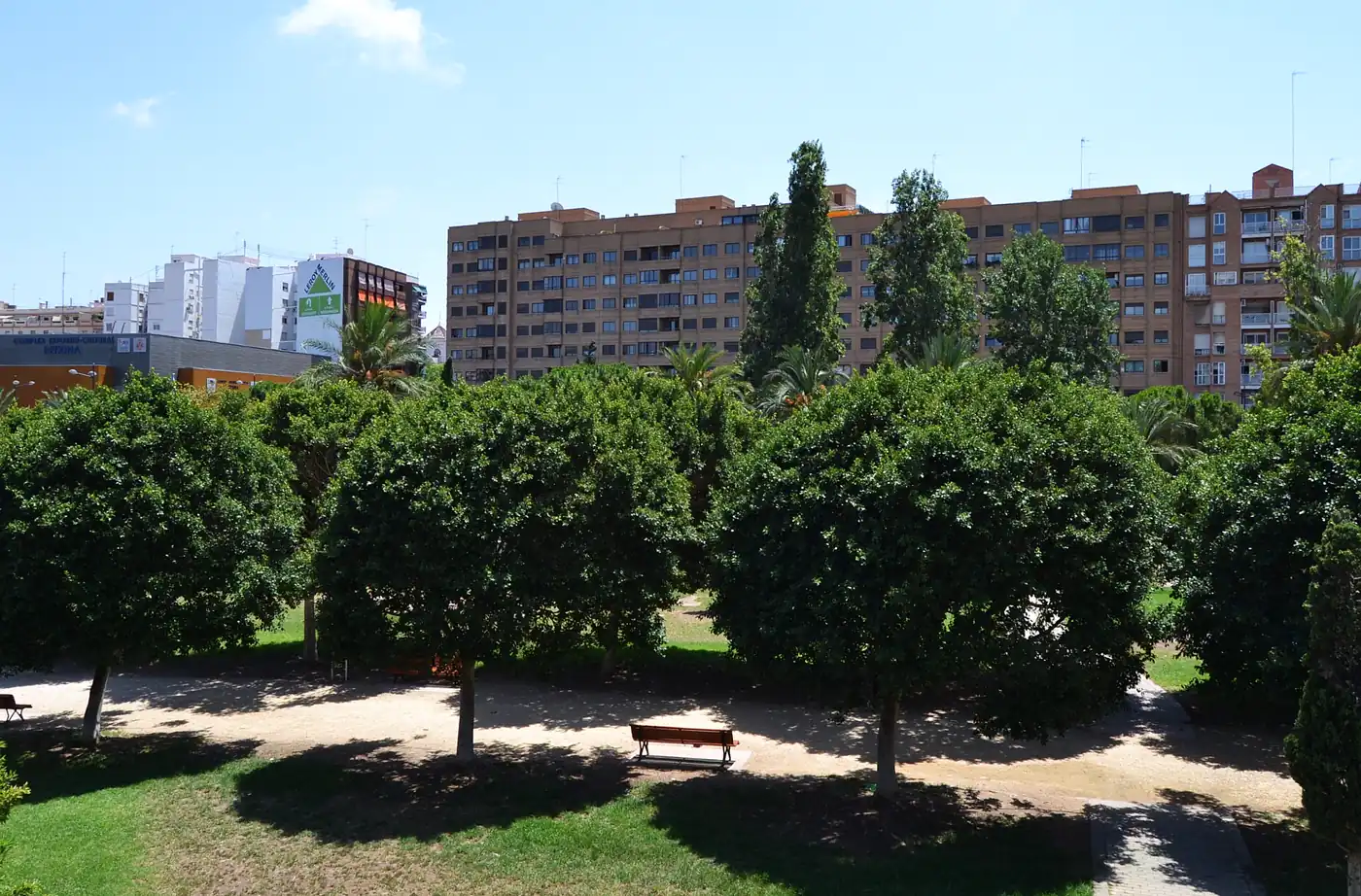
Photo: Joanbanjo, CC BY-SA 4.0
Gulliver Park: the giant kids climb on
Near the City of Arts and Sciences end of the park sits Gulliver Park, built around a 70-meter sculpture of Gulliver lying on his back, which children climb and slide down as if they were Lilliputians from Jonathan Swift's story. The city commissioned it in 1990 from architect Rafael Rivera and fallero artist Manolo Martín, with a design by Sento Llobell, and it works best for kids up to about ten.
Opening hours shift by season: April, May, June and September it runs 10am to 8pm continuously; July and August it splits into 10am to 1:30pm and 5:30pm to 9pm to dodge the midday heat; the rest of the year it runs 10am to 5:30pm. A renovated children's play area opened next to Gulliver Park in June 2025, and a second, 9-meter-tall Gulliver is reportedly planned for a spot between the Pont de les Arts and the Pont de les Glòries Valencianes.
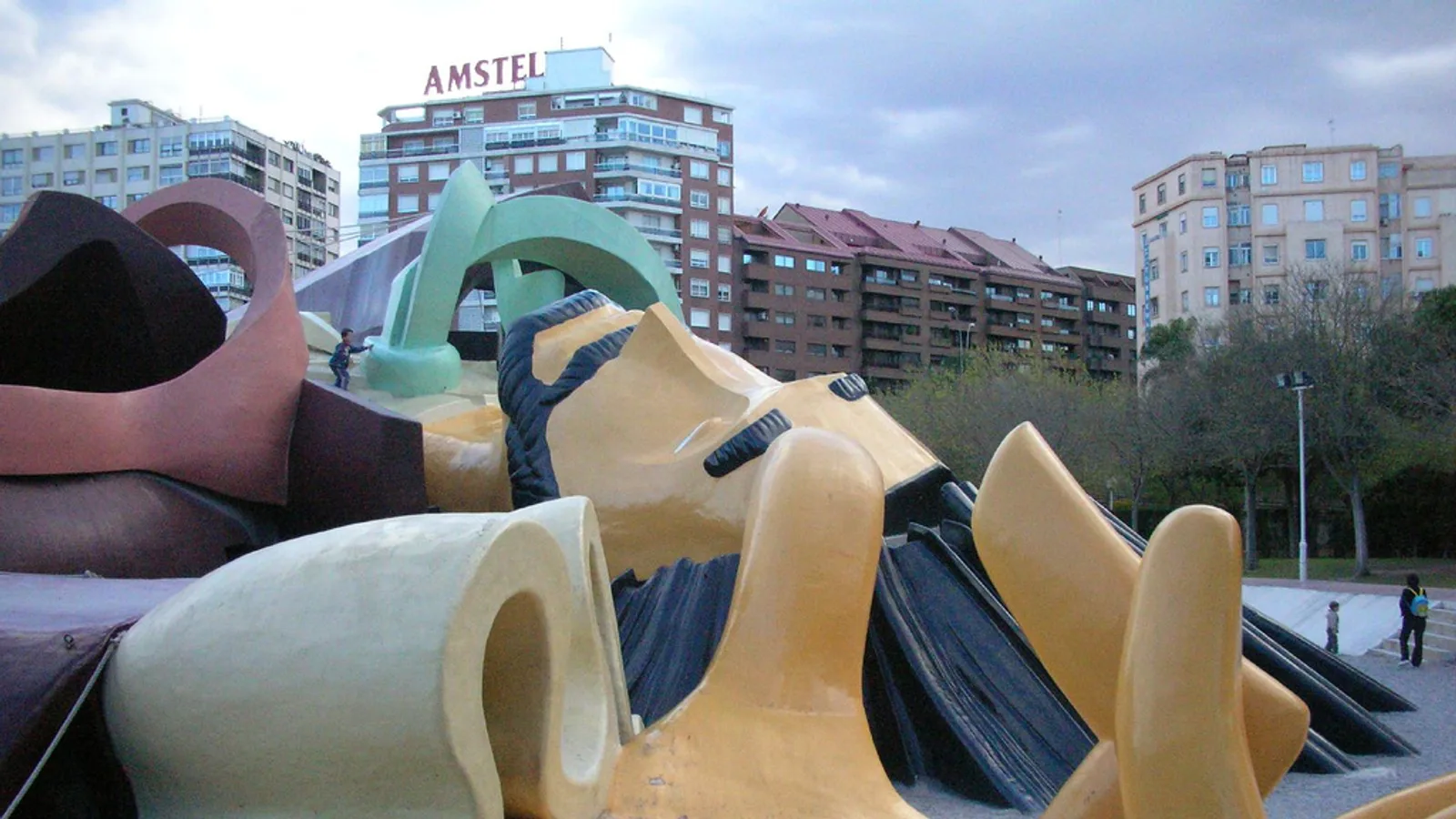
Photo: puroticorico, CC BY 2.0
Eighteen bridges, five centuries
Eighteen bridges of wildly different eras cross the old riverbed, some more than five centuries old. The Pont de la Trinitat (15th century, Gothic) and Pont de Serranos (16th century, now pedestrianized) are the oldest. Pont del Mar dates to 1591.
More recent additions carry real architectural weight: Santiago Calatrava designed the Pont de l'Exposicio (nicknamed "la peineta" for its comb-like shape) and the striking Pont de l'Assut d'Or (nicknamed "el jamonero" after the ham-holder it resembles), plus the Pont de Nou d'Octubre, his first bridge in the city, built in 1989. Norman Foster designed the Pont de les Arts next to the IVAM contemporary art museum.
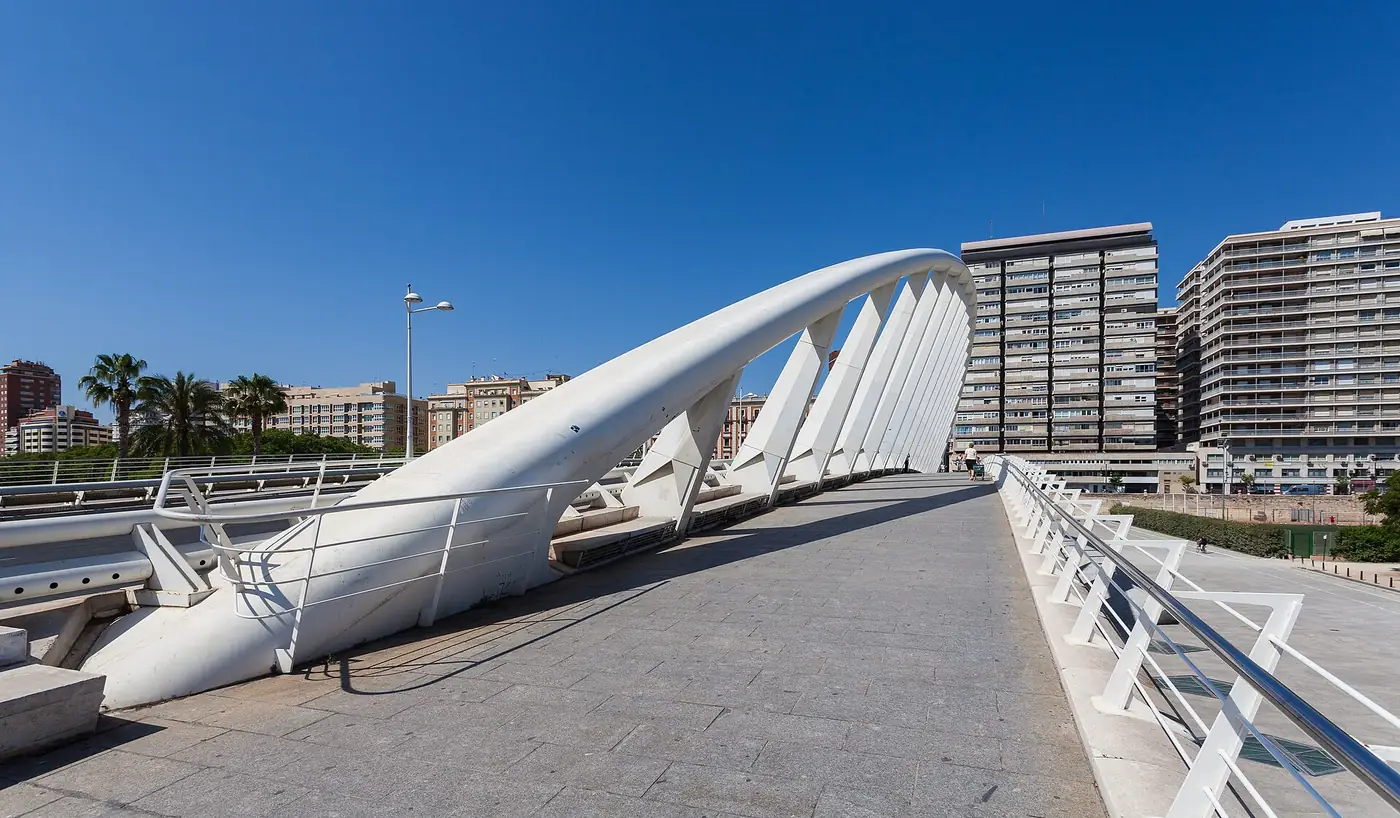
Photo: Diego Delso, CC BY-SA 3.0
Which neighborhoods actually touch the park
The Gardens run west to east through the middle of the city, so a long list of neighborhoods have direct access. On the western stretch: Extramurs (including El Botanic, La Roqueta and La Petxina) and Campanar. To the north: La Saidia, including Marxalenes right on the park edge, and the university-adjacent Pla del Real, home to the Jardines de Viveros and Mestalla stadium.
On the east and south: Quatre Carreres, which stretches down to the futuristic City of Arts and Sciences, and Camins al Grau. Ciutat Vella, the historic old town, borders the park too, best seen from the Torres de Serranos looking out over both the old center and the gardens below. The riverbed also links most of the city's other green spaces, which we map in the guide to Valencia's parks and gardens.
Visiting Turia Gardens: practical information
The park itself is a public space, open around the clock. Public restrooms run 7:30am to 9pm in summer (March to October) and 8am to 7pm in winter. The park gets genuinely crowded on weekends and during festivals, particularly Las Fallas in March, when areas near Plaza del Ayuntamiento fill up fast around 2pm for the daily mascleta, worth avoiding between about 1:30pm and 3pm during that period. Weekday mornings are the reliably quiet window for a run, ride, or walk.
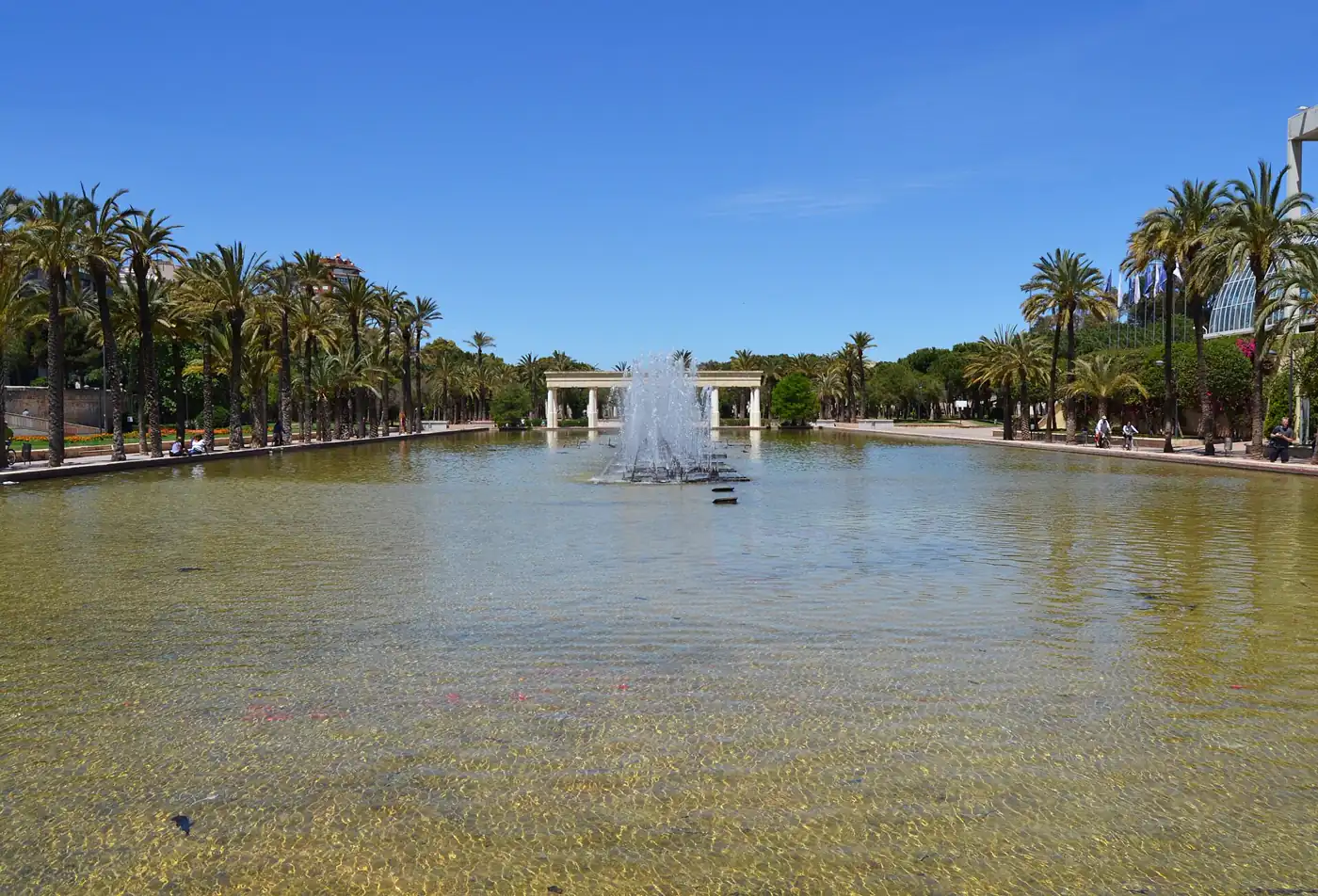
Photo: Joanbanjo, CC BY-SA 3.0
Cycling the full length
Valencia is flat and the Turia Gardens are close to ideal for cycling, so bike rental is easy to find both along the park and in the neighborhoods that border it. If you are settling in for longer rather than just visiting, Valenbisi, the city's bike-share network has docking stations at several points along the Gardens, with subscription pricing that works out far cheaper than daily tourist rental.
Operators offer city bikes, mountain bikes, e-bikes, e-scooters, and kids' bikes, with standard rates around 5 EUR an hour. DoYouBike and ValenciaInBike both run rentals and guided rides. Book ahead if you are planning a ride during a peak period like Las Fallas, when demand spikes hard.
What is changing (2024 to 2026)
The city approved a roughly 16.5 million EUR rehabilitation of sections X and XI (between Pont de les Flors and Pont de l'Angel Custodi), including the Bofill-designed garden near the Palau de la Música, with repaved paths, refreshed planting, restored fountains, and a new pond under the Pont de l'Angel Custodi, expected to take about 12 months.
A separate project will extend a cycling and pedestrian path from the park's final section out to the sea, connecting Penya-roja to the Astilleros bridge in Natzaret, a 1.3km, roughly 2 million EUR link with rest areas and solar lighting, due to go to tender in early 2026 and finish in 2027. Longer term, the city has floated an 80-hectare extension toward the river mouth, roughly the size of 50 football pitches.
Thinking about calling Valencia home?
A city that fought to turn a flood zone into 9km of parkland instead of a motorway tells you something about how it is run. If you want to experience it long-term, we can help with the visa and the practical side of the move.
Contact us
About the author
Michael Bastin
Founder, ValenciaMove - Valencia since 2016
Michael moved to Valencia in 2016 and has helped dozens of families relocate since. He writes every guide on this site personally and verifies every fact against Spanish government sources before publishing.
Buy Michael a coffeeNeed help with your move?
Contact us. We handle visa, admin, and housing so you can focus on the exciting part.