

Photo: Diego Delso, CC BY-SA 3.0
Criminal record check and apostille for a Spanish visa
Every Spanish long-stay visa asks for a criminal record certificate from each country you have lived in over the last five years, authenticated and translated. We order the certificate, arrange the fingerprints it depends on, and put the apostille or legalisation on it.

Resident in Valencia since 2016. Founder of BeTranslated. 25+ years in translation, interpretation and multilingual SEO.
Reviewed 14 September 2026 by Michael Bastin
What a Spanish consulate asks for, and why it is rarely one document
A Spanish long-stay visa file needs a criminal record certificate from the competent authority of every country you have lived in during the last five years. One certificate covers one country, so somebody who moved London to Dubai to Toronto needs three of them.
Each certificate then has to be authenticated before Spain will accept it. For most countries that means a Hague apostille. For a few, the United Arab Emirates among them, it means the older consular legalisation chain instead, and the two are not interchangeable.
Last comes the sworn translation into Spanish. The order matters: an apostille is legally part of the document, usually stamped on the reverse or on an attached page, so it has to be on the certificate before anything is translated. Translate first and you pay twice.
Consulates also set their own window on how recent the certificate must be, and they do not all agree. Several state three months. The Consulate General of Spain in Miami states six on its student visa page. Read the page of the consulate that will receive your file before you order anything, because the clock starts at issue, not at submission.
What the 20 calendar day commitment covers, and what sits outside it
Twenty calendar days is our service commitment, not a government processing time. It starts the day we have your signed authorisation and a usable set of fingerprints, and it ends when the authenticated certificate is in your hands.
Inside it: ordering the check, arranging fingerprinting where the issuing authority requires it, tracking the file, and getting the apostille onto the certificate.
Outside it: the sworn translation into Spanish, which is a separate service; your consulate's own appointment calendar, which we do not control; and any re-run caused by rejected prints, which is the single most common cause of a blown timeline.
The commitment applies to the United States, United Kingdom and Canadian routes. The UAE route runs through two separate attestation queues inside two ministries, so we scope that one case by case rather than promise a date nobody outside those ministries can hold.
Pricing is upon request. Tell us which country issued your record, where you are now, and which visa the file is for, and we will come back with the route and the figure.
FBI background check and fingerprinting for US applicants
The document Americans call an FBI background check has an official name: the FBI Identity History Summary. They are the same thing, and it is what a Spanish consulate means when it asks a US applicant for a federal certificate.
Federal is the operative word. The Consulate General of Spain in Miami puts it plainly on its student visa page: local and state certificates are not accepted, only federal ones. A state police letter, however official it looks, comes straight back.
The summary is requested under the Department of Justice's Departmental Order 556-73, either direct to the FBI or through an FBI-approved Channeler. Both routes are fingerprint-based, which is exactly why Americans already living in Spain get stuck: there is no local office to walk into.
Because it is a federal document, the apostille comes from the US Department of State's Office of Authentications, on form DS-4194, and not from a state secretary of state. Sending an FBI summary to a state office costs you a fortnight and teaches you nothing.
ACRO police certificate and apostille for UK applicants
The UK equivalent is the ACRO Police Certificate, issued by the ACRO Criminal Records Office. A DBS certificate is not a substitute: DBS exists for employment inside the UK, and consulates will not take it in place of a police certificate.
The apostille goes on at the FCDO Legalisation Office. The United Kingdom has been a party to the Apostille Convention since January 1965, which makes this the most predictable of the four routes.
One detail catches people out. GOV.UK notes that ACRO police certificates for England and Wales are not eligible for the e-Apostille and need the paper service instead. Applying for the electronic one means starting the legalisation over.
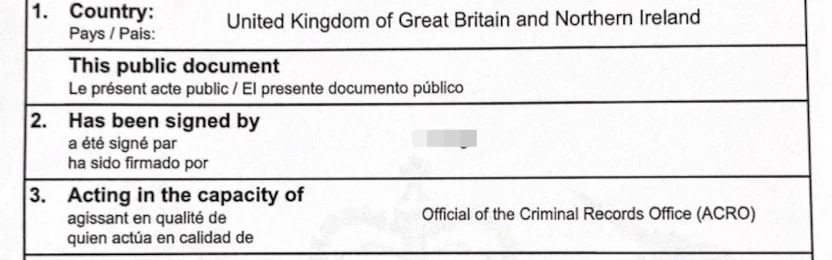
Photo: Tidin, CC BY-SA 4.0
RCMP criminal record check and apostille for Canadian applicants
Canada issues both a name-based check and a fingerprint-based one. For a visa file it is the fingerprint-based certified criminal record check that the RCMP returns, and the prints go in through a local police service or through a fingerprinting company accredited by the RCMP to submit electronically.
The authentication half changed recently and a great deal of advice online has not caught up. The Apostille Convention entered into force for Canada on 11 January 2024, so a Canadian document now carries an apostille rather than going through a consular legalisation chain.
An RCMP check is a Government of Canada document, so Global Affairs Canada issues its apostille. Alberta, British Columbia, Ontario, Quebec and Saskatchewan are competent authorities in their own right, but for documents issued or notarised in those provinces, not for a federal RCMP certificate.
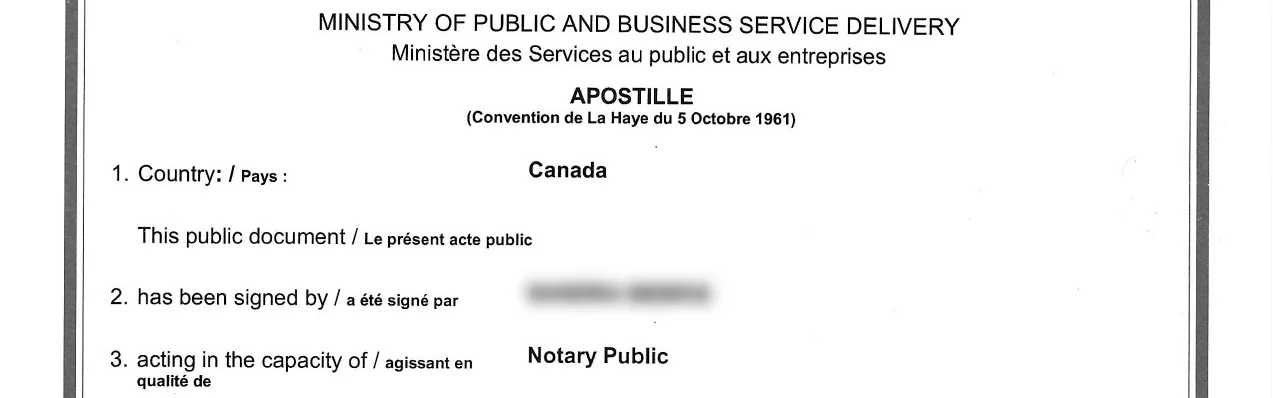
Photo: Ministry of Public and Business Service Delivery, Government of Ontario, CC BY-SA 4.0
UAE police clearance certificate and consular legalisation, not apostille
The UAE document is the Police Clearance Certificate, also called the Good Conduct Certificate. It is issued by the police forces and applied for through the Ministry of Interior, in Arabic or English.
Here is the fact that decides this entire route, and the one most often got wrong: the United Arab Emirates is not a contracting party to the Hague Apostille Convention. It does not appear in the HCCH status table at all. There is no such thing as a UAE apostille for a Spanish visa file, whatever a search result tells you.
The certificate goes through the older chain instead. Attestation by the UAE Ministry of Foreign Affairs, then legalisation by the Spanish consular mission, then sworn translation. Two ministries, two queues, and no single tracking number across them.
If you have already left the UAE, the government's own guidance is that you take a fingerprint card in your country of residence and have it attested by the UAE embassy there before the application can move at all. That step is the reason we scope this route separately rather than putting it inside the 20 days.
Getting acceptable fingerprints when you already live in Spain
Most of the people who come to us are already here. The apartment is signed, the appointment is booked, and the one thing in the way is a set of prints that a police force on another continent will accept.
Prints have to be rolled on the card that force uses, legible enough for an automated matcher, and submitted through a route it recognises. A rejection is not a warning, it is a restart, and it typically costs three to four weeks on a timeline that had none to spare.
We arrange the print session, check the card before it goes anywhere, and submit it through the channel the issuing country actually accepts. Getting that right the first time is most of what this service is.
Start your criminal record check and apostille
Tell us which country issued your record, where you are living now, and which visa the file is for. We will come back with the route, what it costs, and when the authenticated certificate lands.
Tell us about your fileFirst contact goes through the form. We reply with a written scope before anything is ordered.
More on documents for a Spanish visa
Official sources
- Apostille Convention status table, which states have joined and when - HCCH
- Identity History Summary Checks - Federal Bureau of Investigation
- Office of Authentications, apostilles on US federal documents - US Department of State
- Police certificates - ACRO Criminal Records Office
- Get a document legalised, including the e-Apostille exclusion for ACRO certificates - GOV.UK
- Criminal record checks - Royal Canadian Mounted Police
- Authentication of documents and the provincial competent authorities - Global Affairs Canada
- Police Clearance Certificate - The Official Portal of the UAE Government
- Student visa requirements, criminal record rules for US applicants - Consulate General of Spain in Miami