

Erasmus+ in Valencia 2026: grants, universities and deadlines
Five active host universities, verified grant amounts per sending country, ECTS credit transfer, the application timeline from home university to arrival, and what to bring on day one. Every number traces back to an institutional source listed at the bottom.
Why students choose Valencia for Erasmus+
Spain remains one of Europe's strongest Erasmus+ destinations, and Valencia consistently sits in the top tier of Spanish hosts alongside Madrid, Barcelona and Seville. Current annual volumes are not all publicly disclosed, but UPV states it receives about 2,000 exchange students per year.
- Lower cost of living: shared-flat rooms in student areas typically run well below what the same room costs in Paris, Brussels or Geneva.
- Scale: five active host institutions across public, private and specialist tracks give a real choice of subject and campus, from the city's full list of universities down to the smallest business school.
- Climate: a long shoulder season either side of summer, useful if your programme includes fieldwork or an internship placement.
- Compact city: Valencia is small enough to live without a car, which keeps the monthly budget simpler than a bigger Spanish capital.
Reasons aside, the exchange still has to work logistically: your home department needs a live bilateral agreement with one of the five Valencia institutions below, and that agreement, not your own preference, decides which university you can actually apply to. Once that is settled, our university life guide covers what classes, campus culture and daily routines actually feel like once you arrive.

Photo: Dorieo, CC BY-SA 4.0
Erasmus+ universities in Valencia: the five host institutions
Universitat de Valencia (UV)
The broad public host. Humanities, law, economics, social sciences, medicine, biology.
Nomination deadlines: 31 May for autumn or full year, 31 October for spring. Bilateral agreement between sending university and UV required.
Main campus at Blasco Ibáñez, in the Algiros district. See UV's incoming Erasmus+ students page.
Universitat Politècnica de Valencia (UPV)
Engineering, architecture, computer science, agronomy, design. Approaching 2,000 exchange students per year.
UPV does not publish incoming deadlines on its own page - confirm the dates with your home university's international office. Vera campus, well-connected by Metro Line 3. See UPV's incoming students page.
Universidad CEU Cardenal Herrera (UCH-CEU)
Private university with health sciences, veterinary, dentistry and communication. UCH-CEU does not currently publish application deadlines or a required language level for this programme, and no placements are currently available for the Medicine degree in either language stream.
Confirm exact dates and available subjects with your home university's international office before applying. See UCH-CEU's inbound mobility programmes page.
ESIC Business and Marketing School (ESIC)
Specialist business school for marketing, digital and management. Reports over 200 exchange students annually from 123 partner universities.
ESIC does not publish application deadlines on its own page - confirm the dates with your home university. Compact campus in Eixample. See ESIC's incoming students page.
Universidad Católica de Valencia (UCV)
Active incoming exchange calendar: nominations 1 April to 15 May (autumn or full year), applications close 1 June; spring nominations 15 September to 31 October, applications close 15 November. Dates confirmed on UCV's own page in September 2026; that page carries no academic-year label, so treat them as the current cycle. See UCV's exchange application page.

Photo: Carlesmari, CC BY 3.0
How an Erasmus+ exchange to Valencia works, step by step
Erasmus+ is administered through a bilateral convention between your home university and the Spanish host. You do not apply directly to the Spanish institution as an Erasmus+ student - your own university runs the whole process on your behalf, in five steps:
- Your home department confirms it has a live bilateral agreement with one of the five Valencia host universities.
- Your home university nominates you to the Valencia host, inside that institution's own nomination window.
- You and your home academic coordinator draft the learning agreement, the ECTS contract that pre-validates the courses you will take in Valencia.
- The Valencia host confirms your enrolment once your dossier and learning agreement are complete.
- Credit transfer runs through the ECTS system: a 30 ECTS semester in Valencia equals 30 ECTS at home, provided the learning agreement was signed before departure.
The framework behind every one of these steps is set centrally by the European Commission; see the European Commission's Erasmus+ Programme Guide for the full rules if your home coordinator cannot answer a specific question.
Grant amounts are a different matter: they are set by national agencies and, in practice, by each sending institution's call year and budget, so they are not uniform across Europe. The table below summarises confirmed institutional implementations for 2025/2026 to Spain. Where the dossier flagged data as last-confirmed for 2024/2025 or requiring direct confirmation per sending university, we say so rather than promote a number as 2026.
How much is the Erasmus+ grant for Spain? Monthly amounts by country
Amounts below come from institutional Erasmus+ pages of representative sending universities. Your exact rate depends on your home institution's call year and budget. Always confirm with your own international office before counting on a specific figure.
| Country / institution | Verified monthly amount | Notes | Source |
|---|---|---|---|
 Belgium (Wallonia-Brussels Federation, ULB) Belgium (Wallonia-Brussels Federation, ULB) | 540 EUR per month standard; 790 EUR per month for students with fewer opportunities | One-time travel fee of 309 EUR for the 500-1,999 km band; green-travel bonus of 108 EUR. Payment in two instalments: 70 percent after grant contract and OLS, balance after final attendance certificate. | [2] |
 Germany (DAAD via University of Oldenburg) Germany (DAAD via University of Oldenburg) | 540 EUR per month | Travel bands per the Erasmus+ Programme Guide 2026: 309 EUR standard or 417 EUR green for 500-1,999 km. | [3] |
 Netherlands (Utrecht University) Netherlands (Utrecht University) | 330 EUR per month | Maximum funded grant period of 3 months plus 22 days (112 days) for 2026-2027, unless study-programme rules require longer. Fewer-opportunities top-up of 250 EUR per month. One-time travel allowance. | [4] |
 Italy (Sapienza) Italy (Sapienza) | 300 EUR per month | Plus Italian/Sapienza/MUR supplements based on ISEE. 80 percent advance payment after arrival documentation. | [5] |
 France (national portal) France (national portal) | Varies by sending institution | The French student portal explains ranges and cumulation rules (CROUS social scholarships, AMI, 250 EUR per month inclusion top-up) but does not publish a single 2026 Spain figure. Confirm with your home institution's 2025/2026 or 2026/2027 call. | [6] |
 Switzerland (SEMP via Movetia) Switzerland (SEMP via Movetia) | CHF 1,600 per semester (about CHF 400 per month over four months) | Switzerland is outside Erasmus+; SEMP is the federally funded Swiss substitute. Federal Council aims for possible Erasmus+ association from 2027. Confirm exact amount with your Swiss home university. | [7] |
The European Commission sets Erasmus+ rules and broad travel-support bands, but monthly amounts are implemented per national agency and per call year. Recent institutional implementations show large differences across Europe (compare Belgium's 540 EUR per month to the Netherlands' 330 EUR per month for the same destination and academic year). Figures vary by sending university; confirm with your home institution's Erasmus+ office.
Erasmus+ Valencia deadlines: the application timeline month by month
Start at your home university 8 to 12 months before your planned departure. Spanish host universities accept incoming students for the September intake (autumn semester) or the January intake (spring semester). The exact deadlines vary by home institution but follow this rough pattern, cross-checked against UV, UPV, UCH-CEU, ESIC and UCV public calendars:

Photo: Donarreiskoffer, CC BY-SA 4.0
What the Erasmus+ grant covers in Valencia, and what you pay yourself
What a room or residence actually costs
The Erasmus+ grant is designed to cover a slice of your living costs, not all of them. Budget for a monthly top-up of 200 to 500 EUR from family, savings or part-time work depending on your sending-country grant.
- Shared-flat room in a student area (Benimaclet, Algirós, Russafa, El Carmen): 250 to 450 EUR per month (listing-portal asking prices, September 2026), with central or higher-quality rooms above that range.
- University residence, including meals, laundry, gym and Wi-Fi: 600 to 900 EUR per month, per UCV's own preparation page for exchange students.
- One-off move-in costs on top of the monthly rent: expect a deposit and sometimes an extra month in advance, covered under what the grant does not pay for below.
For the full breakdown of Valencia rents by neighbourhood, including what changes once you are looking for something longer than a semester, see our renting guide. For a student-specific walkthrough of upfront costs, the fianza rules and how to avoid a rental scam, see our student housing guide.
What the grant does not cover
Five costs regularly catch new Erasmus+ students out because they fall outside the monthly grant entirely:
- Flights to and from Valencia.
- Your first month's rent, usually payable in full before you move in.
- The statutory fianza (legally one month's rent for a standard rental under the Ley de Arrendamientos Urbanos, though landlords may ask for additional guarantees, and international students without Spanish income are sometimes asked for an aval bancario or several months in advance).
- A private health insurance top-up, if you decide your EHIC is not enough for the length of your stay.
- Travel within Spain during the semester, outside your daily commute.

Photo: Artvill, CC BY-SA 4.0
Your first 30 days in Valencia: NIE, padrón, bank and transport
If you do these six things in the first 30 days, the rest of your Erasmus+ semester is administratively smooth. Skip any of them and you will pay for it later when you try to open a bank account, sign a long-term lease or claim healthcare. For the full day-by-day version of this list, plus how to spot a housing scam and what your move-in budget actually looks like, see our first 30 days survival guide.
Certificado de Registro and NIE
EU/EEA/Swiss citizens request the Certificado de Registro de Ciudadano de la Union within the first 30 days at the Oficina de Extranjería in Valencia. Non-EU students on a student visa should also check their visa conditions against the official student-visa guidance. The NIE is a unique foreigner identification number used for economic, professional and social procedures; UV's own guidance page walks students and researchers through the process.
Empadronamiento (volante)
Register at your barrio's town hall once you have a rental contract, via empadronamiento. Valencia's procedure generally requires an appointment or electronic procedure at sede.valencia.es, identity document, completed registration form, and proof of address. The certificate is time-limited for administrative use; request a fresh one when needed.
Spanish bank account
Opening a Spanish bank account often requires passport, NIE if available, proof of address and university enrolment. Some banks open non-resident accounts before a TIE or Certificado de Registro. Practical, not legal: market practices change faster than law.
Healthcare cover
EU/EEA students generally use the European Health Insurance Card for necessary public healthcare during temporary stays. For long stays, check whether your cover needs a private health insurance top-up - local SIP card issuance depends on your legal basis and regional health-service registration, so avoid assuming an EHIC alone is enough without checking your own case.
Local SIM or eSIM
An eSIM bought before you fly gets you connected the moment you land, but it is a stopgap for the first few days only - it has no Spanish phone number, which you will need for admin, banking and bookings. Switch to a local prepaid SIM from Orange, Movistar or Yoigo as soon as you can; they can usually be bought with just your passport, and entry-level student plans start around 15 EUR per month.
Transport pass
EMT Valencia's bus network covers all five main university campuses, and Metro/tram completes the picture with a combined ticket. Check the current EMT fares and titles page before you budget.
EMT Jove, the bus pass for under-30s, is 12.50 EUR per month - half the general 25 EUR tariff. EMT Jove covers EMT buses only; SUMA is the separate Metrovalencia and ATMV card for metro and tram.
Getting all six right in the first month is exactly the kind of admin our admin support service handles for relocating families and students alike. If you would rather talk through your specific situation first, get in touch through the form.
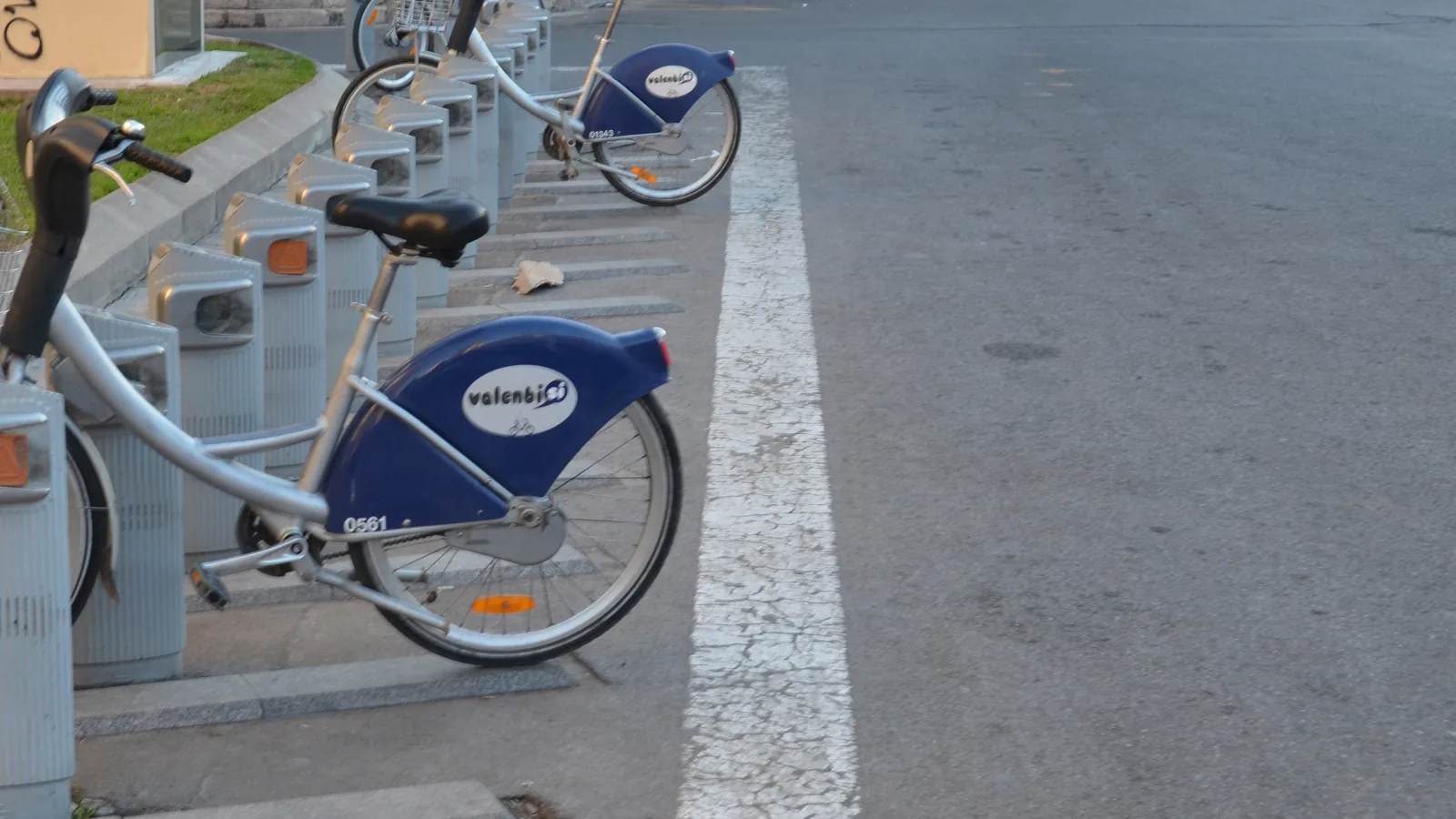
Photo: Steven Lek, CC BY-SA 4.0
Living in Valencia as an Erasmus student: language, meal times, cycling
Valencian is a co-official language and you will see it on signs, in academic buildings and on official documents alongside Castilian. You do not need to learn Valencian for an Erasmus+ semester; Castilian is sufficient everywhere.
Spanish meal hours are later than French, Belgian or Dutch habits (lunch 14:00 to 16:00, dinner from 21:00 onward), and the mid-morning esmorzaret ritual fills the gap. The siesta is real in some quarters but quiet, not closed: shops in Russafa and Benimaclet often shut from 14:00 to 17:00 while Mercadona and the bigger chains stay open.
Confident urban cycling is still required: the bici lane network keeps expanding but is not yet at the density of a Dutch or Belgian university town. For the full monthly numbers behind all of this, see our student budget breakdown, and for what the day-to-day adjustment actually feels like, see our cultural integration guide.

Photo: Choinowski, CC BY-SA 4.0
After Erasmus+: master's, work and staying on in Valencia
A significant share of Erasmus+ alumni return to Valencia within two years of finishing the exchange. The most common routes:
- Continuing your studies with a master's at UV, UPV or UCH-CEU.
- Finding work through the Beckham regime if a Spanish company hires you as a new resident.
- Registering as autónomo for freelance work.
- Applying for a long-term work-and-residence route once you have a job offer or a qualifying stay.
Salary-threshold routes such as the EU Blue Card change from year to year, so check the current figures and eligibility on Spain's own Portal de Inmigración rather than an older number repeated online.
Staying longer: the job-search permit
Non-EU graduates who want to stay in Spain to look for work after finishing their studies can apply for the Autorización de residencia para búsqueda de empleo, a job-search residence permit available for up to one year. If you land remote work with a foreign employer during your exchange, look at the digital nomad visa route instead of the student-visa track.
On salary: local pay in Valencia is often lower than in Northern Europe, and Spanish fluency matters a lot for the local job market. For real numbers rather than a guess, see our average salary breakdown for Spain.
Erasmus+ traineeships vs study mobility
Erasmus+ funds two different tracks: Student Mobility for Studies (the semester-abroad track covered above) and Student Mobility for Traineeships, an internship placed with a company, NGO or research lab. The EU Erasmus+ programme typically adds around EUR 150 per month for traineeship placements versus study mobility, though this top-up is implemented per sending institution, so confirm your exact grant with your home university's Erasmus+ office before counting on a figure.
Valencia's tourism sector, its export and international-trade companies, and its growing local tech scene commonly host international interns. A traineeship in Spain is formalised through a Convenio de Prácticas (internship agreement) between your university, the host organisation and you, and non-EU students will usually need a NIE to sign one.
If you are a UK or US student on a traineeship rather than a study placement, check with your immigration adviser or your home university whether your student authorisation actually covers a traineeship or needs separate authorisation. Do not assume the study-mobility rules simply carry over.
Mental health and inclusion support
Erasmus+ includes Inclusion Support, supplementary funding for students with physical or mental health conditions or fewer opportunities, on top of the standard grant. The practical details vary by sending institution, so ask your home university's Erasmus+ office what applies to your case before you leave.
For day-to-day healthcare in Valencia, an EHIC or CEAM card covers a Centro de Salud appointment for EU, EEA and Swiss students; see our health insurance guide for how that compares with a private policy. Many students also want English-language counselling support: check your university's international office (UV and UPV both run one) for what is available before assuming you will need to find something privately.
Erasmus+ 2026 updates: BIPs and the European Student Card
Blended Intensive Programmes (BIPs) combine a short physical mobility component, typically 5 to 30 days, with a virtual learning component, and are offered at both UV and UPV alongside the classic semester exchange.
Separately, the European Student Card Initiative, built on the Erasmus Without Paper infrastructure, is rolling out a digital student card that simplifies access to libraries, transport and campus services, gradually reducing the need for a separate physical local student card. Neither change alters the core process described above; treat them as extra options to ask your coordinator about.
Michael's Insight
What French, Dutch, British and Belgian students get wrong about their first month
I did my own Erasmus exchange in Utrecht, three months, and the Netherlands row in the grants table above (330 EUR a month) is exactly what I lived on - the lowest figure in that whole list. It taught me how thin an Erasmus grant can actually stretch.
Since then I have hosted teenagers from Brussels through Erasmus+, and university students from French, Dutch, British and Belgian translation programmes in my own home. The mistake I see most often is treating the grant as a full budget rather than a top-up, and then getting caught out by a deposit or first month's rent nobody warned them about. Plan the one-off costs before you plan the monthly ones.
Official sources and Erasmus+ references
Facts on this page are sourced from the official bodies linked inline throughout, plus the additional institutional sources below.
- [1]European Commission - Erasmus+ Programme Guide
- [2]ULB - Outgoing mobility funding (FWB implementation)
- [3]University of Oldenburg - Erasmus+ funding (DAAD implementation)
- [4]Utrecht University - Erasmus+ grants for studies
- [5]Sapienza - Erasmus study mobility grants
- [6]etudiant.gouv.fr - Erasmus+ and AMI
- [7]Movetia - Swiss Programme for Erasmus+
- [8]UV - Incoming Erasmus+ students general information
- [10]UPV - Incoming students
- [11]UCH-CEU - Inbound mobility programmes
- [12]ESIC - Incoming students
- [13]UCV - Application for exchange program acceptance
- [30]Spanish consulate London - Student visa
- [33]UV HRS4R - NIE for foreigners
- [34]Sede electrónica Valencia (empadronamiento)
- [37]UCV - Preparing your stay at UCV (housing prices)
- [42]BOE - Ley de Arrendamientos Urbanos (fianza)
Compare your scholarship options next
Most Erasmus+ students stack two funding sources. Our scholarships page shows what is realistically combinable.
Compare scholarships
Resident in Valencia since 2016. Founder of BeTranslated. 25+ years in translation, interpretation and multilingual SEO.
Reviewed 10 September 2026 by Michael Bastin