

Photo: 19Tarrestnom65, CC BY-SA 4.0
Public and Concertado schools in Valencia: How the system works
One admission window a year, a points table that decides who gets in, and a language choice you make on the application form. Here is what a newcomer needs to know before May.
Most children in Valencia go to a state school or a state-funded concertado (), not an international one. If that is the route you are considering, the process is more predictable than it looks, provided you know the calendar.
This guide covers the three types of school, the annual admission round run by the Conselleria d'Educació, the points that decide a place when a school is oversubscribed, and what the Valencian-language streams actually mean for a child who arrives speaking neither Spanish nor Valencian.
It also covers what a concertado really costs, the book bank and lunch aid you can claim, and how to read the Conselleria's own school finder. No school is rated or ranked here: the finder and an open day will tell you more than any list. If you would rather have someone handle the paperwork, our school enrolment service does exactly that.
The 2026-2027 admission round at a glance
The dates below are the ones the Conselleria published for the 2026-2027 year. The pattern repeats every spring.
Application window
Infantil and Primaria: 7 to 18 May. ESO: 21 May to 1 June. One application per child, listing schools in order of preference.
Where you apply
Online only, through the Conselleria's Adminova portal. Families without internet access can do it in person at their first-choice school.
Lists and enrolment
Infantil and Primaria: provisional lists 4 June, definitive lists 18 June, enrolment 18 to 29 June online. ESO: lists 15 June and 2 July, enrolment 2 to 7 July.
Points when oversubscribed
15 points for a sibling already at the school, 10 for living or working in its catchment area, 7 for low income. Ties are broken by a letter drawn by lot.
Language choice
On the same form you pick the child's base language, Valencian or Castilian. In Valencia city that decides whether roughly half or two thirds of lessons are in Valencian.
What it costs
Public schools charge no tuition. Concertados may not either by law, but most ask for a monthly contribution. Lunch is 4.35 euros a day at a public school.
Public, concertado and private: the three types
A public school (colegio público, CEIP for Infantil and Primaria, IES for secondary) is run and funded by the Generalitat. Tuition is free, teachers are civil servants, and places are allocated by the points system below. Infantil starts at three, is technically voluntary and is close to universal; Primaria runs from six to twelve; ESO, the compulsory secondary stage, from twelve to sixteen.
A concertado is a privately owned school, very often Catholic, that receives public funding for the compulsory stages in exchange for following the same admission rules and charging no tuition for them. In practice most ask families for a monthly contribution, which the law says must be voluntary. The point to hold on to is that a concertado is not a private school with a discount: it sits inside the same admission round as the public ones.
A private school sets its own fees and admits whoever it likes. The international schools guide and the school fees calculator cover that route. This page is about the other two.

Photo: Francesc Fort, CC BY-SA 4.0
The admission window and the Adminova portal
There is one ordinary admission round a year, in spring, for the following September. For the 2026-2027 year the Infantil and Primaria window ran from 7 to 18 May, and the ESO and Bachillerato window from 21 May to 1 June. You submit a single application per child through Adminova, the Conselleria's online portal, listing the schools you want in order of preference.
The Conselleria then publishes provisional lists (4 June for Infantil and Primaria in 2026), takes claims for a few days, and publishes definitive lists (18 June). If your child has a place you enrol, the matrícula, between 18 and 29 June online or until 2 July in person. ESO runs about two weeks behind that, with definitive lists on 2 July and enrolment from 2 to 7 July.
If you arrive after the window closes, you do not lose the year. Places for late arrivals are handled by the Conselleria's escolarización service, which assigns a school with free places rather than letting you choose freely. It works, but the school may not be the one nearest to you, which is one more reason to time a move with children for the spring if you can. The school year calendar has the term dates.
The points table: how a place is decided
When a school has more applicants than places, Decreto 48/2024 sets the order. The big ones: 15 points for a sibling already enrolled at the school, 10 points for a family or work address inside the school's catchment area (área de influencia) and 5 for a bordering area, 7 points if a parent works at the school, 7 for a family income below half the IPREM or for a household on the Renta Valenciana de Inclusión, and 7 or 5 for large or single-parent families depending on the category.
Smaller ones exist too: points for a disability in the family, one point per sibling from a multiple birth, two for a conservatory pupil or an elite athlete, and one point the school itself can award. Ties are broken by a letter of the alphabet drawn by lot each year, which is why two families with identical circumstances can get different results.
Since 2024 the Comunitat runs a single district per municipality: you can apply to any school in Valencia, not only the ones in your zone. The catchment areas still matter because they carry the 10 proximity points, and the Conselleria publishes the maps before the window opens. For a newcomer without siblings in the system, proximity is usually the only points you have, so where you register on the padrón before May decides more than anything else.
Línea en valencià, lengua base and how much Valencian a child gets
Valencia is officially bilingual and its schools teach in both languages. Older parents still talk about the línea en valencià (), the stream taught mostly in Valencian, and the línea en castellano. Since Ley 1/2024 the mechanism has changed: on the admission form you choose the child's lengua base (), the language used for early literacy and most lessons, and the school plans its groups around what families asked for.
The proportions are fixed by the law's annex. In Valencia city, a Valencian-predominance zone, Infantil is 65 percent in the base language, 25 percent in the other official language and 10 percent in English. From the third year of Primaria and through ESO it settles at about 52.5 percent base language, 32.5 percent the other, and 15 to 25 percent English depending on the model the school adopted. So a child on a Castilian base still gets roughly a third of the week in Valencian, and a child on a Valencian base gets the same in Castilian.
A child arriving from another system can ask to be exempted from being assessed in Valencian for the year of arrival and the following one (article 14.3 of the law). They still sit in the lessons; they are simply not graded on the subject while they catch up. Whether to choose the Valencian base for a child who speaks neither language is a genuine judgement call: small children absorb both, teenagers arriving in ESO usually do better on a Castilian base with the exemption.
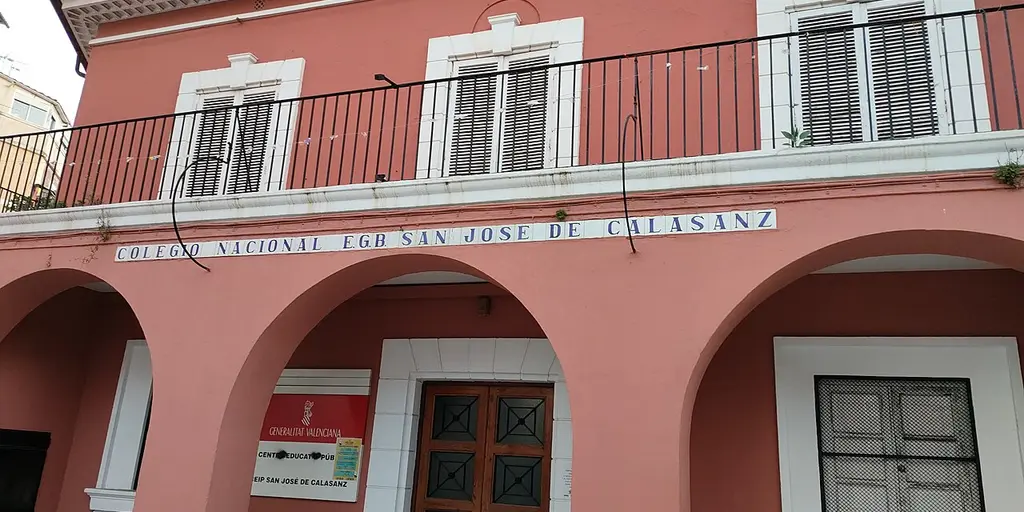
Photo: Josu PV, CC BY-SA 4.0
What a concertado really costs
By law a concertado cannot charge tuition for the state-funded stages. What it can do is ask for a voluntary contribution, and most do. An EsadeEcPol study of the sector found that 82 percent of concertados in the Comunitat Valenciana ask families for a payment, averaging 597 euros a year among the families who pay, which works out at roughly 50 to 60 euros a month over a school year.
On top of that, budget for the same things a public school also charges for: lunch (the comedor ()), the parents' association fee, uniform where there is one, school trips and after-school activities. Bachillerato is not a funded stage at most concertados, so the two post-16 years are usually paid at close to private rates. Ask the school for the full list in writing before you rank it first; they are used to the question.
Book banks, lunch aid and the city's school cheque
Textbooks are free from Primaria onwards through the banco de libros (), the Generalitat's book bank, in public and concertado schools alike. You join through the school, the child gets the set for the year, and you hand it back in June in good condition; lose or damage a book and you replace it. Families joining for the first time for 2026-2027 can apply until 10 November 2026.
Lunch aid (ayuda de comedor) is means-tested and covers up to 4.35 euros a day for Infantil, Primaria and ESO, which is the full price of the meal in a public school. You apply through the school at enrolment time in June or July, and the same round includes individual transport aid for children assigned a school far from home.
For the youngest, Valencia city council runs its own cheque escolar (), a municipal grant towards nursery and Infantil fees at authorised centres inside the city. The 2026-2027 application window ran from 27 March to 27 April 2026, before the Conselleria's admission round, so it is easy to miss in a first year.
How to read the Conselleria's school finder
The Guía de Centros Docentes on the Conselleria website lists every school in the Comunitat. Filter by municipality, level (Infantil, Primaria, Secundaria) and régimen (público, concertado, privado), and open each school's ficha. The fields that matter to a newcomer are the language programme, whether it has a comedor and school transport, whether it teaches Infantil and Primaria on one site or feeds into a separate IES, and the address, which you then check against the catchment map.
What the finder does not tell you is what the school is like. For that, go to the open days (jornadas de puertas abiertas) most schools hold in March and April, and talk to parents at the gate. We deliberately do not rank schools on this site: a school that suits a bilingual six-year-old may be wrong for a monolingual fourteen-year-old, and the finder plus a visit beats any list.

The mistakes that cost families a place
Assuming a concertado is free
Tuition is, by law. The monthly contribution, the comedor, the uniform and the post-16 years are not. Get the full cost in writing before you rank it first.
Registering on the padrón too late
The 10 proximity points depend on the address you can prove during the May window. A padrón certificate dated June helps nobody.
Skipping the language choice
The base language is chosen on the application. Leave it to chance and the school allocates by availability, which can mean a Valencian-base group for a child who has never heard the language.
Listing one school only
If your only choice is full, the Conselleria assigns you a school with places. List several in order of preference, including one you are fairly sure of.
The process, step by step
- 1
Register on the padrón
Your address on the municipal register is what the proximity points are checked against. Do it as soon as you have a lease.
- 2
Shortlist with the school finder
Use the Guía de Centros Docentes to filter Valencia schools by level and régimen, and check each one against the catchment map the Conselleria publishes before the window.
- 3
Visit in March and April
Open days are when you see the building, ask about the language groups and the comedor, and find out whether the school has a waiting list every year.
- 4
Apply on Adminova in May
One application per child, schools in order of preference, base language chosen, and the boxes ticked for every point you can claim.
- 5
Have the documents ready
Passport or NIE for the child and parents, the padrón certificate, the birth certificate or family book, and proof for any points you claim, such as a large-family card.
- 6
Check the lists and enrol
Provisional lists in early June, a short claims period, definitive lists mid-June, then the matrícula at the school before the deadline. Apply for lunch aid and the book bank at the same time.
Arriving mid-year, and what happens next
Children who arrive outside the spring window are placed by the Conselleria's escolarización service in a school with free places, usually within a couple of weeks of asking. Bring the same documents you would for the ordinary round, plus the child's last school report if you have it, translated if it is not in Spanish or English.
Once the child is in, the first term is mostly about language. Public schools run support hours for pupils who do not yet speak Spanish or Valencian, and the assessment exemption above takes the pressure off the Valencian grade for two years. Most families find that a seven-year-old is comfortable in both languages within a year; the teenagers take longer and are the ones for whom the base-language choice matters most.

Resident in Valencia since 2016. Founder of BeTranslated. 25+ years in translation, interpretation and multilingual SEO.
Reviewed 5 September 2026 by Michael Bastin