
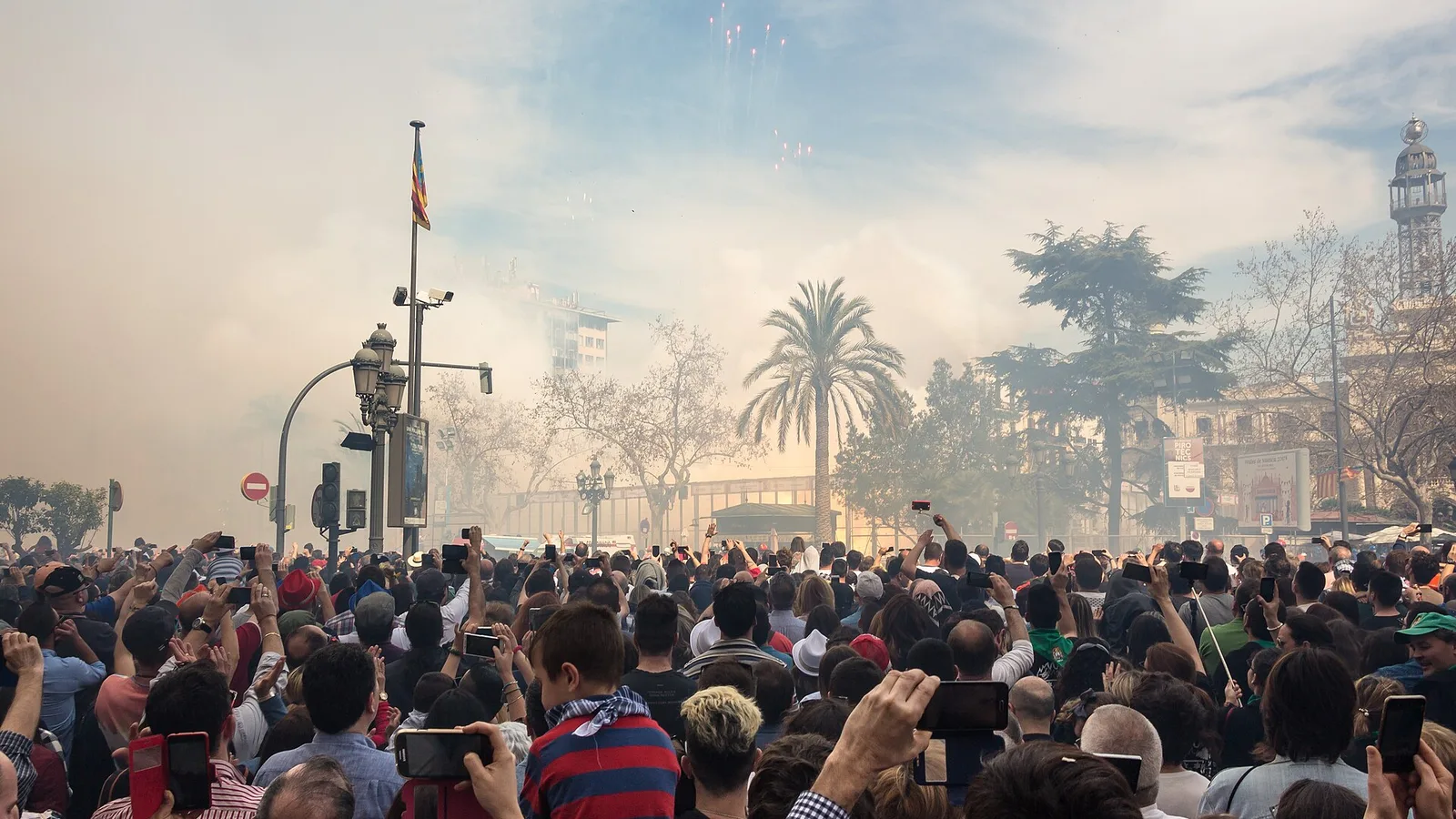
Most of what happens at Fallas is a controlled tradition with centuries behind it. This is the exception.
Over the last few years the Spanish press has put a name to a new phenomenon: turismo de pirotecnia, firework tourism. Groups of young men, most of them Dutch, now travel to Valencia during the festival specifically to set off powerful and often illegal devices.
It is a small group making a disproportionate amount of trouble, and it has become the one part of the festival Valencians talk about with real irritation rather than pride.
What is actually happening
The groups coordinate over social media, and they either bring devices in or build them here. In 2024 Spanish police arrested 17 Dutch nationals for carrying firework bombs during the festival.
The response has escalated accordingly. Authorities have flown thermal-imaging drones over the Turia riverbed at night to locate groups setting off blasts in the dark, which is not a measure any city takes over ordinary festival noise.
The distinction that matters is not nationality, it is legality. Spain grades consumer pyrotechnics F1 to F4, and everything in that range is available here legally to anyone of the right age. What the firework tourists are after sits above it: homemade or modified devices with no classification at all.
Why the Dutch, specifically
To understand the pull you have to look at how fireworks work back home. The Dutch have long been among the largest consumers of fireworks in Europe, and the New Year tradition of Oud en Nieuw descends from old rituals meant to drive off evil spirits with noise and fire.
After the war it grew into a full national event. On 31 December Dutch streets turn into what people only half-jokingly call a war zone, with a legal window during which anyone can light fireworks.
It has always carried a cost. Hundreds of serious injuries a year, sustained attacks on emergency workers, and the memory of the 2000 Enschede disaster, when a fireworks depot exploded and killed 23 people, which still shapes the whole debate.
The ban that closed the outlet
Worn down by the injuries and the attacks on emergency services, the Netherlands has been tightening its fireworks law for years, and the Dutch Senate has approved a nationwide ban on consumer fireworks in categories F2 and F3.
As the domestic tradition is switched off, the hardcore enthusiasts have gone looking for somewhere the party is still running. Valencia, with a world-famous festival and a genuinely deep gunpowder culture, looks from a distance like the obvious destination.
The perception, as the Spanish reporting puts it, is that during Fallas anything goes. That reading is wrong, and the gap between it and reality is the whole problem.
Why Valencians take it badly
A Valencian and a firework tourist are chasing two different things that happen to make a similar noise.
The mascleta is a composed, licensed, judged performance fired by professionals whose names people know. It is loud on purpose and controlled on purpose, and the control is the part locals are proud of.
What the firework tourists come for is the uncontrolled version: the biggest possible bang, in the street, at night, with no permit and no classification. From inside the city that does not read as enthusiasm for the tradition. It reads as somebody treating a heritage festival as a venue for the thing their own country just outlawed.
There is also a practical edge. The devices are the same class the city is trying to eliminate for safety reasons, and the injuries land on Valencian emergency services during their busiest week of the year.
If you are coming for the fireworks legitimately
None of the above should put off anyone who wants to experience the loudest festival in Europe honestly, which is most people.
Everything worth hearing is legal and free. The daily mascleta at 2pm, the Nit del Foc, the street petardos sold in licensed shops within the F1 to F3 range. You do not need to bring anything, and bringing anything is exactly what causes the problem.
If you are moving rather than visiting, our guide to moving to Valencia from the Netherlands is a better starting point than a weekend of explosions.

Photo: Rafa Esteve, CC BY-SA 4.0
Planning a move rather than a weekend?
Fallas is a good reason to fall for this city and a bad basis for a relocation plan. If you are thinking seriously about living here, we can walk through the visa and the practical side.
Contact us
About the author
Michael Bastin
Founder, ValenciaMove - Valencia since 2016
Michael moved to Valencia in 2016 and has helped dozens of families relocate since. He writes every guide on this site personally and verifies every fact against Spanish government sources before publishing.
Buy Michael a coffeeNeed help with your move?
Contact us. We handle visa, admin, and housing so you can focus on the exciting part.