
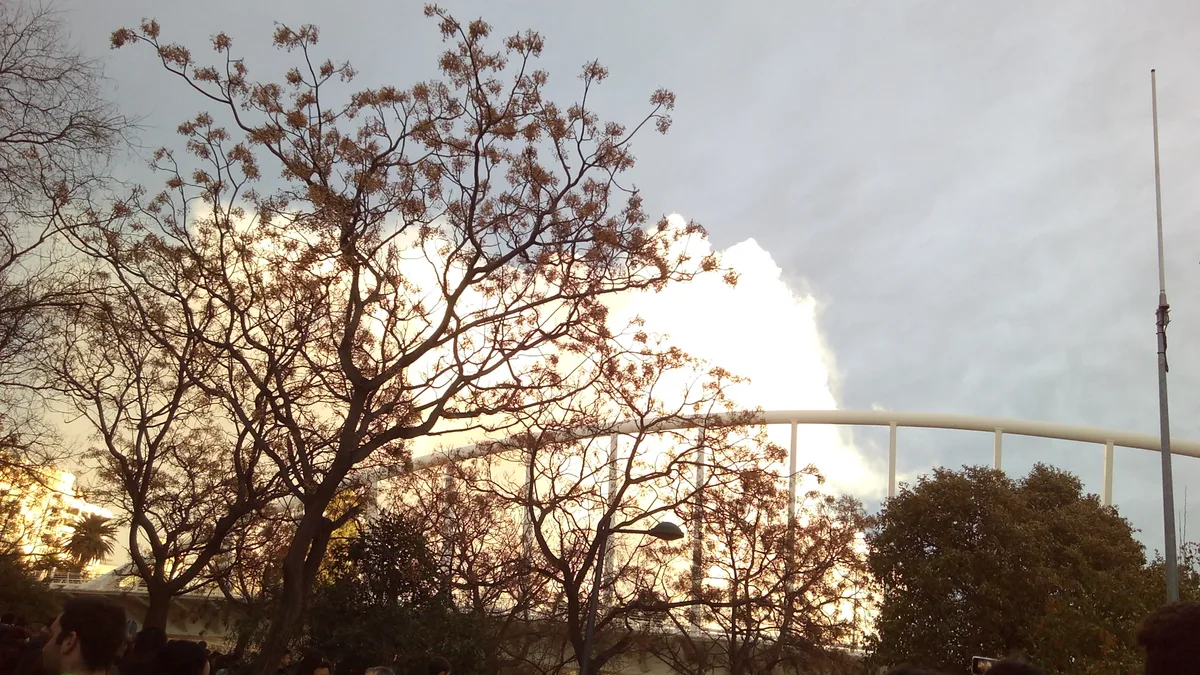
The first time a mascleta goes off, you do not hear it so much as feel it. It comes up through the soles of your feet, rattles your ribcage and sets off every car alarm on the block.
I remember standing in the Plaza del Ayuntamiento convinced something had gone badly wrong, while thirty thousand Valencians around me cheered like their team had just scored. That is Las Fallas in a single moment: this city does not simply celebrate with gunpowder, it is built on it.
What follows is where that came from, why it is treated as an art form rather than a bang, and what all the smaller explosions in the street actually are.
Where the mascleta actually comes from
The love affair with explosives goes back centuries. Gunpowder reached the Iberian Peninsula through the Moors in the Middle Ages, and by the fourteenth century what people called fuego griego, Greek fire, was already lighting up royal weddings and religious feasts.
The Valencian twist came later, and it came from the countryside rather than the city. The mascleta grew out of the tracas, strings of firecrackers laid along a street and fired in sequence, used in small inland towns like Almansa.
What made it Valencian was the carpenters. Their patron is Saint Joseph, and in the days before his feast they burned their offcuts and worn-out workbenches in the street to see off the winter. Adding firecrackers to that fire did two jobs at once: it chased off evil spirits, which was the stated reason, and it drew a crowd, which was the real one.
The first official mascleta fired in 1885. What separates it from that carpenters' bonfire is composition: it stopped being noise added to a fire and became a written piece, built in movements, ending in the ground-shaking finale locals call the terremoto, the earthquake.
How to read a mascleta, because it is judged by ear
A mascleta is not fireworks, and the most common mistake visitors make is watching it. There is almost nothing to see: a haze of smoke and a rack of tubes lying on the ground. Close your eyes and you lose nothing.
It is built like a piece of music. It opens with a fast rattle that establishes the pulse, tightens as the intervals compress, and resolves into the terremoto, where the charges are laid so close together that the individual bangs stop being audible as separate events and arrive as one continuous pressure wave through the chest.
What Valencians praise afterwards is pacing, compression and the cut-off. A mascleta that ends raggedly, trailing a few late bangs after the terremoto, is a bad one however loud it was. A clean stop is the mark of a good pyrotechnician.
During Fallas the city fires one every day at 2pm sharp in the Plaza del Ayuntamiento, and the plaza is packed well before one. The slots are competitive, and the firms who win them are a small circle of family houses: I dug into who really makes Valencia's fireworks separately.
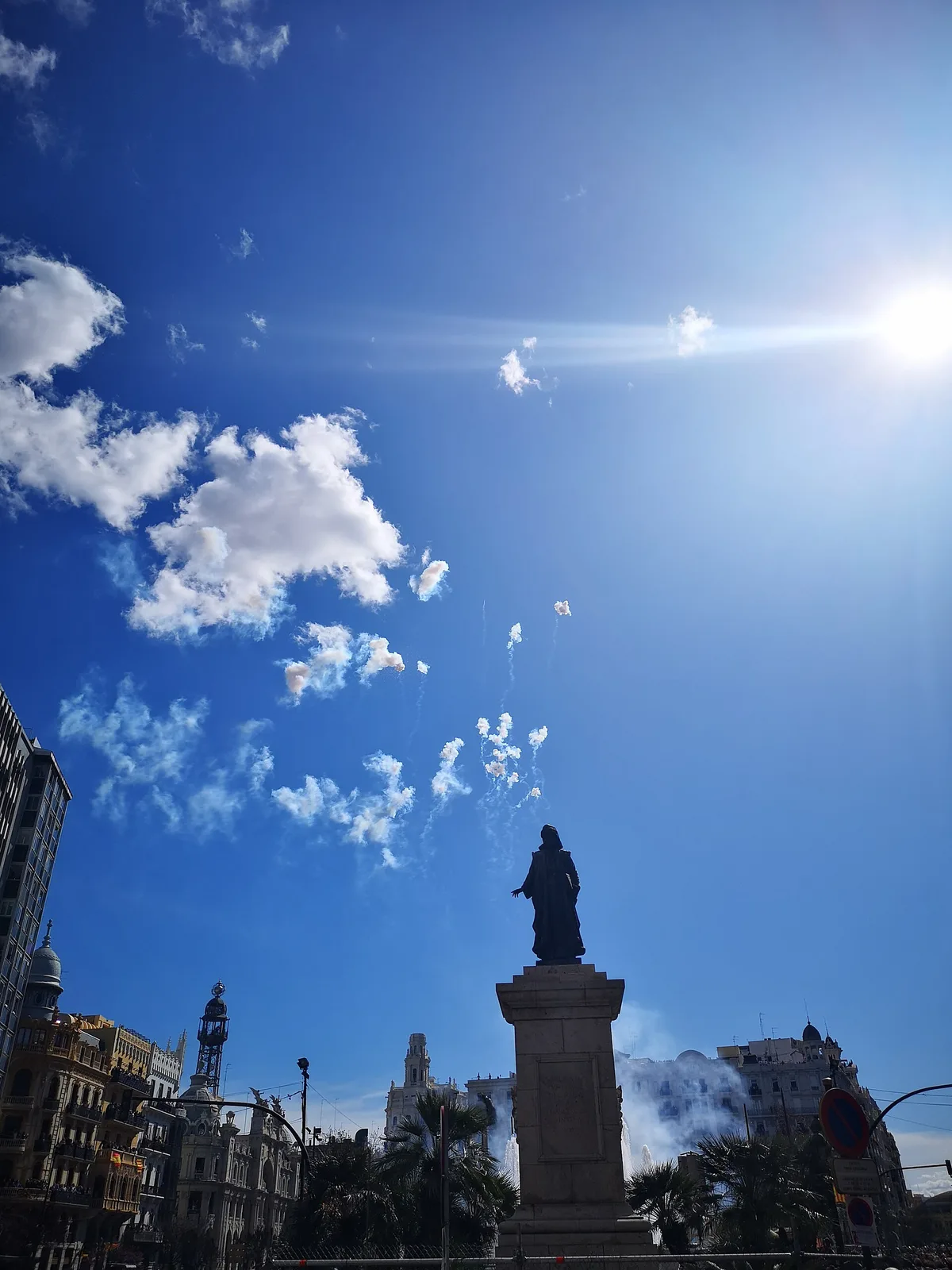
Photo: Monoyamonobooks, CC BY-SA 4.0
Why Valencians love it this much
The short answer is that a mascleta is not a spectacle you attend, it is something that happens to your body alongside thirty thousand other bodies. That is a different category of experience from watching a firework display, and it explains most of the confusion outsiders have about it.
It is also daily. For nineteen days the city stops at the same hour in the same square, which turns a pyrotechnic show into a civic appointment. People develop opinions about which firm is having a good year the way other cities argue about a football side.
There is a claim to craft underneath it. The pirotecnics are treated as artists rather than technicians, their names are known, and a strong Plaza del Ayuntamiento slot is a career event. When a Valencian says a mascleta was good, they are making an aesthetic judgement about a composition, not reporting that it was loud.
And it is participatory in a way the visitor rarely sees on day one. The noise in the streets around the official firing is not the show, it is the audience answering back, which is what the rest of this article is about.
Petardos, truenos, masclets: a field guide to the firecrackers
Walk any Valencian street in March and you will hear half a dozen different bangs, each with its own name. Knowing the difference is the key to reading the city's soundscape, and it also tells you what is a harmless toy and what can take a finger off. Here are the ones worth knowing, sorted roughly the way Spanish pyro shops sort them:
| Type | What it is | Where you meet it |
|---|---|---|
| Petardo | The catch-all word for any small firecracker that just makes a bang. | Casual street use by absolutely everyone. |
| Trueno | A high-power firecracker built for one dry, brutal detonation. | Enthusiasts chasing maximum noise. |
| Masclet | A potent charge with a dry blast and heavy vibration, the building block of the mascleta. | The official daytime displays. |
| Traca | A long chain of firecrackers on a single fuse that goes off in sequence. | Weddings, communions and street parties. |
| Carcasa | An aerial shell that climbs and bursts into colour and shape. | The night displays and the Nit del Foc. |
| Bombeta | A tiny impact popper that cracks when you throw it at the ground. | The gentle introduction handed to small children. |
How old do you have to be? Spain's F1 to F4 rules
Spain sorts fireworks into four hazard categories, F1 to F4, and the legal age climbs with the risk. The Valencian Community, being the Valencian Community, carves out lower ages for the milder categories as long as a parent signs a written authorisation form. Roughly:
- F1 - very low hazard. Bombetas and sparklers. Restricted to 12 nationally, but 8 in Valencia with signed parental consent.
- F2 - low hazard. Standard petardos for outdoor use. 16 nationally, 10 in Valencia with parental consent.
- F3 - medium hazard. Powerful truenos and bigger devices. Strictly 18 and over, everywhere in Spain.
- F4 - high hazard. Professional use only. This is what the pirotecnics fire, not the public.
The rules are one thing; enforcement in the chaos of Fallas is another. A study of firework injuries in pediatric emergency departments found that a large share involved children below the legal age, usually hurt while handling the devices themselves, which points straight at the obvious gap: not enough adults watching.
The homemade-firework problem
In the last few years a nastier trend has crept into Fallas: illegal homemade explosives, the petardos caseros or pirotecnia extrema, built by people who find even a legal F3 too tame. They are made by cramming gunpowder into tin cans or taping bundles of commercial firecrackers together, and they are exactly as unstable as they sound. The consequences have been grim. During the 2024 festival a 35-year-old man lost his hand and part of his arm after setting off a device built from a one-kilo tuna can packed with gunpowder.
Days later a homemade bomb tore a two-metre crater in a park on Calle Tomas de Montanana, blew out windows and injured a street cleaner. The local police USAP unit now seizes hundreds of these things every Fallas, some holding up to 150 grams of powder, far past any legal consumer limit. That is exactly the class of device the Dutch firework tourists travel here for.
Las Fallas is Valencia showing off centuries of mastery over gunpowder, and it is genuinely thrilling to stand inside. The trick is telling the artistry apart from the recklessness: the mascleta and the Nit del Foc are worth every decibel, the homemade tuna-can bombs are how people lose hands.
Come for the noise, respect it, keep small children away from the street firecrackers, and pack earplugs. When you are ready to plan the trip properly, the Fallas trip hub and our notes on booking accommodation before it fills up will get you a bed and a spot to watch from.
Watching from a balcony beats watching from the crowd
Book early and pick the right barrio. Our guide covers where to stay for the mascleta and Nit del Foc, and how fast hotel prices climb.
Thinking of making Valencia home?
Fallas is the loud, glorious front door to a city that is even better the other fifty weeks of the year. If you are weighing up a move, we can help with the visa, the paperwork and finding a barrio that suits you.
Contact us
About the author
Michael Bastin
Founder, ValenciaMove - Valencia since 2016
Michael moved to Valencia in 2016 and has helped dozens of families relocate since. He writes every guide on this site personally and verifies every fact against Spanish government sources before publishing.
Buy Michael a coffeeNeed help with your move?
Contact us. We handle visa, admin, and housing so you can focus on the exciting part.