
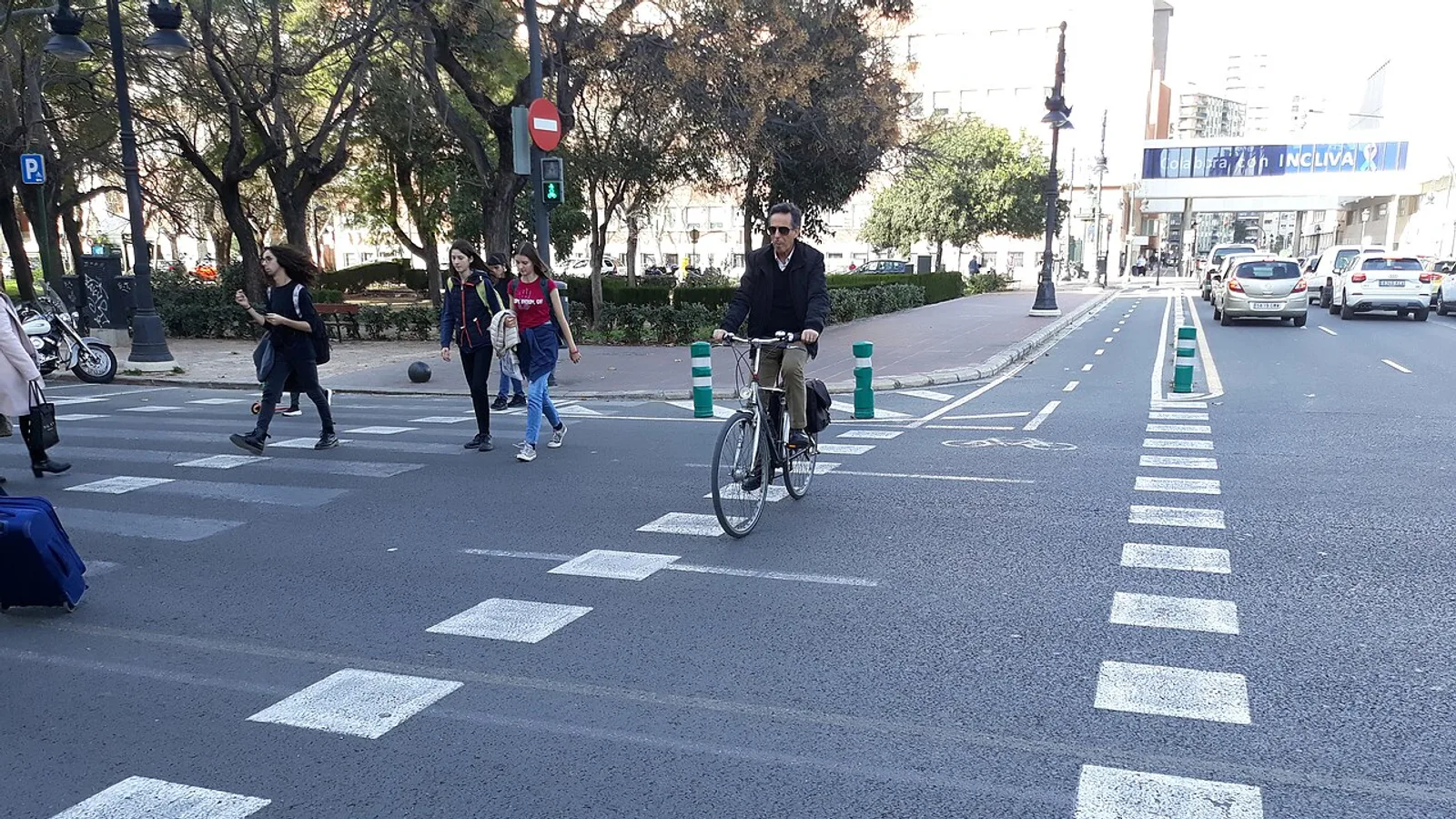
Ask anyone who has just moved here what surprised them about getting around and the traffic lights come up fast. Crossing the city by car feels like a sequence of short hops between red lights, and the impression is not imagined.
Valencia genuinely runs one of the densest traffic-light networks of any city its size. The reason is not bad planning. It is a street grid drawn in the 19th century, plus a deliberate choice about who the road belongs to.
How many traffic lights does Valencia actually have?
The city's own Traffic Management Centre puts it plainly: more than 1,000 junctions in Valencia are controlled by traffic lights. Those signals sit on a main road network of around 300 km, carrying close to 498,000 registered vehicles for a population of just over 800,000.
Spanish press coverage usually rounds the figure to about 1,100 signalised junctions, which works out at roughly one for every 730 residents. Treat the exact number as approximate: a junction is not a single lamp, and each one carries several signal heads for vehicles, pedestrians and often bicycles.
The comparison is what makes it striking. On the same per-resident basis, Madrid runs about one signalised junction per 2,700 people and Barcelona about one per 2,000. Valencia is roughly three times denser than the capital.
Why so many? Look at the street plan
The answer is geometry rather than policy. Valencia's Eixample, built out from the second half of the 19th century once the medieval walls came down, was laid out as an orthogonal grid of wide avenues meeting at right angles, in the same spirit as Barcelona's.
A regular grid manufactures junctions. Where an old irregular street plan produces occasional awkward crossings, a grid produces a crossing at every single block corner, systematically, across the whole district. Each one is a place where two streams of traffic and two streams of pedestrians have to be separated in time, which is precisely what a traffic light does.
Add the second factor and the number stops looking strange. Valencia is flat, compact and heavily walked and cycled, and the city has spent two decades pushing road space towards pedestrians and bikes. Signals are the tool that makes that work at a junction.
The network is not left to run blind, either. It is coordinated from the municipal Traffic Management Centre in the old Tabacalera building, over a fibre-optic network, with CCTV and detectors buried in the lanes feeding live conditions back so signal timings can be adjusted rather than fixed.
The first one arrived in 1930
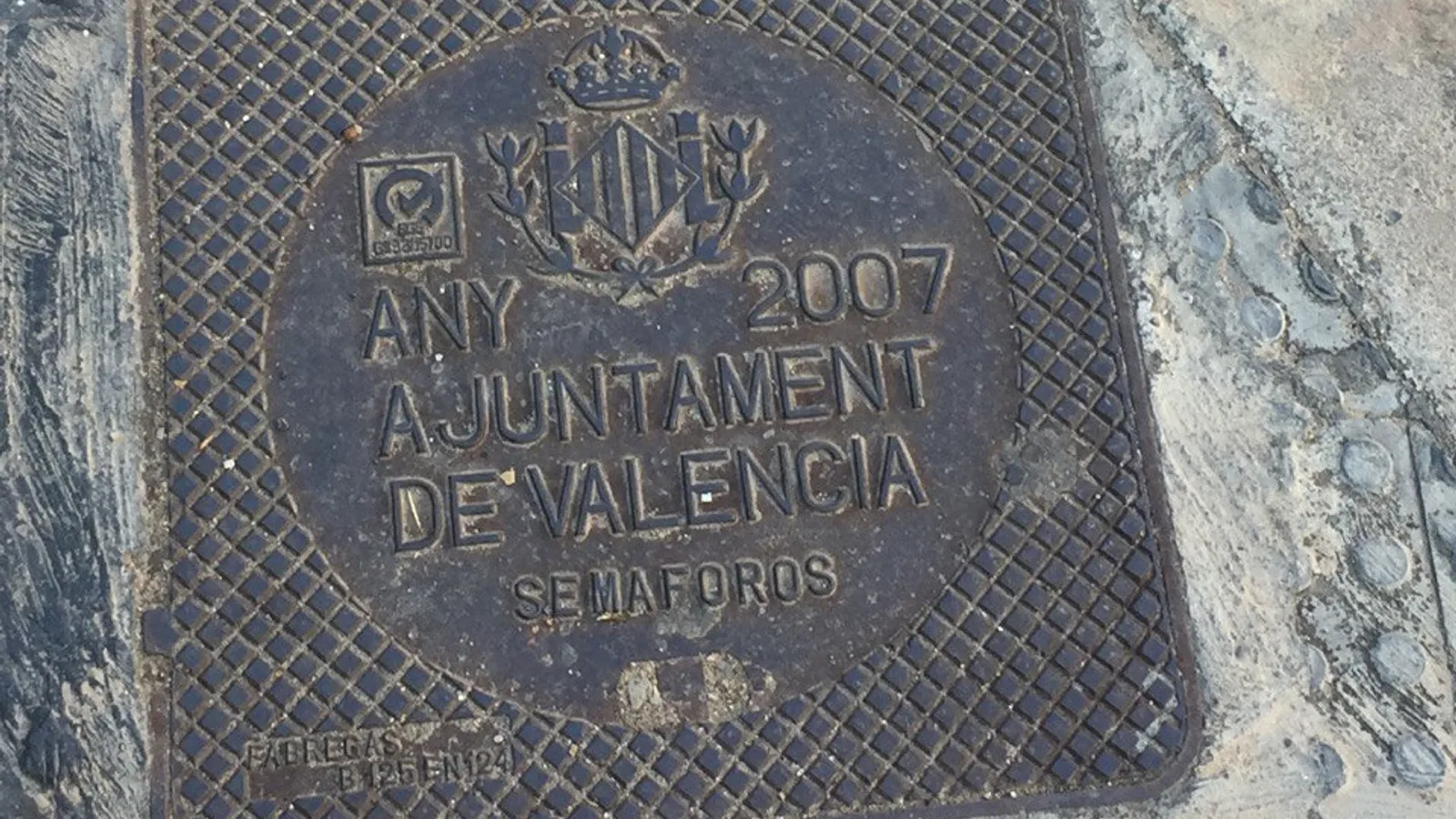
Valencia's first light signal went up in June 1930, at Plaza de la Reina, in the heart of the old city. It is a useful date to hold onto: the city was regulating traffic by signal almost a century ago, and the network has been extended, rebuilt and re-timed continuously since.
Most of what you see today is far newer. The old incandescent heads have been progressively swapped for LED units, which are brighter, far cheaper to run and, as it turns out, the reason the next part of this story cost nothing.
The traffic lights wearing skirts
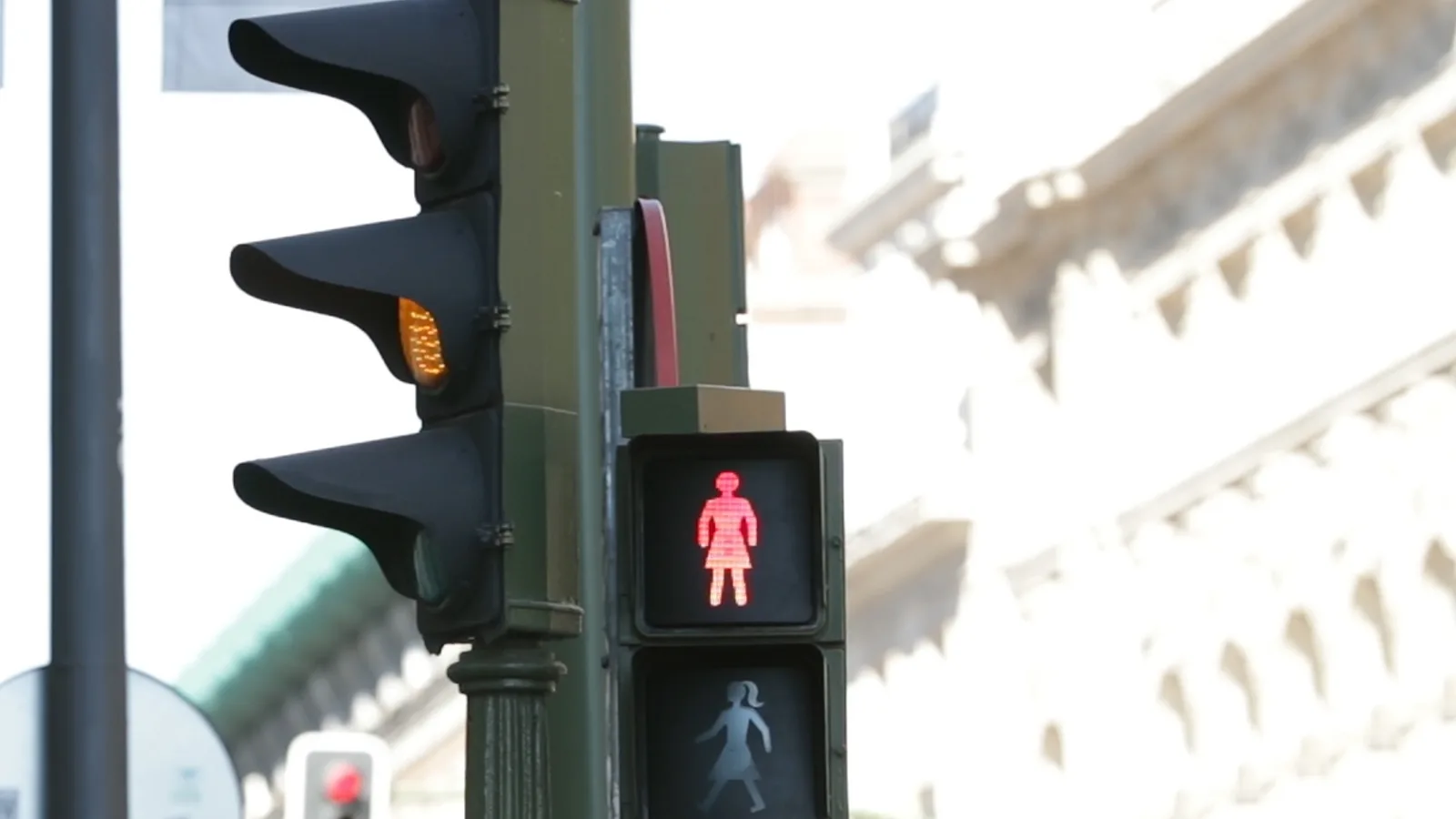
On 9 January 2019 the city switched on its first 20 semaforos paritarios, parity traffic lights. Alongside the usual walking figure, these show a female silhouette: a standing figure in a skirt on the red phase, and a walking figure with a ponytail on the green.
They went in at named junctions across the city, including Plaza del Ayuntamiento with Sangre and with Periodista Azzati, Marques de Sotelo with Xativa, Blasco Ibanez with Doctor Moliner and with Gomez Ferrer, Colon with Sorni and with Xativa, Torres de Serranos, Pio XII with Menendez Pidal, and Ramon Llull with Avenida de los Naranjos.
The detail worth knowing is the cost, because it is the question everyone asks first. There was none. The city was already replacing those heads with LED units on a budgeted renewal programme, so the change was a different pictogram on hardware that was being swapped anyway.
The reasoning given at the time was straightforward. The mobility councillor, Giuseppe Grezzi, described it as ending the exclusive representation of the male figure as the universal one, noting that everything masculine has long been treated as if it were neutral. The equality councillor, Isabel Lozano, framed it as making women and their needs visible in the fabric of the city.
Valencia was not first, and other cities went further
Madrid got there first in Spain, installing inclusive signals in June 2017 to coincide with WorldPride, in a batch that included both female figures and same-sex couples. Vienna had done something similar in 2015, and the idea has since turned up in cities across Europe and Latin America.
So Valencia joined a pattern rather than starting one. What is unusual here is not the gesture but the scale of the network it sits inside: 20 parity signals out of more than a thousand junctions is a small share, and the city has never announced a full conversion.
Which cities have even more?
New York is the one that beats Valencia, and the arithmetic is checkable. The New York City Department of Transportation operates more than 13,250 signalised intersections for a population of roughly 8.3 million, which is about one junction per 620 residents, against Valencia's one per 730 or so.
Spanish and regional media routinely describe Valencia as the European city with the most traffic lights per inhabitant and the second in the world after New York. That claim circulates very widely, but no ranking body or methodology is ever named with it, so it is worth repeating with care. The underlying arithmetic against New York does hold up; the global second place is a media formula rather than a published league table.
Within Spain the picture is clearer, and Valencia comfortably leads the large cities on a per-resident basis. Against Madrid and Barcelona the gap is not marginal, it is a factor of two to three.
What this means for you day to day
If you drive, adjust your expectations rather than your route. Cross-city journeys are slower than the map distance suggests, and the signals are coordinated in progressions along the main avenues, so holding the posted speed usually gets you more green lights than accelerating between them.
If you walk, you will wait less than you expect. Dense signalisation is the flip side of a city that is genuinely comfortable to cross on foot, and pedestrian phases here are frequent rather than long.
One practical warning worth internalising. Crossing against a red pedestrian signal is a traffic offence in Spain, not a local custom, and it carries a fine under the national traffic law. Enforcement against pedestrians is light in practice, but it is not zero, and it becomes very relevant if you are involved in a collision while crossing on red.
If you cycle, note that Valencia's bike lanes have their own signals at many junctions, and they do not always run in phase with either the road traffic or the pedestrian crossing beside them. Read the one that applies to your lane.
Working out what living here is actually like?
The traffic lights are a small thing, but the questions behind them, how you get around, where to live, what the city prioritises, are the ones that decide whether a move works. We can walk through the practical side with you.
Contact us
About the author
Michael Bastin
Founder, ValenciaMove - Valencia since 2016
Michael moved to Valencia in 2016 and has helped dozens of families relocate since. He writes every guide on this site personally and verifies every fact against Spanish government sources before publishing.
Buy Michael a coffeeNeed help with your move?
Contact us. We handle visa, admin, and housing so you can focus on the exciting part.