

Valencia is a genuine university city. Between its public research universities, a cluster of private and Catholic universities, and a growing base of English-taught Master's programs, there is a real option here whatever your background or budget.
This guide breaks down the public, private and international-facing options, where their campuses actually are relative to the neighborhoods this site already covers, and what to know about the residency side of enrolling as a foreign student.
Public universities

Photo: Carlesmari, CC BY 3.0
The Universitat de Valencia (UV) is one of Spain's oldest universities, founded in 1499, and by far the largest in the city. It runs three main campuses: Blasco Ibáñez (health sciences and humanities, near the city center), Burjassot-Paterna (sciences), and Tarongers (law, economics and social sciences, in the Benimaclet-Algiros area). Most Bachelor's degrees teach in Spanish or Valencian, but a growing number of Master's and doctoral programs teach partly or fully in English.
The Universitat Politècnica de Valencia (UPV) is the city's engineering and technical university, best known internationally for its architecture, computer science, industrial engineering and fine arts programs. Its main Camino de Vera campus sits on the north side of the city, a short ride from the Ciutat de les Arts i les Ciencies rather than right beside it, and it consistently ranks among Spain's top technical universities. Like UV, UPV teaches most Bachelor's degrees in Spanish, with more English-taught options at Master's level, including several double-degree programs with partner universities abroad.
Private and Catholic universities

Photo: B25es, CC BY-SA 3.0
The Universidad Católica de Valencia San Vicente Martir (UCV) is one of the largest private universities in the city, well known for health sciences, particularly medicine, nursing, physiotherapy and dentistry, alongside education and psychology degrees.
CEU Cardenal Herrera (CEU-UCH), with a campus in Moncada just outside the city, is a private Catholic university with a strong reputation in veterinary medicine, dentistry, pharmacy and business, and English-taught options in several of its programs.
Universidad Europea de Valencia focuses on business, design, health sciences and communication, with smaller class sizes and a practical, industry-connected teaching style typical of the wider Universidad Europea network.
Florida Universitaria, based in Catarroja just south of the city, is a well-established private university center with degrees in business, education, health sciences and ICT, generally at a lower cost than the other private options.
For anyone who needs full flexibility, Universidad Internacional de Valencia (VIU) is a fully online private university headquartered in the city, offering Bachelor's, Master's and doctoral programs entirely at a distance, an option worth knowing about if you are relocating and do not want your studies tied to a single campus.
Universities near Valencia: Castellon, Gandia and Elche
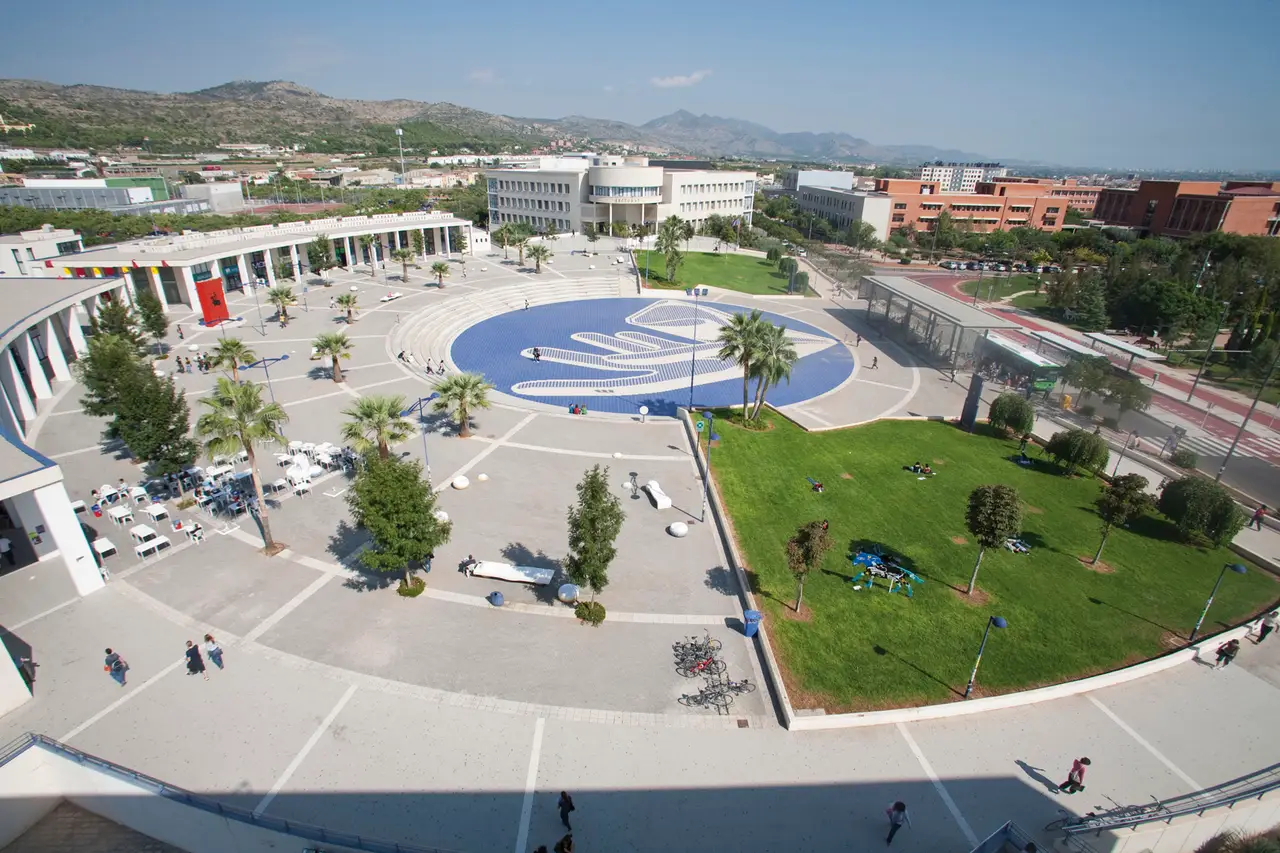
Photo: Socialuji, CC BY-SA 4.0
Valencia city is not the only option in the region. Three more public universities sit within day-trip distance, each with its own specialty and its own commute.
The Universitat Politècnica de Valencia's Gandia campus opened in 1993, about 600 meters (about 1,969 ft) from the beach, and teaches audiovisual communication, telecommunications engineering, environmental science and tourism. It is reachable by a direct Cercanías C1 train from Valencia's Estacio del Nord, or about 45 minutes by car.
Universitat Jaume I (UJI), in Castellon de la Plana, is a public university founded in 1991 with around 14,000 students. It sits about 77 km (about 48 mi) north of Valencia, roughly an hour by the Cercanías C6 line or by car on the AP-7.
Universidad Miguel Hernández (UMH) has its main campus in Elche, about 180 km (about 112 mi) south of Valencia, with further campuses in Sant Joan d'Alacant, Orihuela and Altea. Founded in 1996 with around 14,000 students, it is best known for health sciences. It is a longer trip, closer to two hours by car, so most students there live in the Alicante area rather than commuting from Valencia.
English-taught programs and international options

Photo: Dorieo, CC BY-SA 4.0
Do not expect a wide menu of English-taught Bachelor's degrees at the public universities. Most undergraduate teaching happens in Spanish or Valencian, and international undergraduates typically need a B2-level Spanish certificate or equivalent for admission. Where English genuinely opens doors is at Master's and doctoral level, where UV, UPV and several of the private universities run programs taught partly or fully in English, particularly in business, engineering and health sciences.
Erasmus Plus exchange places are common across UV and UPV for students already enrolled at a partner university abroad, and both universities run dedicated international offices and orientation sessions to help incoming exchange and degree-seeking students settle in.
How to choose

AI-generated image
If you want a well-known name, a large student community and the lowest tuition, UV or UPV are the default choice, provided your Spanish is strong enough for a Bachelor's degree or you are targeting an English-taught Master's. If you are drawn to health sciences, particularly medicine, dentistry or veterinary medicine, the private and Catholic universities (UCV, CEU-UCH) generally offer more direct admission routes and smaller cohorts than the public system, at a real cost difference in tuition. If flexibility matters more than campus life, VIU's fully online model is worth a serious look.
Where the campuses actually are

Photo: V0ctor, CC BY-SA 4.0
UV's Blasco Ibáñez campus and UPV's main Camino de Vera campus both sit on the north side of the city, close to each other and within easy reach of Benimaclet and Algiros, which is why those two neighborhoods have such a large student population and a steady supply of shared apartments. UV's Tarongers campus (law, economics) is a short walk from the same area. CEU Cardenal Herrera's Moncada campus and Florida Universitaria's Catarroja campus both sit outside the city center, connected by metro or bus, which tends to mean cheaper rent but a longer commute.
Most students meet the city at the airport before they ever see a campus. Manises sits at the far end of metro lines 3 and 5, so the run in from Valencia airport to the centre is a single ride with your luggage, and it is worth planning before you land rather than at the taxi rank at midnight. For what classes and daily routines on those campuses actually feel like, see university life in Valencia, and for current room and flat prices near them, student housing in Valencia.
The residency side of studying in Valencia

Photo: Maria Ziegler, Unsplash License
Non-EU students staying more than 90 days need a student visa before arrival, and will need to handle the NIE and, depending on nationality and length of stay, the TIE card once in Spain. Universities generally provide a formal admission or enrollment letter that supports the visa application, and international offices can usually point new students toward the right paperwork, but the actual visa appointment and residency steps go through the same channels as any other move to Spain.
Whichever route you take, Valencia's combination of long-established public universities, a real range of private options and a genuinely lower cost of living than Madrid or Barcelona makes it one of the more practical Spanish cities to study in.

AI-generated image
Relocating to Valencia for university?
From NIE appointments to finding housing near campus, we help students and families settle in without the guesswork.
Contact us
About the author
Michael Bastin
Founder, ValenciaMove - Valencia since 2016
Michael has lived in Valencia since 2016 and helps people move here.
Buy Michael a coffeeNeed help with your move?
Contact us. We handle visa, admin, and housing so you can focus on the exciting part.