

Photo: B25es, CC BY-SA 3.0 ES
Living in Chiva
Thirty kilometres inland, 270 metres up, no metro, the cheapest housing in this cluster, and the town where the flood of October 2024 began.
Chiva () is not l'Horta. It sits in the Hoya de Buñol, roughly thirty kilometres west of Valencia along the A-3, at 270 metres (about 886 ft) above sea level, and it is a genuinely different proposition from every other town in this cluster: further out, cheaper, more rural, and reached by a Cercanías line rather than by the metro.
The municipality covers 178.7 square kilometres, forty per cent of it forest, rising to peaks of over eleven hundred metres, with 17,951 residents on the 2025 padrón ().
It has grown almost twenty per cent since 2014, the fastest of the seven towns in this batch, and much of that growth is people moving out from the metropolitan area rather than a local baby boom.
Two things have to be said about Chiva and both matter. The first is that it is the cheapest place in this cluster to rent or buy, by a distance, and that it has real countryside rather than a green edge.
The second is that the barranc () del Poyo rises above the town, and Chiva was one of the epicentres of the flood of 29 October 2024. That is dealt with in full below, and it is not a reason to skip the town, but it is a reason to research a specific street rather than a town.
Chiva at a glance
The six figures that decide whether this town belongs on your list. Every one of them is sourced at the foot of the page.
Commute
Renfe Cercanías line C-3, fare zone 4, reopened in December 2025 after fourteen months closed. No metro, and none planned.
Rent
The rent index reads a little over half the city of Valencia, on a thin sample that moves sharply month to month.
Buy
The sale index is under half the city. This is the cheapest municipality in this batch of guides on both measures.
Flood risk
The barranc del Poyo rises above the town. Emergency works finished in June 2026 tripled the urban channel capacity; a second phase is not yet funded.
Space
178.7 square kilometres, forty per cent forest, seventeen urbanisations, altitudes from 270 to over 1,100 metres (about 3,609 ft).
Population
17,951 residents on the 2025 padrón, up almost twenty per cent since 2014. The fastest growth of the seven.
The C-3, and fourteen months without it
Chiva is on Renfe Cercanías line C-3, the inland line that runs from Valencia Nord out through Cheste and Buñol toward Requena and Utiel. The station is in fare zone 4, the furthest band of any town in this cluster.
There is no metro and there is no plan for one. Anyone comparing Chiva with the l'Horta towns should start from that.
The line matters more here than a railway usually does, because for fourteen months there was not one. The flood of 29 October 2024 closed the C-3, and Chiva station stayed shut until 22 December 2025.
The section from Loriguilla to Buñol reopened on 22 December 2025, and from 2 February 2026 Renfe has run forty-eight trains a day on it, twenty-four in each direction, between Valencia and Buñol. The stretch beyond Buñol to Utiel is still closed, with replacement buses, and full reopening is planned for late 2026.
So the service is real and current, and it is also newly restored rather than long settled. Check the live timetable rather than an older one, and note that a zone 4 fare on a timetabled line is a materially more expensive and less flexible commute than a metro ride from Torrent or Moncada.
Cercanías is inside the ATMV integrated fare system, so a single SUMA title still covers a journey that mixes train, metro and bus.
In practice most people here drive. The A-3, the Autovía del Este, runs past the town and puts central Valencia around half an hour away outside peak, with the CV-50, CV-379 and CV-421 covering the local network and MetroBus routes running into the city.
Valencia's low emission zone rules apply once you reach the city, which for a town at this distance is a genuine cost to check before you buy an older car.
Renting: a little over half the city
Fotocasa's rent index puts Chiva at 10 EUR/m² in September 2026, 0.5 per cent down against a year earlier. The city of Valencia reads 18 EUR/m² on the same index in the same month.
That is a little over half, and only Picassent reads lower among the seven towns in this batch.
Read the movement with caution. The same index fell 11.5 per cent over the last quarter while sitting level with a year earlier, down 0.5 per cent, which is the signature of a thin sample rather than of a volatile market.
In a municipality of eighteen thousand people spread across nearly a hundred and eighty square kilometres, a handful of listings can swing the figure. Treat it as an order of magnitude, not a valuation.
On 10 EUR/m², a ninety square metre flat works out around 900 EUR a month before bills, community charges and the IBI. The rental market here is genuinely small, and a good deal of the housing stock is second homes in the urbanisations rather than long-let flats in the town, so expect fewer options and a longer search than the price suggests.
Buying: under half the city, and mostly houses
Fotocasa's sale index reads 1,568 EUR per square metre for Chiva in September 2026, against 3,355 EUR for the city of Valencia in the same month. That is about 47 per cent of the city and the lowest figure in this batch of seven guides.
Fotocasa publishes several zones inside the municipality, corresponding to the urbanisations rather than to town quarters.
What that price actually buys is different in kind from what it buys nearer the city. Chiva has seventeen urbanisations, among them El Bosque with its golf course, Sierra Perenchiza, Calicanto, La Loma and Las Pedrizas, and a large part of the market here is detached houses with plots rather than apartments.
Many were built as weekend places, which affects both the condition you find and the community you join.
The two things to check on any purchase in an urbanisation are the water and the road. Some of these developments have their own supply arrangements, their own maintenance obligations and their own community charges, and the difference between an urbanisation that has been formally received by the ajuntament () and one that has not is a difference you want to understand before you sign, not after.
The flood of 29 October 2024
Chiva was one of the epicentres of the flood, not a place on its edge. The rain fell here first and hardest: about 491 litres (about 130 US gal) per square metre on 29 October, effectively all of it inside eight hours, which is close to a full year's rain in a day and among the highest values ever recorded in the Valencian Community. Turis, twenty-five kilometres away, took 771.8 millimetres in twenty-four hours, the highest daily total recorded anywhere in Spain since November 1987.
The first calls to the emergency number about the barranc del Poyo overflowing came from Chiva, from about half past four in the afternoon.
The barranc del Poyo rises in the hills above the town and runs through it, and what came down it that day peaked at close to 2,300 cubic metres a second at the control point where it crosses the A-3, with perhaps 3,000 further downstream. Chiva lost homes, vehicles and part of its built heritage, and families were displaced for weeks.
The damage further down the barranc, in Paiporta, Picanya, Torrent and Catarroja, is what the world saw. It began here.
What has changed since is real and partial. The Confederación Hidrográfica del Júcar carried out emergency works through the urban stretch of the barranc, completed in June 2026, which roughly triple the channel's discharge capacity to about 600 cubic metres a second, with new banks and a reinforced channel.
A second phase, widening the channel and building retention basins upstream, was at the design stage during 2026 with an estimated cost of around five million euros and no construction budget assigned. Anyone telling you the problem is either solved or untouched is wrong in both directions.
The honest advice is that this is a street-level question, not a town-level one. Most of Chiva is nowhere near the channel and was never at risk; some of it is very close to it indeed, and that will still be true after phase two is built.
Check the specific address on the Generalitat's PATRICOVA flood risk viewer and read the CHJ's own page on the emergency works before you make an offer. Both are linked at the foot of this page, and twenty minutes with them is worth more than any general reassurance.
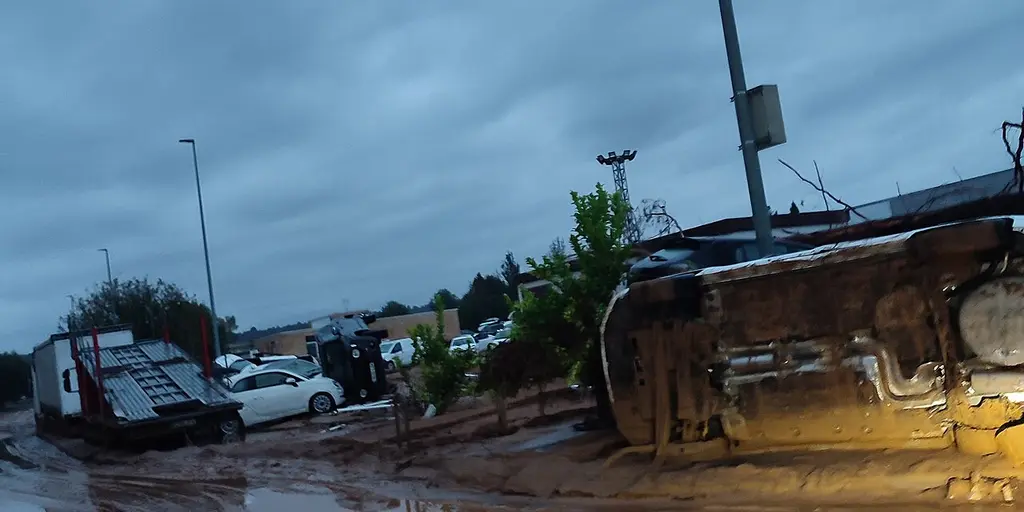
Photo: Jaigascom, CC BY-SA 4.0
The town itself
Above the town stand the ruins of the Castell de Xiva, a protected monument on the pine-covered hill, and below them a compact centre built around the eighteenth century church of Sant Joan Baptista and the modernista Font dels 21 Canyos.
It reads as an inland Valencian town rather than as a coastal one: stone, pines, altitude and a different light.
Chiva's best-known festival is the Torico de la cuerda in August, the rope bull, which the town claims as its world capital and which is genuinely central to local identity. The patronal festival of the Verge del Castell falls in September, and Setmana Santa is observed properly.
If bull festivals are something you object to, that is worth knowing before you move to a town that organises part of its year around one.
Economically the town has moved from agriculture toward industry and services, with ceramics, metalworking and construction alongside citrus and vegetables, and a weekend population that swells the urbanisations.
What it does not have is the density of shops, restaurants and services that a town of eighteen thousand nearer the city would carry, because a good part of its population is not there midweek.

Photo: B25es, CC BY-SA 3.0
Schools
Chiva has infant and primary provision and a state secondary school inside the municipality, plus adult education, taught in Valencian and Spanish. The Generalitat's centre directory is the list to check against and the ajuntament's education department publishes the local detail.
For a town this size that is adequate rather than generous, and cohorts are growing with the population.
Chiva does have one international school inside the municipality: Colegio Internacional Levante, part of the SEK group, sits in the Urbanizacion Calicanto and teaches the International Baccalaureate from early years through secondary. It is a private school in an outlying urbanisation rather than in the town centre, so check the real drive time from wherever you plan to live rather than assuming it is minutes away.
Beyond that one option, the next choices are back toward the city, which from most of Chiva is still a thirty kilometre drive rather than a train ride, and that is a serious daily commitment for a child. Our guide to international schools in Valencia sets out where they actually are.
That one school will not suit everyone in the municipality: it is private, and it only makes sense as a daily run if you live in or near Calicanto. For anyone elsewhere in Chiva, Torrent or Picassent answer the same need with a shorter drive. If you plan to use the state system instead, our state school guide explains admission and zoning.

Photo: B25es, CC BY-SA 3.0
Who Chiva actually suits
It suits someone who wants land, quiet and altitude, and who accepts that thirty kilometres and a zone 4 fare is the price of it. This is the only town in this cluster where a house with a real plot and a view of forest is an ordinary purchase rather than an exceptional one.
It suits people who work remotely, or who work locally, rather than people commuting into central Valencia five days a week.
It suits walkers, cyclists and anyone who wants the Sierra de Chiva and the inland country on the doorstep. It suits a household with two cars, because one will not be enough.
It suits a buyer with a long horizon: the town is growing fast, the prices are the lowest in this cluster, and the railway has just come back.
It suits you less if you need the metro, a choice of international schools, the sea or a shop open at ten on a Tuesday night. It suits you less if a timetabled train at the far fare zone is your only way into work.
And it suits you less if you would rather not think about flood risk at all, because here you have to think about it properly once, at the level of the individual street.
The admin is Chiva's own, and the comarca is different
Chiva is a separate municipality in a different comarca () from every other town in this cluster: the Hoya de Buñol, not l'Horta. Your padrón () registration is at the Chiva ajuntament, and your IBI, refuse and water bills follow from that.
The comarca matters for more than geography: health, education and emergency services are organised on different districts out here, and the nearest hospital is not a Valencia city one.
If you buy in one of the urbanisations, ask the ajuntament directly what the situation is with adoption of the roads, the water supply and the street lighting, and ask the community of owners what the annual charge covers.
That is not scaremongering, it is the standard due diligence for a Spanish urbanisation, and it is more consequential here than in a town where everything is municipal by default.
The name appears as Chiva in Castilian and Xiva in Valencian, and both are used. The NIE and residency paperwork are national, and our empadronamiento guide covers the registration itself, which works the same way here as anywhere else.
Four things people get wrong about Chiva
Filing it with the l'Horta towns
It is in the Hoya de Buñol, thirty kilometres out and 270 metres (about 886 ft) up, on a Cercanías line in fare zone 4. It is a different kind of place with a different daily rhythm.
Thinking the railway is still closed
Chiva station reopened on 22 December 2025 and since 2 February 2026 Renfe has run forty-eight trains a day between Valencia and Buñol. Only the stretch beyond Buñol is still out.
Treating flood risk as a town-level question
Most of Chiva is well away from the barranc. Some of it is very close. The PATRICOVA viewer answers the question for a specific address in minutes.
Assuming an urbanisation is fully municipal
Several of the seventeen have their own water, road and lighting arrangements and their own community charges. Ask the ajuntament and the community before you buy.
How to work out whether Chiva fits
- 1
Check the address on PATRICOVA first
Before the price, before the viewing. Twenty minutes with the Generalitat's flood risk viewer and the CHJ works page settles the biggest question about this town.
- 2
Drive the commute at eight in the morning
Thirty kilometres on the A-3 is half an hour at midday and something else entirely at peak. Do it once before you decide it is fine.
- 3
Read the current C-3 timetable
The service is newly restored, so older information is wrong. Check the real departures at the hours you would travel, in both directions.
- 4
Interrogate the urbanisation
Water, roads, lighting, community charges, and whether the ajuntament has formally received the development. Get the answers in writing.
- 5
Visit in midweek February
A town with a big weekend population is a different place on a wet Tuesday in winter. If it still appeals then, it will suit you.

Resident in Valencia since 2016. Founder of BeTranslated. 25+ years in translation, interpretation and multilingual SEO.
Reviewed 6 September 2026 by Michael Bastin