
An unusual choice for a city emblem
Plenty of cities reach for a lion, an eagle, or a bull when they need a powerful animal for their coat of arms. Valencia went a different way. Look closely at the city's shield, at carvings on a handful of historic buildings, or even at Valencia CF's football crest, and the same small flying creature keeps turning up. Locals call it Lo Rat Penat, Valencian for "the bat." It isn't decoration. So how did a nocturnal flying mammal end up as one of Valencia's most recognisable symbols?
The Legend of the Bat and King Jaume I
The most-told version of the story goes back to 1238, during King Jaume I's campaign to conquer Valencia from Moorish rule. According to local legend, a bat flew into the royal camp one night, not long before a decisive battle.
Its noise, or the commotion it caused among the sleeping soldiers, is said to have woken the camp in time to spot an enemy force approaching under cover of darkness. Forewarned, Jaume I's troops were ready, and the surprise attack failed.
In gratitude, so the story goes, the king had the bat placed above the city's new coat of arms, right over the crown, as a mark of honour. It's a vivid story, and it is told across Valencia as settled fact. Worth being clear from the start, though: this is a popular legend, not a documented historical event. No surviving chronicle from the period records a bat saving Jaume I's campaign.
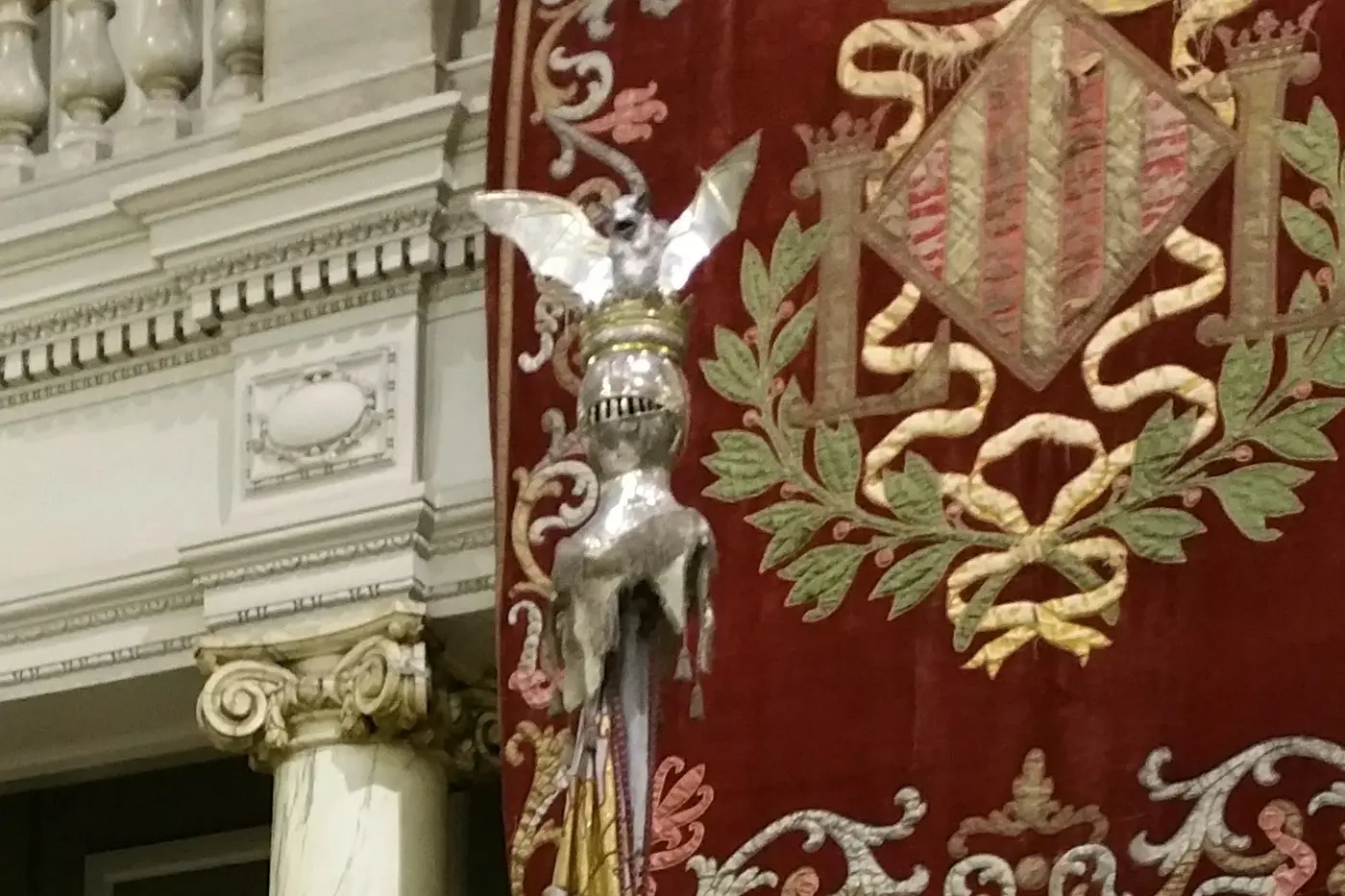
Photo: Hypatia2010, CC BY-SA 4.0
What Is Lo Rat Penat, and Where Does the Symbol Really Come From?
Lo Rat Penat is simply the Valencian name for the bat, and it's also the name of a well-known cultural association founded in the 19th century to protect the Valencian language, a sign of how deeply the animal is woven into local identity beyond heraldry alone.
The documented history of the bat on Valencia's coat of arms is less dramatic than the Jaume I legend, and also less settled. The city's own heraldic record points to medieval conventions rather than one single royal gesture, and historians trace the bat's appearance to municipal seals from the 15th century onward.
From there it gradually became a fixed part of the design, wings spread, perched directly above the crown that tops the shield, the position it still holds today.
Why Is the Bat So Important to Valencia?
Today the bat carries several layers of meaning at once. It still evokes protection and good fortune, thanks to the Jaume I legend. It links the modern city back to its medieval founding, a shorthand for centuries of history in a single image. And it shows up often enough, on official documents, building facades, football shirts, that it has simply become a point of local pride.
There's also a more practical side that often gets left out. Bats are genuine allies in a city built beside wetlands and rice paddies: they eat large numbers of insects, including mosquitoes, which has mattered here given Valencia's long history living alongside marshland and standing water.

Where Can You Spot the Bat Symbol in Valencia?
Start with Valencia's coat of arms itself, where the bat sits with wings spread directly above the crown. You'll find that same shield reproduced across the city, from official buildings to street signage.
Historic architecture carries it too. Decorative stonework around the old town, Ciutat Vella, often repeats the city's heraldry, bat included, and the Puerta del Mar, one of the historic gateways into the centre, is one of the better-known places to look for it worked into the facade above the arch.
Football fans will also recognise it: Valencia CF carries the bat on its club crest, inherited directly from the city's own coat of arms, visible on every shirt at Mestalla.
More Than Just a Bat, a Symbol of Valencia
The bat might look like an odd choice to top a city's shield, but its story brings together medieval history, a well-loved legend tied to King Jaume I, a practical bit of nature, and a sense of local identity that has lasted for centuries. Next time you walk through Valencia and spot a bat perched above a doorway or on the city's own coat of arms, you'll know there's a lot more behind it than decoration.
About the author
Zac Allen
ValenciaMove intern
Zac is a ValenciaMove intern who spends his weekends exploring the city's parks, sports clubs and family attractions, then writes up what he finds.
Need help with your move?
Contact us. We handle visa, admin, and housing so you can focus on the exciting part.