
Every Thursday at noon, as the cathedral bells strike twelve, the elected representatives of Valencia's old irrigation canals sit down in black smocks outside the cathedral's Apostles' Door and hold court over water. That is UNESCO heritage too, although nobody would call it a monument.
Valencia has four UNESCO entries, and they sit under three different labels. La Lonja de la Seda () is on the World Heritage List. The Water Tribunal, the Tribunal de las Aguas (), and Las Fallas are on the list of intangible cultural heritage, and the city belongs to UNESCO's Creative Cities Network for design.
Most guides lump all of it together as "World Heritage", which is true of only one. This guide explains what each label protects, when it was granted, and where and when you can actually see it.
Valencia's four UNESCO entries at a glance
One building, one court, one festival and one network: four entries under three different UNESCO labels.
| Entry | What UNESCO recognises | UNESCO list | Year | Where and when to see it |
|---|---|---|---|---|
| La Lonja de la Seda | A late Gothic building | World Heritage List | 1996 | Plaça del Mercat, opposite the Central Market |
| Water Tribunal of the plain of Valencia | A living court that shares out irrigation water | Representative List of the Intangible Cultural Heritage of Humanity | 2009 | Cathedral, Apostles' Door, Thursdays at 12:00 |
| Valencia Fallas festivity | A festival and the crafts behind it | Representative List of the Intangible Cultural Heritage of Humanity | 2016 | Streets and squares across the city, in March |
| Valencia, Creative City of Design | A city's commitment to design | Creative Cities Network | Member since 2023 | No single site to visit |
La Lonja de la Seda: Valencia's World Heritage Site
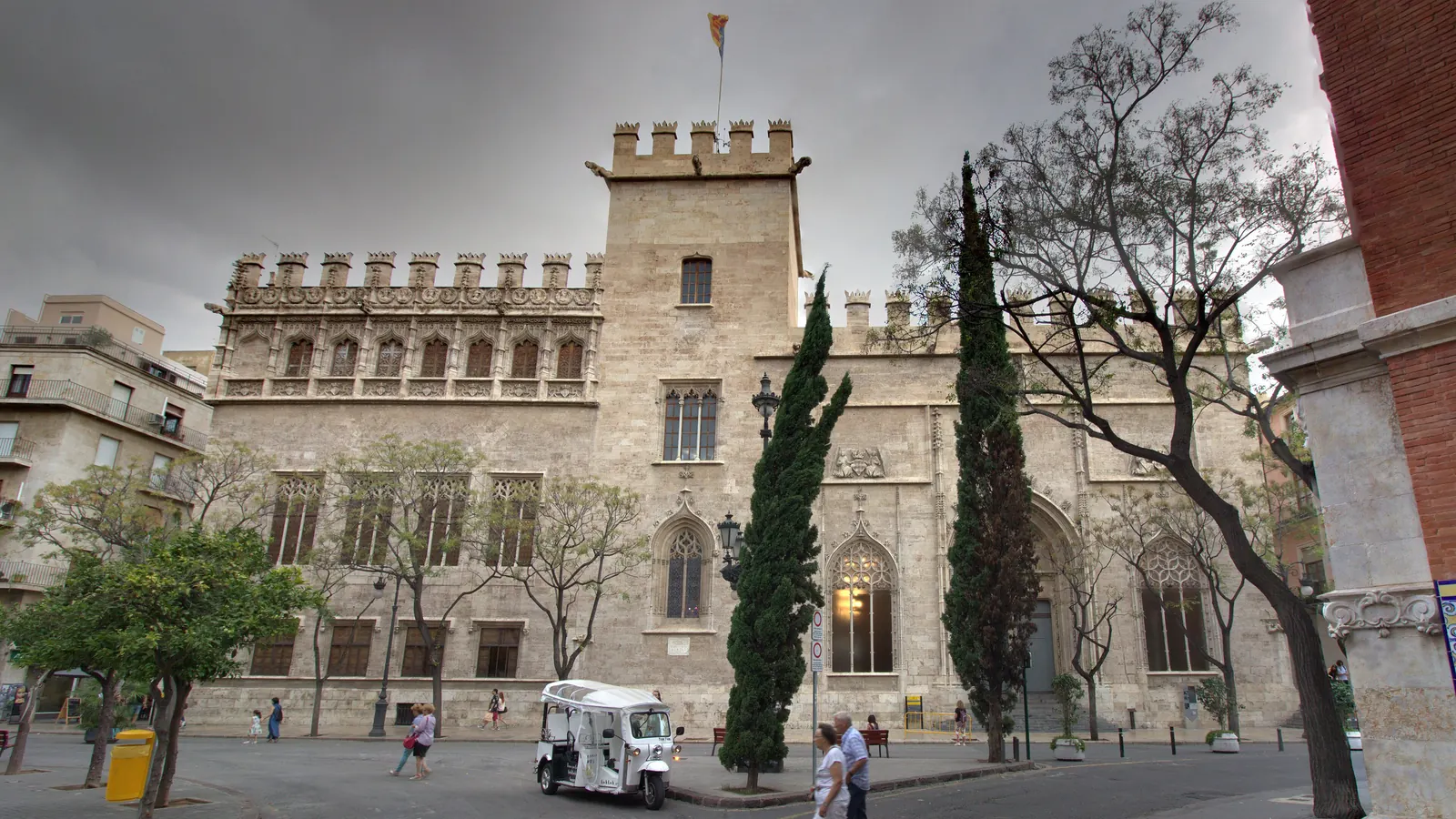
La Lonja de la Seda, the silk exchange, was built between 1482 and 1533 and inscribed on the World Heritage List in 1996. UNESCO chose it as an exceptional late Gothic building made for trade rather than worship, a statement of how rich a Mediterranean merchant city had become. It is the only World Heritage Site in the city of Valencia.
The hall of columns is the reason most people come: an old trading floor where spiral stone columns rise into a ribbed vault. Upstairs, the Consulat del Mar hall has a carved and gilded ceiling, and a small courtyard of orange trees sits between the wings. Our guide to Valencia's museums says how long to give it.
The Lonja is one of the city's municipal monuments, and entry to those is free on Sundays and public holidays. On other days there is an entry charge, and the Ajuntament publishes the current hours and prices.
Photo: Joanbanjo, CC BY-SA 3.0
World Heritage or intangible heritage: what is the difference?
The two lists come from two different UNESCO conventions. The World Heritage List protects places, buildings and landscapes, which is why La Lonja is on it: you can walk round it, and it would still matter if nobody traded there again.
The Representative List of the Intangible Cultural Heritage of Humanity protects practices that only exist while people keep doing them: rituals, crafts, festivals, ways of settling disputes. The cathedral door where the Water Tribunal meets is not what is listed, and neither are the streets where the fallas stand. What is listed is the custom itself.
That is why "Las Fallas is a World Heritage Site", a line you will find on many tourist pages, is wrong. Las Fallas is intangible heritage, which is a different list with a different purpose.
The Water Tribunal: intangible heritage that meets every Thursday
UNESCO inscribed the Water Tribunal of the plain of Valencia in 2009, together with Murcia's Council of Wise Men, as the irrigators' tribunals of the Spanish Mediterranean coast. It traces these courts back to the al-Andalus period and notes that they are recognised under Spanish law. Valencia's court is made up of eight elected representatives of the canals that share out the water of the Turia.
It still sits every Thursday at 12 noon at the door of Valencia cathedral, the Apostles' Door on the Plaça de la Mare de Déu, and anyone can stand and watch. The bailiff calls each canal in turn, starting with "Denunciats de la séquia de Quart" (), and if a farmer has been reported, the case is heard there and then.
Everything is spoken, and in Valencian: no lawyers, no written documents, and no appeal against the verdict. Tourists, school groups and passers-by gather round before the bells strike twelve, so arrive early for a view. Our guide to the huerta and its produce explains the farmland these canals still water.
Photo: Rafa Esteve, CC BY-SA 4.0
Las Fallas: a festival on the intangible heritage list
The Valencia Fallas festivity joined the same intangible list in 2016. The listing is not for the monuments, which burn every year, but for what produces them: the know-how of the artists and craftspeople who build the figures, passed down within families, plus the marching bands, the outdoor meals and the fireworks. UNESCO also notes that the festival helped keep the Valencian language alive when it was banned.
Each falla is built of ninots, satirical figures, and stands in the street until the festival ends on 19 March, when it is burnt. Each year two figures are spared by public vote, one from an adult falla and one from a children's falla, as the ninot indultat (), and the pardoned ones end up in the Fallas Museum.
For dates and what the festival weeks are actually like, see our Las Fallas guide. For the daily gunpowder show, the mascletà (), here is where the mascletà comes from.
Photo: Jerónimo Roure Pérez, CC BY-SA 4.0
Valencia, UNESCO Creative City of Design
The fourth entry is not heritage at all. Valencia joined the UNESCO Creative Cities Network for design in 2023, a network of cities that commit to putting a creative field at the heart of how they are run. UNESCO's profile of the city traces its design history back to the first printing press and the silk industry of the fifteenth century, and to the La Nave design group of the 1980s.
The same profile describes Valencia as the only city in Spain with a Local Design Council. This label is a policy commitment rather than a protected place, so there is nothing to tick off on a walk.
Do not confuse it with World Design Capital 2022, a separate title Valencia held that year. It is awarded by the World Design Organization, which is not part of UNESCO.
UNESCO beyond the city, and what is not on any list
The Valencian Community has more UNESCO entries outside the city, and they are easy to blur with Valencia's own. South of the city, the Mare de Déu de la Salut festival in Algemesí joined the intangible list in 2011, and in Alicante province the Mystery Play of Elche is on it too.
Two more towns are Creative Cities in fields other than design: Llíria for music, since 2019, and Dénia for gastronomy, since 2015. Neither title belongs to Valencia itself.
L'Albufera, the lagoon south of the city, often turns up on these lists by mistake. It is a natural park, and its international recognition comes from the Ramsar Convention on wetlands, a separate treaty, rather than from UNESCO. Our L'Albufera guide covers how to visit it.
A UNESCO morning in Valencia, best on a Thursday
Pick a Thursday and La Lonja and the Water Tribunal fit into one morning. Start at La Lonja when it opens, then cross the square to the Central Market, which stands opposite.
Walk on to the cathedral before noon for the Water Tribunal. In the afternoon, the Fallas Museum, south-east of the old town, keeps the pardoned ninots, and our hidden gems of Valencia can fill the rest of the day.
In mid-March the fallas themselves stand in the streets until they are burnt on 19 March, and the same walk takes you past several of them. If you would rather have all this on your doorstep than on a day out, our guide to the El Mercat barrio, the quarter around La Lonja, covers what it is like to live there.
Photo: Joanbanjo, CC BY-SA 3.0

About the author
Michael Bastin
Founder, ValenciaMove - Valencia since 2016
Michael has lived in Valencia since 2016 and helps people move here.
Buy Michael a coffeeNeed help with your move?
Contact us. We handle visa, admin, and housing so you can focus on the exciting part.