

Photo: Marasmo, CC BY-SA 4.0
Living in Alboraya
The beach on the far side of Malva-rosa, two metro lines into the centre, and a separate town hall that catches most people out.
Alboraya () is not a neighbourhood of Valencia, although almost everything about walking there suggests it is. The Patacona seafront carries straight on from the city's own Malva-rosa with nothing to mark the boundary, and the two metro stations look like any other stop on the line.
It is a municipality of l'Horta Nord () with its own ayuntamiento, its own padrón () register and its own IBI rate. Around 26,000 people live here, which is roughly the size of a mid-sized Valencian town rather than a city district.
The practical consequence surprises people who move here expecting a commuter discount. Alboraya does not price like a suburb. It rents at exactly the city average and it costs more per square metre to buy into than the city of Valencia does.
Alboraya at a glance
The six figures that decide whether this town belongs on your list. Every one of them is sourced at the foot of the page.
Commute
Two stations on Metro lines 3 and 9. Alboraia-Peris Arago sits in the A to B fare overlap, so a trip into the city is charged as a single zone.
Rent
The rent index reads the same as the city of Valencia, and every zone inside the town echoes the municipal figure. There is no cheaper corner.
Buy
The municipal sale index sits above the city's. The seafront is the reason, and the town centre is well below both.
Beach
La Patacona is continuous with Malva-rosa. Port Saplaya is a separate marina quarter about two kilometres further north.
Schools
Three state primaries, one state secondary and two concertados. No international school in the municipality.
Population
26,273 residents on the 2025 padrón, up about eleven per cent in eleven years. Growth, but nothing like a boom.
Two metro lines, and the fare zone that matters
Alboraya has two underground stations, Alboraia-Peris Arago and Alboraia-Palmaret, and both are served by Metro Line 3 and Line 9. Line 3 runs from Rafelbunyol through the city to the airport. Line 9 terminates at Peris Arago and runs out west to Riba-roja de Turia.
That gives the town something most of the metropolitan belt does not have: two lines through the same platforms, so a signalling problem on one does not strand you.
The detail worth checking before you sign anything is the fare zone. Peris Arago sits in the A to B overlap, and an overlap station is counted as whichever of the two zones is cheaper for the passenger.
In practice that makes a trip into Valencia a single zone journey: 1.50 EUR for a single, or 0.80 EUR a ride on the TuiN card, with charging stopping once you have spent 35 EUR inside a calendar month. That table has been in force since 1 July 2025.
The catch is that the stations serve the old town, not the beach. la Patacona () and Port Saplaya () are both a walk or a bus ride from a platform, and the seafront is where most newcomers actually want to live.
Walk the route from the specific address to the specific station before you decide, because the difference between a five minute walk and a twenty minute one is the whole argument for living here.
Driving into Valencia is short in distance and unpredictable in time, and the city's low emission zone rules apply once you cross in. The V-21 carries most of the traffic and it queues in both directions at the obvious hours.
Renting: the same price as the city
Fotocasa's rent index puts Alboraya at 18 EUR/m² in September 2026, 1.8 per cent down against a year earlier. The city of Valencia reads 18 EUR/m² on the same index in the same month.
That is the single most useful fact on this page. Moving out to Alboraya does not buy you a rent discount. It buys you a beach and a shorter building.
It is worth being precise about what that index can and cannot tell you. All five of the zones Fotocasa publishes inside Alboraya - Centro, Ausias March, La Patacona, Port Saplaya and Zona Metro - report the same figure as the municipality.
That is a sign of a thin rental sample rather than a genuinely uniform market, so treat the municipal number as the only rent figure here that carries any weight.
On 18 EUR/m², a ninety square metre flat works out around 1,620 EUR a month before bills, community charges and the IBI. Long lets on the seafront are scarce because summer short lets pay better, so a family signing for a school year usually ends up a few streets back from the sand.
Buying: dearer than the city, and wildly uneven
Fotocasa's sale index reads 3,763 EUR per square metre for Alboraya in September 2026. The city of Valencia reads 3,355 EUR on the same index in the same month, so the town is running at about 112 per cent of the city.
A municipality of 26,000 people costing more per square metre than Valencia itself is not what the phrase 'commuter town' usually means.
The municipal average is close to meaningless here, because the zones underneath it are further apart than in any other town in this cluster. Alboraya Centro reads 2,529 EUR. La Patacona reads 6,468 EUR, which is roughly double the city.
Port Saplaya sits at 3,581 EUR and the streets around the metro at 3,303 EUR.
So the same municipal figure covers a 1970s flat in the old centre and a sea-facing apartment on the Patacona promenade, and the two are not in the same market at all. Decide which quarter you want first, then read that zone's number, and ignore the municipal headline entirely.

Photo: JaGa9480, CC BY-SA 4.0
La Patacona and Port Saplaya are two different places
la Patacona () is the reason most people find Alboraya. It is the direct continuation of Valencia's Malva-rosa: same sand, same width, no boundary you can see from the promenade, and the walk from the Cabanyal takes about twenty-five minutes along the front.
What it has that Malva-rosa does not is a slightly quieter promenade and a shorter row of buildings behind it.
Port Saplaya () is a different proposition about two kilometres north. It is a purpose-built marina quarter from the 1970s, painted in blocks of colour around an inner harbour, and it is locally nicknamed the little Venice.
It has its own health centre, its own civic centre and a nautical club, and it functions more like a self-contained resort than a piece of the town.
Neither is close to a metro station, and that is the trade-off the whole town turns on. If you want the sand and the metro both within a short walk you are looking at a narrow band of streets, and that band is the most expensive housing in the municipality.
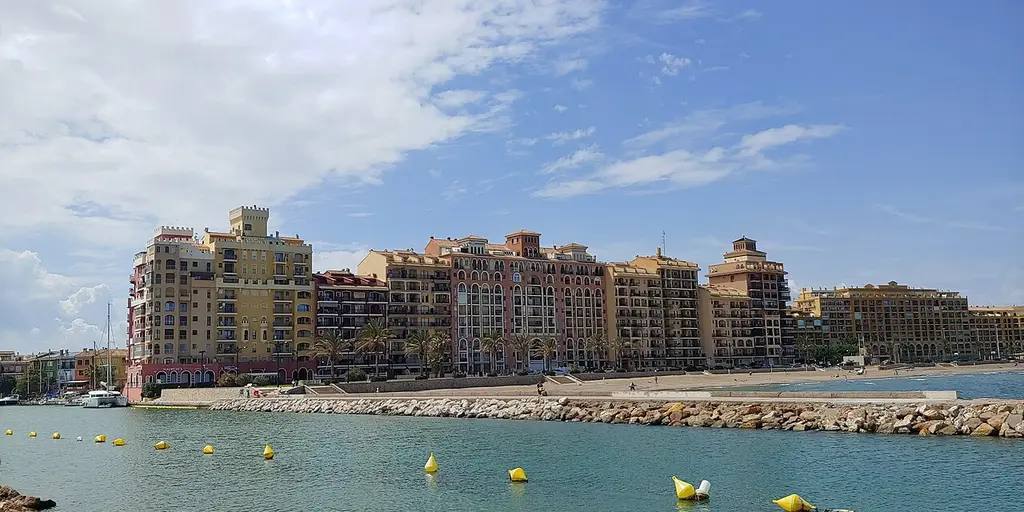
Photo: JaGa9480, CC BY-SA 4.0
Horchata, and what the protected origin actually covers
Alboraya is where orxata () comes from, and the claim is a real one rather than a tourist-board flourish. The fields around the town grow la chufa (), the tiger nut the drink is pressed from, and the horchaterías in the centre have been at it for generations.
Horchatería Daniel, on the road that is literally named Avinguda de l'Orxata, has been trading since 1949.
The protected designation is worth stating accurately, because it is routinely overstated. The DOP is Chufa de Valencia, and it protects the tuber, not the finished drink.
It covers a production zone of roughly 542 hectares (about 1,339 acres) spread across twenty-seven municipalities, Alboraya among them but also Almassera, Meliana, Godella, Paterna, Sagunto and the city of Valencia itself.
So Alboraya is the historic heart of the crop and the place the trade is identified with, and it is not the sole holder of the designation. The huerta itself is the thing to look at when you visit: irrigated market gardens running right up to the back of the apartment blocks, still worked, still fed by the medieval sequia network off the Turia.

Photo: Joanbanjo, CC BY-SA 4.0
Schools
The ayuntamiento lists three state primaries - CEIP Cervantes in the old centre, CEIP Ausias March, and CEIP Patacona out toward the beach - plus one state secondary, IES La Patacona on Avinguda Novelista Blasco Ibáñez.
Two concertados cover the full range: Colegi Parroquial Don José Lluch and Colegio Santa Maria, run by the Marianists.
There is no international school inside the municipality, and that is the gap families notice. Anything British, French or American means a commute out, which for most Alboraya addresses means a car rather than the metro because the schools sit on the other side of the city.
Budget the school run properly before you commit to a beach address.
For adult and vocational study the town is better served than its size suggests. There is a municipal adult school in the Canonigo Julia civic centre, and two private FP colleges, one of them teaching hospitality and cooking. Teaching in the state system is in Valencian and Spanish, as everywhere in the comarca.
Who Alboraya actually suits
It suits someone who wants the beach as a daily thing rather than a weekend outing, and who is willing to pay city prices for it. That is a narrower group than the town's reputation as a quiet suburb suggests.
If your reason for looking outside Valencia is cost, this is the wrong town and Godella or Betera answer that question better.
It suits families who want a smaller school system and a shorter walk to everything, provided no international school is on the requirement list. It suits anyone who works in the north of the city or at the university campuses, because both metro lines run that way.
It suits people who want a boat, which is a real and unusual thing to be able to say about a town this close to Valencia.
It suits you less if you want nightlife, a wide choice of restaurants, or the sense of being in a city. The centre closes early, and the answer on a Friday night is the metro back into Ruzafa. It also suits you less if you are buying to let, because the seafront stock is priced on summer demand.
The admin is Alboraya's, not Valencia's
This is the part that catches people, and it is the reason this guide is not filed with the city's barrio pages. Alboraya is a separate municipality, so your padrón () registration is done at the Alboraya ayuntamiento and not at a Valencia city office.
The certificate names Alboraya, which is what the school, the health centre and the traffic office will all go by.
Your IBI is set by Alboraya's own rate on its own calendar, your rubbish and water bills come from Alboraya, and your health centre is one of the four in the municipality rather than a Valencia city centro de salud.
None of it is harder than the city version. It is simply a different set of offices, and assuming otherwise costs you a wasted morning.
One thing does stay the same: the NIE and the residency paperwork are national, so where you live in the metropolitan area changes nothing about them. Our empadronamiento guide covers the registration itself, and the steps are identical whichever town hall holds your file.
Four things people get wrong about Alboraya
Assuming it is a Valencia neighbourhood
The beach is continuous and the metro is the same network, so it reads as a barrio. It is a separate municipality, and every piece of local admin follows from that.
Expecting a commuter discount
The rent index matches the city exactly and the sale index is above it. Alboraya is a lifestyle choice, not a cost-saving one.
Reading the municipal sale price
The municipal figure averages a modest old centre with a seafront that costs roughly double the city. Read the zone you are actually buying in.
Believing the horchata origin claim as usually told
The protected designation is Chufa de Valencia, it covers the tuber rather than the drink, and twenty-seven municipalities sit inside it. Alboraya is the heart of it, not the whole of it.
How to work out whether Alboraya fits
- 1
Walk from the address to the platform
The beach and the stations are not next to each other. Time the specific walk, at the hour you would really do it, before you take the flat.
- 2
Read the zone, not the town
Centro, Patacona and Port Saplaya are three separate markets. Pick the quarter first and price that one.
- 3
Check the school run on a map
No international school is in the municipality. If you need one, drive the route in the morning peak before you sign anything.
- 4
Ask what happens in August
Seafront stock moves to short lets in summer. Confirm the contract is a long let and that the landlord is not planning around the season.
- 5
Compare it honestly against the city
At the same rent you could live in the Cabanyal with the same beach. Be clear about what the extra quiet is buying you.

Resident in Valencia since 2016. Founder of BeTranslated. 25+ years in translation, interpretation and multilingual SEO.
Reviewed 6 September 2026 by Michael Bastin