

Living in Puçol
A blue flag sand beach, two Cercanías lines, the cheapest rent of any coastal town in this cluster, and a British school on the doorstep.
Puçol () is the coastal town people arrive at by accident and then keep coming back to. It has a sand beach, a wetland reserve, two commuter rail lines and a rent index a third below the city of Valencia.
It is a municipality of l'Horta Nord () about eighteen kilometres north of the city, with 21,659 residents on the 2025 padrón () and eighteen square kilometres of territory running from the Serra Calderona foothills down to the sea.
It has grown twelve per cent in eleven years, which is real growth without the pressure that number implies further south.
The town has three distinct pieces and they price very differently. The old core is inland and inexpensive, the beach strip is a sand seafront with a promenade, and Alfinach and Los Monasterios are a hillside urbanisation shared with Sagunt.
For an English-speaking family there is a fourth thing that usually decides it, and it is a school.
Puçol at a glance
The six figures that decide whether this town belongs on your list. Every one of them is sourced at the foot of the page.
Commute
Renfe Cercanías lines C-5 and C-6 both call here, in Cercanías fare zone 3. No metro station in the municipality.
Rent
The rent index reads a third below the city of Valencia. That is the cheapest of any coastal town in this cluster.
Buy
The municipal figure is well under the city, but the beach and the hillside urbanisation each cost well over half again as much as the core.
Beach
Sand since the 2004 regeneration, roughly two kilometres of promenade, blue flag, and the Marjal dels Moros wetland immediately south.
Schools
State provision in the town plus Caxton College, a British school running the England curriculum from age one to eighteen.
Population
21,659 residents on the 2025 padrón, up about twelve per cent since 2014.
Two Cercanías lines, and no metro at all
Puçol has one railway station served by two Cercanías lines. The C-6 connects the town with Valencia Nord and continues north towards Castelló, while the C-5 runs between Valencia and Caudiel via Sagunt. Having two lines gives residents more options for travelling towards Valencia.
What Puçol does not have is Metrovalencia. Cercanías trains run to a fixed timetable rather than every few minutes, so commuting requires a little more planning. The advantage is that trains run directly to Valencia Nord, right in the city centre.
The station is in the town itself, so it is particularly convenient if you live nearby. From Puçol beach or the Alfinach area, however, you will normally need another form of transport to reach it.
By road, Valencia is easily accessible via the V-21. If you regularly drive into the city, it is also worth checking Valencia's low emission zone rules.
Renting: a third below the city, and falling
Fotocasa's rent index puts Puçol at 12 EUR/m² in September 2026, 1.8 per cent up against a year earlier. The city of Valencia reads 18 EUR/m² on the same index in the same month.
That is the widest rent gap of any coastal town in this cluster, and it is the reason to look here at all.
The zone detail is thinner than the sale detail and should be read with care. Fotocasa's beach zone reports a euro above the municipality and the Alfinach zone reports level with it, while the town-centre zone was last published in July 2026 rather than the current month.
A stale row is not a wrong row, but it is not this month's market either, so the municipal figure is the one to plan against.
On 12 EUR/m², a ninety square metre flat works out around 1,080 EUR a month before bills, community charges and the IBI. As on every coast in this province the long-let stock thins out near the sand because summer pays better, so a family signing for a school year usually looks inland.
Buying: a cheap core with two expensive edges
Fotocasa's sale index reads 1,993 EUR per square metre for the municipality in September 2026, against 3,355 EUR for the city of Valencia in the same month. That is around 59 per cent of the city, and on the face of it that makes Puçol look like the bargain of this cluster.
The zones underneath tell a more useful story.
Playas de Puçol reads 3,319 EUR per square metre and Alfinach with Los Monasterios reads 3,155 EUR. The town-centre zone last published at 1,715 EUR, in July 2026 rather than the current month, and it is the volume of that cheap core that pulls the municipal average down.
So the headline figure is an average of one large inexpensive market and two small expensive ones.
In practice that means the decision is which Puçol you are buying into, not whether Puçol is cheap. The core genuinely is. The seafront and the hillside are priced close to the city of Valencia and should be compared against city stock, not against the town average.

Photo: 19Tarrestnom65, CC BY-SA 4.0
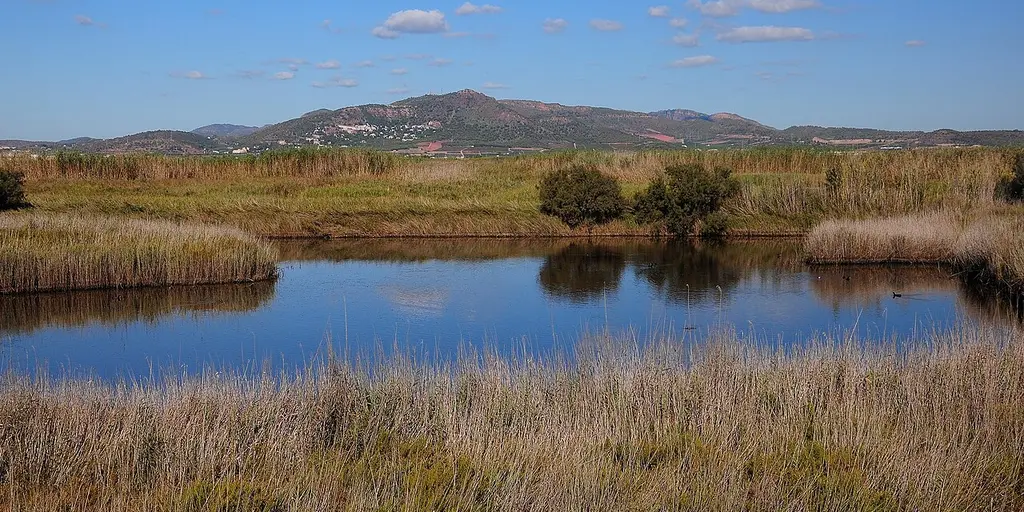
The beach, and the wetland behind it
Puçol's beach is sand. It was stone until a regeneration in 2004 replaced it, and it now runs to roughly two kilometres of promenade with blue flag certification and a permanent resident population of its own.
That is a straightforwardly different product from the shingle at El Puig a few kilometres south. For people comparing Puçol with El Puig, the sandy beach can be an important difference.
Immediately to the south sits the Marjal dels Moros, a coastal marsh with special protection area status for birds. It is one of the last surviving wetlands on this stretch of coast and it puts a hard limit on how much more the seafront can be built out.
For a buyer that is a genuine amenity: the view behind you is not going to become another urbanisation.
The trade-off is the usual one. The beach settlement is a drive from the station and from the old town, its shops and services thin out sharply between October and May, and much of the housing around you is used for part of the year rather than all of it.
Decide whether you want to live in a seasonal place in February before you fall for it in July.
Schools, and the one that changes the calculation
Puçol has the usual state provision for a town of twenty thousand, infant through secondary, taught in Valencian and Spanish. The Generalitat's centre directory is the authoritative list, and the ajuntament () publishes the local detail.
What sets the town apart is not the state system.
Caxton College is here: a private British school founded in 1987, teaching the National Curriculum for England from age one through to eighteen, with pupils from more than thirty nationalities.
For a relocating family that changes the arithmetic completely. Most towns in this cluster mean a commute out to an international school somewhere else in the metropolitan area. For some international families, having Caxton College nearby can be a major reason to consider Puçol.
It also pulls in families from the surrounding towns, which is worth knowing when you look at the local rental market: some of the demand for family-sized long lets here is school demand rather than commuter demand. Our guide to international schools in Valencia sets it beside the alternatives.
Who Puçol actually suits
It suits a family that wants a British education and does not want to spend an hour a day delivering a child to it. That is a narrow requirement, and Puçol answers it better than anywhere else on this coast.
It suits anyone who wants a sand beach at a rent a third below the city and is willing to live to a train timetable to get it.
It suits people who work north, in Sagunt or toward Castelló, because two lines run that way as easily as they run into Valencia. It suits a household with a car and a preference for space, because the hillside urbanisations offer plot sizes the city cannot.
It suits birdwatchers, which is not a sentence you can write about many commuter towns. It suits walkers too: the Beselga to Garbí loop from Estivella starts a short drive inland, past Sagunt.
It suits you less if you want turn-up-and-go transport, or an evening out that does not end with a timetable. It suits you less if you would be buying at the beach or in Alfinach purely on price, because neither is cheap. And a seafront address in a town this seasonal is a different life in January from the one you looked at in August.
Photo: Coentor, CC BY-SA 3.0
The admin is Puçol's own
Puçol is its own municipality, so your padrón () registration is done at the ajuntament here rather than at a Valencia city office, and the certificate names Puçol.
Your IBI rate, your refuse and water bills and your health centre all follow from that, and none of it is harder than the city version. It is simply a different set of counters.
Two naming details save time. The municipality is Puçol in Valencian and Puzol in Castilian, and public databases, portals and postal systems use both, so search for the one that fails you.
Alfinach and Los Monasterios straddle the boundary with Sagunt, so a hillside address may sit in either municipality and that decides which town hall holds your file. Check the boundary on the cadastre before you assume.
The NIE and residency paperwork are national and unaffected by which town you live in. Our empadronamiento guide covers the registration itself; the steps are identical whichever ajuntament holds your file.
What to know before moving to Puçol
Expecting a metro
There is none. Puçol is a Cercanías town on lines C-5 and C-6, with a printed timetable and a zone 3 fare. Plan around departures, not frequencies.
Reading the municipal sale price
The average is dragged down by a large, inexpensive old core. The beach and Alfinach both cost well over half again as much.
Judging the beach settlement in August
A good part of the seafront stock is seasonal, and the shops follow the season. See it in February before you commit to a year there.
Assuming Alfinach is entirely in Puçol
The urbanisation straddles the Sagunt boundary. Which municipality your plot sits in decides your town hall, your IBI and your padrón.
How to work out whether Puçol fits
- 1
Decide which of the three Puçols you mean
For someone choosing where to live, Puçol can be thought of as three very different residential areas: the town, the beach and the hillside urbanisations.
- 2
Read the C-5 and C-6 timetables
Check the departures at the hours you would really travel, both ways, including Sunday night. That is the commute, not the map.
- 3
Visit the school if it is the reason
If Caxton is why you are looking here, get on the waiting list and confirm a place before you sign a lease. The school is the constraint, not the flat.
- 4
Walk the beach out of season
The promenade in February tells you far more about living there than the promenade in July does.
- 5
Compare it against the metro coast
Alboraya has two metro lines and city rents. Puçol has a timetable and rents a third lower. Be honest about which trade you want.

Resident in Valencia since 2016. Founder of BeTranslated. 25+ years in translation, interpretation and multilingual SEO.
Reviewed 6 September 2026 by Michael Bastin