

Photo: Joanbanjo, CC BY-SA 3.0
Living in Tavernes Blanques
Three quarters of a square kilometre, no station of its own, rents within two euros of the city, and the town where Mercadona and Lladro both started.
Tavernes Blanques () occupies 0.74 square kilometres, which makes it one of the smallest municipal terms in Spain. The boundary with the city of Valencia is a street rather than a stretch of open country, and you can walk out of the city and into another municipality without noticing.
It is a municipality of l'Horta Nord () with 9,824 residents on the 2025 padrón (), which on that footprint gives it a population density well above most of the city of Valencia's own districts.
It borders Valencia, Almassera, Alboraya and Bonrepos i Mirambell, and the barranc () del Carraixet marks its northern edge.
Two Valencian companies were born here. Mercadona was founded in Tavernes Blanques in 1977 and kept its headquarters in the town until 2025, and Lladro still has its porcelain factory and museum here.
For a town of this size that is an unusual industrial history, and it is a large part of why a place with no station of its own is not a backwater.
Tavernes Blanques at a glance
The six figures that decide whether this town belongs on your list. Every one of them is sourced at the foot of the page.
Commute
No Metrovalencia station in the municipality. EMT and MetroBus serve the town, and the nearest platforms are a walk into Valencia city.
Rent
The rent index reads within two euros of the city of Valencia. Being contiguous with the city is priced accordingly.
Buy
The sale index is about two thirds of the city. Renting here costs almost the same as the city; buying does not.
Size
0.74 square kilometres, one of the smallest municipal terms in Spain, with roughly ten thousand residents inside it.
Industry
Mercadona was founded here in 1977 and Lladro's porcelain factory and museum are still in the town.
Population
9,824 residents on the 2025 padrón, up about six per cent since 2014 after a decade of decline before that.
No station of its own, and what that actually means
Tavernes Blanques has no Metrovalencia station inside its municipal term. That sounds like a serious defect for a town in the metropolitan area and it is much less of one than it sounds, because of where the town sits.
The nearest platforms are Machado, on lines 3 and 9, which is roughly a kilometre and a fifteen minute walk from the town, and Tossal del Rei, the terminus of the line 6 tram, which sits in the Torrefiel barrio of Valencia just over the boundary.
Both of those stations are in the city of Valencia, not in Tavernes Blanques, and both are in fare zone A. That is the compensation for having no station: a walk of ten to twenty minutes gets you onto the network at the cheapest zone there is, which is not true of any other town in this cluster.
Walk the specific route from the specific address before you commit, because fifteen minutes is a different proposition in July from what it is in March.
Day to day the town is served by bus. EMT, Valencia's own city operator, runs into Tavernes Blanques, which is unusual: EMT serves the city and only a handful of adjoining municipalities, and being one of them is a direct consequence of the contiguity.
MetroBus routes connect the town northward through l'Horta Nord. Between the two, the bus rather than the tram is what most residents actually use for short trips.
By car it is minutes into the city, and that is exactly the problem: Valencia's low emission zone rules begin essentially at the end of the street, and parking on the city side is what parking in a city is.
A household here can realistically manage without a car, which is not something you can say about most of the towns in this cluster.
Renting: city prices, without the city
Fotocasa's rent index puts Tavernes Blanques at 16 EUR/m² in September 2026, 12.9 per cent up against a year earlier. The city of Valencia reads 18 EUR/m² on the same index in the same month.
That is within two euros. Moving here buys you almost nothing on rent, and anyone shortlisting it as a cheaper alternative to the city should stop and reread that sentence.
The reason is not mysterious. The town is physically continuous with Valencia, walkable to a zone A platform, and it has only three quarters of a square kilometre of land on which to build anything.
A fixed and very small supply beside a large city produces city prices, and there is no cheaper corner of the municipality because there is barely a corner at all. Fotocasa publishes no zone breakdown here, and for once that is a fair reflection of the place. One caution: its row for Tavernes Blanques is identical, to the decimal, to its rows for Serra and Rafelbunyol, so read the figure as a thin shared sample.
On 16 EUR/m², a ninety square metre flat works out around 1,440 EUR a month before bills, community charges and the IBI. What you are paying for is proximity and a smaller-scale civic life, not a discount.
Buying: two thirds of the city, which is the real gap
Fotocasa's sale index reads 2,134 EUR per square metre for Tavernes Blanques in September 2026, against 3,355 EUR for the city of Valencia in the same month. That is about 64 per cent of the city.
So the rent gap is almost nothing and the purchase gap is about a third. That asymmetry is the most useful fact on this page.
For a household that intends to buy, it makes Tavernes Blanques worth a serious look: broadly city living, with a city walk to a zone A platform, at two thirds of the price per square metre. For a household that intends to rent, it makes it hard to justify against simply living in the city.
The stock is mostly mid-century and later apartment blocks rather than period housing, which is part of why the price is where it is.
The constraint on the upside is the same as the constraint on supply: there is nowhere to build. Anything new here is a replacement rather than an addition, so do not expect the sort of new-build choice that Paterna or Torrent can offer.
Mercadona, Lladro, and a company town that stopped being one
Mercadona was founded in Tavernes Blanques in 1977 and had its headquarters in the town for most of its history. That changed in March 2025, when the company moved its registered office to a new corporate campus in Albalat dels Sorells, a few kilometres north, built over three phases at a cost of around two hundred million euros.
Anyone reading older material about the town will see the headquarters described as still being here. It is not.
Lladro remains. The porcelain company's factory and its museum are in the town, behind a wall that announces it as the Ciudad de la Porcelana, and it is the industrial presence you actually notice on the ground.
Before either company, the town's trade was meat: pig and cattle fattening, slaughterhouses and butchers, which is where the older buildings and the older street pattern come from.
The practical effect of that history is a town with more employment inside its own boundary than a place of ten thousand people would normally have, and a services sector sized for workers rather than only for residents.
It also explains the built form: this is not a village that grew, it is a small industrial town that filled up.

Photo: Francesc Fort, CC BY-SA 4.0
Schools
For a municipality this small the state provision is what you would expect: infant and primary schooling and a secondary school inside the town, taught in Valencian and Spanish. The Generalitat's centre directory is the authoritative list and the ajuntament () publishes the local detail.
With a term of 0.74 square kilometres every school in the municipality is within walking distance of every address in it, which is a real advantage.
Tavernes Blanques does have an international school inside its own boundary: Valencia Montessori School on Avinguda del Rei en Jaume, an American curriculum school recognised by NEASC and accredited by the regional education authority, teaching an AMI Montessori programme from eighteen months through the early teens. In a municipality this compact, every address is within walking distance of it.
Beyond that one school, the same thing that compensates for the missing metro station applies to wider choice too: the city is across the road, and the rest of Valencia's international provision is a bus ride or a short drive away rather than a commute. Our guide to international schools in Valencia covers the field.
If you plan to use the state system, note that admission and zoning run on the municipality, so a Tavernes Blanques address puts you in the Tavernes Blanques catchment rather than in a Valencia city one even though the schools may be closer together than two city schools would be. Our state school guide explains how that works.
Who Tavernes Blanques actually suits
It suits a buyer rather than a renter. At two thirds of the city's price per square metre with a fifteen minute walk to a zone A platform, the purchase case is strong and the rental case is weak.
It suits someone who wants to live essentially in the city while belonging to a small town, with a town hall that answers the phone and a market where people know each other.
It suits a household without a car, or with one car rather than two. It suits people who work in the north of the city, at the university campuses or around Sant Miquel dels Reis.
It suits anyone who values being able to walk everywhere in their own municipality, which here is not a figure of speech.
It suits you less if you want space, a garden or a view, because the town is dense and flat and small. It suits you less if you want new-build choice, because there is nowhere to put it.
And if the reason you are looking outside Valencia is to spend less on rent, this is the wrong town and Moncada or Picassent answer that question far better.

Photo: Coentor, CC BY-SA 3.0
A street is a border
The thing to internalise about Tavernes Blanques is that a boundary you cannot see is still a boundary. Your padrón () registration happens at the Tavernes Blanques ajuntament, not at the Valencia city office a few minutes' walk away, and the certificate names Tavernes Blanques.
Your IBI rate is set here, your refuse and water bills come from here, and your health centre is assigned from here.
This catches people more often than it does in the towns further out, precisely because the change is invisible on the ground. A neighbour two hundred metres away may be registered in Valencia and be dealing with an entirely different set of offices and deadlines.
When a form, a utility or a delivery company asks for your municipality, the answer is Tavernes Blanques even when the postcode looks like the city's.
The upside of a small town hall is access: appointments are easier to get than in a city of eight hundred thousand and the counter staff are dealing with ten thousand people rather than ninety thousand.
The NIE and residency paperwork are national. Our empadronamiento guide covers the registration itself.
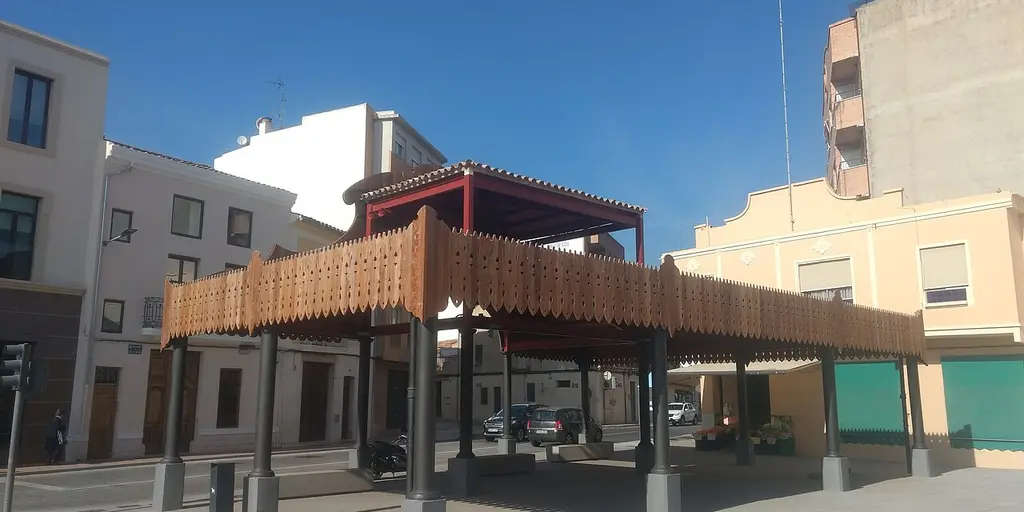
Photo: Francesc Fort, CC BY-SA 4.0
Four things people get wrong about Tavernes Blanques
Expecting it to be cheaper than the city
On rent it is not: the index reads within two euros of Valencia. The real gap is on purchase, where it runs at about two thirds of the city.
Assuming it has a metro station
It has none. Machado on lines 3 and 9 and the line 6 tram terminus at Tossal del Rei are both in the city, ten to twenty minutes away on foot.
Thinking Mercadona is still headquartered here
The company was founded here in 1977 but moved its registered office to Albalat dels Sorells in March 2025. Lladro is the industrial presence that remains.
Treating it as part of Valencia
The boundary is a street and it is invisible, but it is real. Padrón, IBI, refuse, water and school catchment all run through the Tavernes Blanques town hall.
How to work out whether Tavernes Blanques fits
- 1
Decide whether you are buying or renting
The two answers here are different. Buying at two thirds of the city is a strong case; renting at parity with the city is a weak one.
- 2
Walk to Machado and to Tossal del Rei
Both, from the specific address, at the hour you would really do it. The station walk is the whole transport question in this town.
- 3
Check which side of the boundary the address is on
It is not visible on the ground. The cadastre or the padrón office will tell you, and it decides your town hall, your IBI and your school catchment.
- 4
Look at the building, not the town
The stock is mostly mid-century apartment blocks. Condition, lift and community charges vary far more than location does in a municipality this small.
- 5
Compare it honestly against a city flat
At the same rent you could live in Alboraya with a beach or in the city with everything. Be clear what the smaller scale is buying you.

Resident in Valencia since 2016. Founder of BeTranslated. 25+ years in translation, interpretation and multilingual SEO.
Reviewed 6 September 2026 by Michael Bastin