

Photo: Joanbanjo, CC BY-SA 3.0
Living in El Puig de Santa Maria
A Cercanías town rather than a metro one, a monastery Jaume I founded, and a beach of sand and gravel two kilometres from the centre.
El Puig de Santa Maria () is the first town on this list that the metro does not reach. Its station is on the Renfe Cercanías network, not Metrovalencia, and that single fact changes the commute, the ticket and the walk at the far end.
It is a municipality of l'Horta Nord () about eighteen kilometres north of the city, with 9,490 residents on the 2025 padrón (). That makes it the smallest of the northern coastal towns in this cluster.
It grew about seven per cent in eleven years, which is steady rather than dramatic.
Two things define it. The fortified monastery on the hill above the town is one of the founding sites of the Kingdom of Valencia, and it still dominates the skyline.
The other is the split between the old town, which is inland and cheap, and Platja del Puig, which is a separate strip of nine urbanisations by the sea and costs nearly double.
El Puig at a glance
The six figures that decide whether this town belongs on your list. Every one of them is sourced at the foot of the page.
Commute
Renfe Cercanías line C-6, not the metro. The station is a few hundred metres from the old centre and sits in Cercanías fare zone 3.
Rent
The rent index reads below the city of Valencia but above most of the Camp de Turia towns. Both published zones report the same figure.
Buy
The old town and the beach are two different markets. The seafront costs close to double the core, and above the city average.
Beach
Platja del Puig mixes fine sand with stretches of gravel, backed by nine urbanisations and about a kilometre of promenade. Mostly summer homes.
Schools
State infant, primary and secondary provision inside the municipality, plus one international option: the Waldorf-curriculum International Waldorf School Valencia.
Population
9,490 residents on the 2025 padrón, up about seven per cent since 2014. The smallest municipality in this batch of guides.
Cercanías, not the metro, and why that matters
El Puig is served by Renfe Cercanías line C-6, which runs from Valencia Nord through Cabanyal and up the coast to Castello. Practically every C-6 service calls here, and a handful of Media Distancia trains on the Valencia to Tortosa run stop as well.
That is a different transport product from the metro, and it is worth being precise about the difference before you sign a lease.
A Cercanías line runs to a printed timetable rather than a turn-up-and-go frequency, so a missed train costs you real time rather than five minutes. It is also a different operator, with its own station buildings and its own service alerts.
What you gain is speed: the line is a main-line railway with few stops, so the run into Valencia Nord is quick and it lands you at the city's central station rather than at a suburban platform.
Ticketing is integrated. Cercanías sits inside the ATMV zonal system alongside Metrovalencia, EMT and MetroBus, so one SUMA title covers a journey that mixes them. El Puig station is in Cercanías fare zone 3, which is further out than the metro towns in this cluster and therefore costs more per trip.
Check the current zonal table before you budget: the fares are reset periodically and a temporary national discount has applied in recent years.
The station sits a few hundred metres from the old town, which is a genuinely short walk. Platja del Puig is not: the beach urbanisations are a couple of kilometres east across the CV-300 and the motorway, so a beach address here means driving or cycling to the train.
By road it is the V-21 and then the A-7, and the city's low emission zone rules apply once you cross into Valencia.
Renting: below the city, above the inland towns
Fotocasa's rent index puts El Puig at 16 EUR/m² in September 2026, 25 per cent up against a year earlier. The city of Valencia reads 18 EUR/m² on the same index in the same month.
So the town is cheaper than Valencia, but it is not cheap in the way the Camp de Turia villages are. It sits in the middle of this cluster.
Fotocasa publishes two zones inside the municipality, the old town and Platja del Puig, and both report the same figure as the municipality itself. Their month-on-month and year-on-year movements differ slightly, so the two are not literally the same market, but the rounded rent is identical.
Treat the municipal number as the only rent figure here with any weight, and do not expect the beach to rent at a premium the way it sells at one.
On 16 EUR/m², a ninety square metre flat works out around 1,440 EUR a month before bills, community charges and the IBI. Long lets at the beach are thin because the stock there is built and priced around summer, so a family looking for a school year usually ends up in the old town.
Buying: the beach costs nearly double the town
Fotocasa's sale index reads 3,311 EUR per square metre for the municipality in September 2026. The city of Valencia reads 3,355 EUR on the same index in the same month.
That municipal figure is close to useless on its own, because the two halves of El Puig are further apart than almost anywhere in this cluster.
The old town reads 2,124 EUR per square metre. Platja del Puig reads 3,789 EUR, which is around 178 per cent of the core and above the city of Valencia itself.
A 1970s flat behind the monastery and a sea-facing apartment on the promenade are not competing for the same buyer, and averaging them produces a number that describes neither.
Decide which half of the town you want first, then read that zone's figure and ignore the headline. If the answer is the beach, budget as though you were buying in the city, because on this index you are.

Photo: Tuquequeviajero, CC BY-SA 3.0
The monastery, and why the town is called Santa Maria
The Reial Monestir de Santa Maria del Puig sits on the rise above the old town, and it is not a village church. Jaume I founded it in 1238 after the battle fought here the previous year, the engagement that opened the road to Valencia, and Roger de Lluria began the larger complex in 1300.
What you see now is a fortified Renaissance block with square corner towers, visible from the motorway and from the train.
Inside it houses the Museu de la Impremta i de les Arts Grafiques, the printing and graphic arts museum, which is the foremost collection of its kind in Spain and is often described as the second in Europe after Mainz.
It is a genuine reason to walk up the hill rather than a plaque on a wall, and it is five minutes from the station.
The rest of the historic fabric is scattered rather than concentrated: the Castell de Jaume I on the neighbouring hill, the Cartoixa d'Ara Christi out toward the fields, a watchtower, and a run of Civil War fortifications that survive because nobody ever needed the land.
The Via Xurra cycle route runs through the municipality and connects it to the city along the old railway alignment.
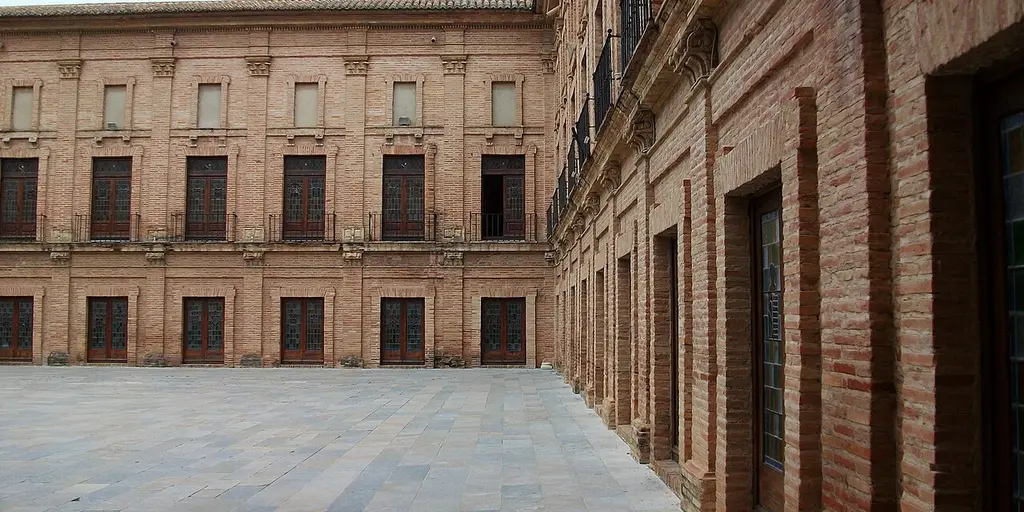
Photo: Joanbanjo, CC BY-SA 3.0
The beach is a separate place from the town
The beach is about two kilometres east of the old town, on the far side of the CV-300 and the motorway, and it functions as its own settlement rather than as a quarter of El Puig. Nine urbanisations sit behind roughly a kilometre of promenade.
Most of the stock was built as summer housing and a good part of it is still used that way, which is what thins out the long-let market.
Platja del Puig is not the Malva-rosa. The Generalitat's own beach listing gives it as fine sand with stretches of gravel, so the surface changes as you walk it, and groynes break the run of the shore rather than leaving one long open sweep.
That is a matter of taste rather than a defect, and it keeps the beach quieter than the city's. Walk the specific stretch nearest the address you are considering, because it is not uniform along its length.
The practical consequence of the split is that a beach address here is a car address. No station, no frequent bus, and a walk to the train that nobody does twice.
If you want a coastal town where the station and the beach are close together, Puçol north of here is the closer fit, and Alboraya is the one where the metro reaches.
Schools
For a municipality of under ten thousand people, El Puig is adequately covered in the state system: infant and primary provision in the old town plus secondary schooling, all taught in Valencian and Spanish as everywhere in the comarca ().
The Generalitat's own centre directory is the list to check against, because a small town's provision changes with its cohort sizes.
El Puig does have an international school: the International Waldorf School Valencia, NEASC-accredited and Generalitat-authorised, on Camino Cebolla in the old town. It teaches a Waldorf-Steiner curriculum for ages three to sixteen, roughly half of it in English, on a small campus of around 170 pupils.
That is a specific pedagogy rather than a British or American curriculum, so if that is what you need, the nearest option in this part of l'Horta Nord is in Puçol, about ten kilometres north, which is a short drive but not a walk or a train ride.
Our guide to international schools in Valencia covers the wider options, and the state system guide explains how admission works if you plan to use the local schools.

Photo: Juan Emilio Prades Bel, CC BY 4.0
Who El Puig actually suits
It suits someone who wants a small, complete town with a real centre and a fast main-line train, and who is content to live to a timetable. The commute is quick when you catch it and slow when you do not.
It suits a household that wants a beach without paying city prices for the flat behind it, provided the old town rather than the promenade is where you end up.
It suits anyone drawn to the history, which here is unusually concentrated for a town this size. It also suits people who work north of the city or toward Sagunt, because the railway runs that way as readily as it runs into Valencia.
It suits cyclists: the Via Xurra makes the run into the city a flat, traffic-free hour. And it suits walkers: the Beselga to Garbí loop from Estivella is a short drive north-west, past Sagunt.
It suits you less if you need turn-up-and-go transport, if you want a beach flat you can walk to a platform from, or if you need a British or American curriculum rather than the town's own Waldorf school. It also suits you less if you want evening life beyond a handful of bars, because at that point the honest answer is the train back into the city.
The admin is El Puig's own
El Puig is a separate municipality, so your padrón () registration happens at the ajuntament () here and not at a Valencia city office. The certificate names El Puig de Santa Maria, and that is the name the school, the health centre and the traffic office will work from.
Your IBI is set at El Puig's rate on El Puig's calendar, and your water and refuse bills come from here.
One quirk worth knowing before you fill in a form: the municipality is officially El Puig de Santa Maria, and older documents, portals and even some public bodies still write it simply as El Puig or as the Castilian El Puig de Santa Maria.
Use the full official name on anything that matters, and do not be surprised when a database disagrees with itself.
The NIE and the residency paperwork are national, so which town hall holds your padrón file changes nothing about them. Our empadronamiento guide covers the registration itself and the steps are the same in every ajuntament.
Four things people get wrong about El Puig
Assuming the metro reaches it
It does not. El Puig is a Renfe Cercanías town on line C-6, with a printed timetable and its own fare zone. The nearest metro terminus is in a different municipality.
Reading the municipal sale price
The average covers an inland old town and a seafront that costs close to double it. Price the half of the town you actually want.
Expecting the Malva-rosa
Platja del Puig is clean and quiet and it is not the city's beach: fine sand in places, gravel in others, and groynes throughout. Walk it before you commit to a beach address.
Treating the beach as walkable from the station
The urbanisations are a couple of kilometres east across a motorway. A beach address here needs a car, whatever the map suggests.
How to work out whether El Puig fits
- 1
Read the real timetable, not the frequency
Look up the C-6 departures at the hours you would actually travel, including Sunday evening. A timetabled line is a different daily rhythm from a metro.
- 2
Pick the town or the beach, then price it
They are two markets with almost double the gap between them. The municipal average describes neither one.
- 3
Walk the beach
The surface changes along the beach and suits some people and not others. Twenty minutes on the promenade settles the question faster than any listing photograph.
- 4
Check the school run on a map
The town's own international school is a Waldorf-curriculum one; if you need a British or American curriculum instead, drive the Puçol route at eight in the morning before you sign anything.
- 5

Resident in Valencia since 2016. Founder of BeTranslated. 25+ years in translation, interpretation and multilingual SEO.
Reviewed 6 September 2026 by Michael Bastin