
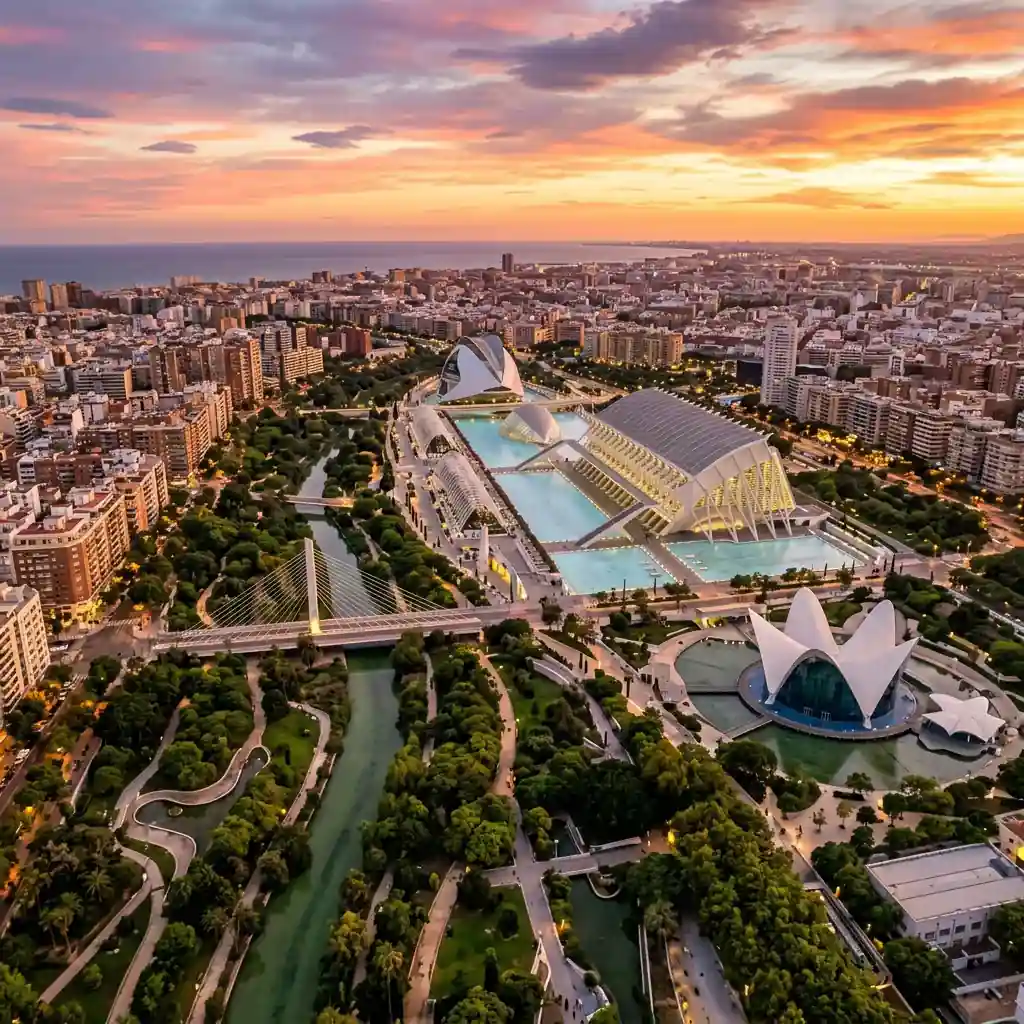
Photo: Diego Delso, CC BY-SA 3.0
Vilafamés Day Trip from Valencia: Red-Rock Village, Castle and Contemporary Art Museum
A village built on a slab of red Triassic sandstone, a castle whose round tower is one of the few pieces of Carlist architecture in the Valencian Community, and a contemporary art museum of some seven hundred works inside a fifteenth-century Gothic palace.
A red sandstone village in Castellon province, an hour and a quarter north
Vilafamés is in Castellon province, in the Plana Alta, and the Generalitat's own heritage decree describes it as founded on a slab of rodeno on top of a mass 350 metres high. Rodeno is Triassic red sandstone, and it is the reason the village looks the way it does: the bedrock, the church and much of the older building stone are all the same warm red.
The whole village was declared a historic-artistic complex in 2005, by Decreto 80/2005 of 22 April, which calls it one of the most important such complexes in the Valencian Community for its beauty and its state of preservation. It is also a member of the Pueblos mas Bonitos de Espana association. The 1971 declaration date that circulates online is wrong; the file was opened in 1981 and the declaration came in 2005.
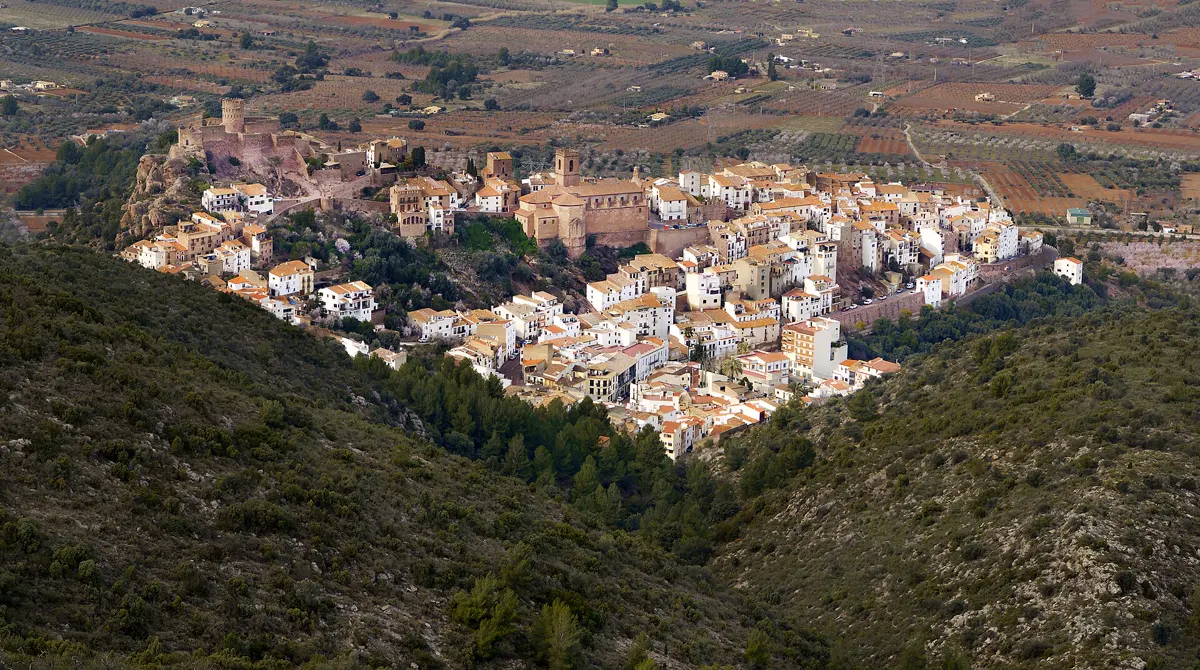
Photo: Pedro José Ponce Asensio, CC BY-SA 4.0
What to see in Vilafamés in a day
La Roca Grossa, the balancing rock above the street
A great mass of rodeno resting in unstable equilibrium on sloping ground, halfway up the climb into the old town, and listed as a Bien de Relevancia Local in the 2005 decree. Note that you can no longer climb on it: after loose rock came away under visitors, the town hall roped it off with posts and cord, so you photograph it from beside rather than from on top.
The castle, and its unusual nineteenth-century tower
The site is Andalusi in origin, known in the documents as Beni-Hamez, and was taken by Jaume I in 1233; the oldest surviving fabric dates from 1375, when the Order of Montesa had the defences rebuilt. Its present shape comes from the Carlist wars, and the town hall notes that the circular central tower is one of very few examples of Carlist architecture in the Valencian Community.
MACVAC, in the fifteenth-century Palau del Batlle
The Museu d'Art Contemporani Vicente Aguilera Cerni was created in 1969 and installed in its present home in 1972, making it the first contemporary art museum in Valencian territory. It holds nearly seven hundred works, every one of them donated or commissioned from the artists rather than bought, inside a Valencian civil Gothic palace built directly onto the natural rodeno.
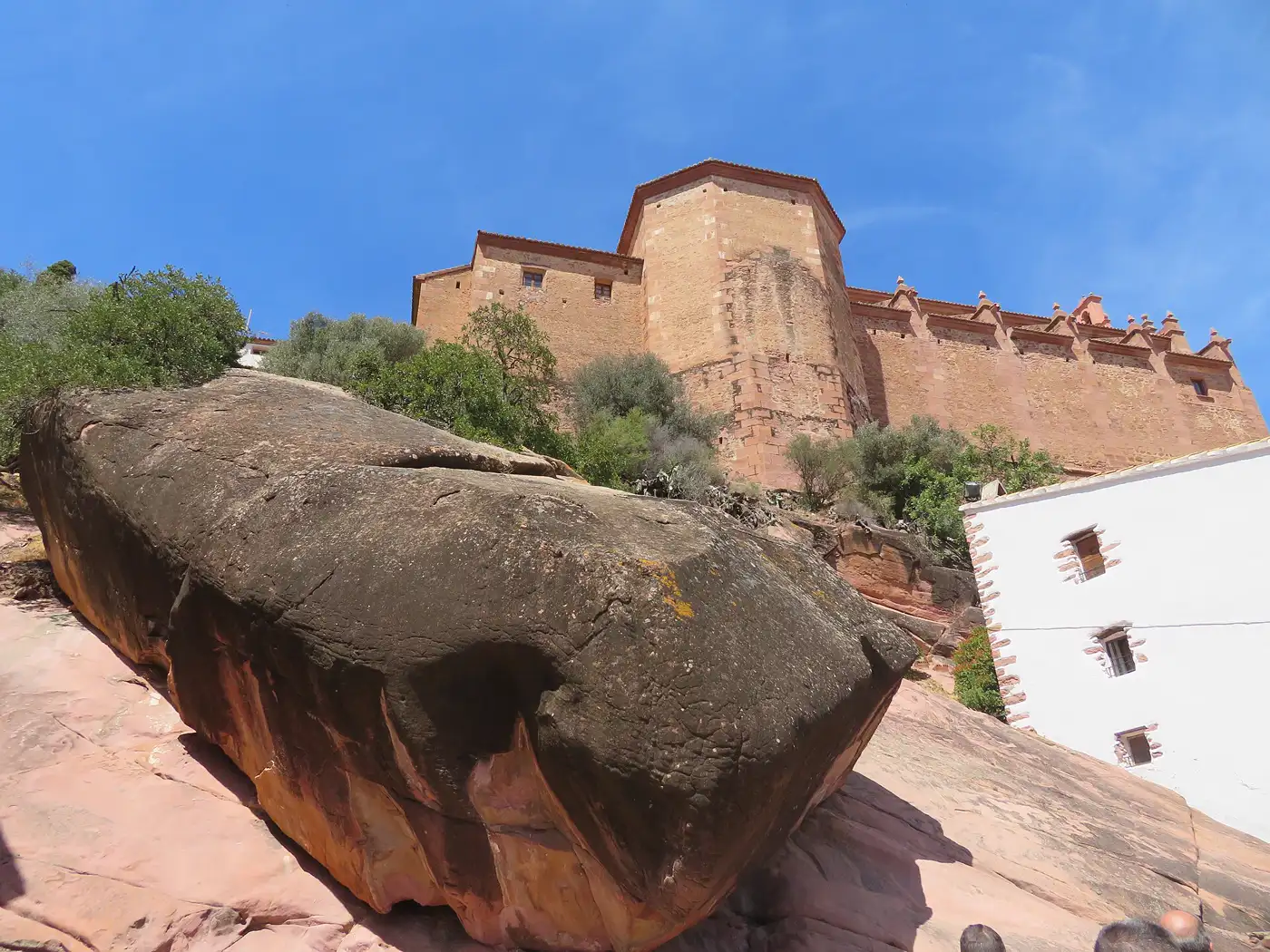
Photo: Juan Emilio Prades Bel, CC BY-SA 4.0
Driving to Vilafamés, parking below the village and walking up
The route MACVAC publishes is the A-7 or AP-7 north, then the CV-10, leaving for Vilafamés on the CV-15 and then the CV-160. Two official sources give different exit numbers for the CV-10, so follow the signs rather than a number. There is no railway station and no direct bus from Valencia: the only regular service is the Castellon to Vilafamés rural line, which means a public-transport day trip would be a train to Castelló and then a country bus, so in practice this one needs a car.
Parking is in the lower part of the village, signposted, and the museum's own directions assume you walk up from there; there is no car park at the top. That walk is the thing to know before you go, because the streets are steep and cobbled and the castle is reached by a flight of steps, which puts it out of reach for wheelchairs and prams even though the lower town is manageable. The museum's own hours page gives Tuesday to Sunday, 10:00 to 14:00 and 16:00 to 18:30, closed Mondays, with an 11:00 to 14:00 morning-only schedule during the August fiesta week.
Official sources
- BOE, Decreto 80/2005 declaring Vilafamés a historic-artistic complex, with the rodeno description and the listed buildings
- MACVAC, the museum's own opening hours and admission prices
- Ajuntament de Vilafamés, on the castle's Andalusi origin, the 1233 conquest and the Carlist tower
- Ajuntament de Vilafamés, on the works protecting La Roca Grossa from being climbed
Vilafamés day trip FAQ
How do you get to Vilafamés from Valencia?
Can you climb La Roca Grossa?
What are MACVAC's opening hours and how much is it?
Is Vilafamés suitable for someone with limited mobility?
Is it Vilafamés or Villafamés?
Is there prehistoric rock art at Vilafamés?
Curious about inland Castellon?
Villages like this one are an hour and a bit from the city and a different world from the metropolitan belt. If you are working out how far inland you would actually want to live, a free consultation can help you weigh it up.
Book a free consultationOther day trips
Morella
A walled medieval town at a thousand metres, further north in the same province.
Coves de Sant Josep
An underground river you cross by boat, on the way up into Castellon province.
Sagunto
A Roman theatre and a kilometre of castle walls, free to enter, half an hour north.

Resident in Valencia since 2016. Founder of BeTranslated. 25+ years in translation, interpretation and multilingual SEO.
Reviewed 14 September 2026 by Michael Bastin