
Valencia is not Tarifa, and pretending otherwise is how visitors end up with a fine. What this coast does have is warm, shallow, forgiving water, an afternoon thermal that fills in on most summer days, and one properly buoyed kite channel within half an hour of the city centre.
The catch is that much of what is written about kitesurfing here is wrong, including about the spot most often recommended. This guide covers the wind, where you may actually launch, the gear that suits the conditions and where to learn.
For what each beach is like to simply swim and sunbathe on, our Valencia beaches guide covers that ground instead.
The winds, and the one you should not ride
The wind that makes Valencia work in summer is the Garbí (), the afternoon sea breeze Valencians also call the marinada. AEMET defines it locally as blowing from the southeast, and it usually fills in from mid-afternoon, often around three o'clock, after a still and hot morning.
That timing matters far more than any monthly average. A Valencia summer day frequently looks windless at breakfast and delivers a usable thermal by the time you have finished lunch.
The Levante () is the easterly, blowing straight onshore off the sea. It is humid, it can be gusty, and it builds chop rather than flat water, but it is safe in the sense that it pushes you back toward the sand. The Llebeig () is the southwesterly, and along this coast it tends to arrive with weather rather than as a clean thermal.
The Poniente () is the westerly, and it is the one to treat with respect. It is a terral, a land wind, blowing off the interior and straight out to sea. It arrives warm and dry, and close to the beach it often feels deceptively smooth.
Offshore wind is not a freestyle bonus. If your kite drops in a Poniente you are being carried away from the coast rather than back toward it, so treat it as a wind to sit out unless you have boat cover and company.
Where you can actually launch
This is the part most kitesurfing guides to Valencia get wrong. Riding here is not a free-for-all on whichever beach looks empty. It is permitted inside marked channels, and there are very few of them.
The one that matters closest to the city sits at the southern end of El Perellonet beach, roughly 20 km (about 12 mi) south of the centre, where the city's municipal sports foundation publishes the conditions of use.
Those conditions are specific. You enter and leave through the buoyed channel at a maximum of 3 knots; you sail outside it beyond the 200 m (about 656 ft) line; risky manoeuvres, including jumps, are not allowed inside the channel itself, and current third party liability insurance is mandatory. Swimming inside the channel is prohibited while craft are using it.
Penalties for sailing outside a permitted zone are not nominal, running up to 6,000 EUR. Signage along this coast is inconsistent, so the absence of a prohibition sign is not permission.
El Saler: the spot the internet keeps recommending
Search for kitesurfing in Valencia and you will be told that El Saler is the local favourite, wide open and ideal for freestyle and foiling. It is worth being blunt about this, because acting on it can cost you money.
El Saler sits inside the Albufera Natural Park. It is a protected natural beach, and coastal protection rules in the Comunitat Valenciana restrict nautical sports on beaches with that classification.
There is no enabled launch channel at El Saler. Only a small, bounded area at its southern end sees any use at all; it is closely monitored through the summer, and it is generally not recommended as a place to turn up and rig.
If you want this stretch of coast, El Perellonet a little further south is the version of it with an actual channel and published rules.
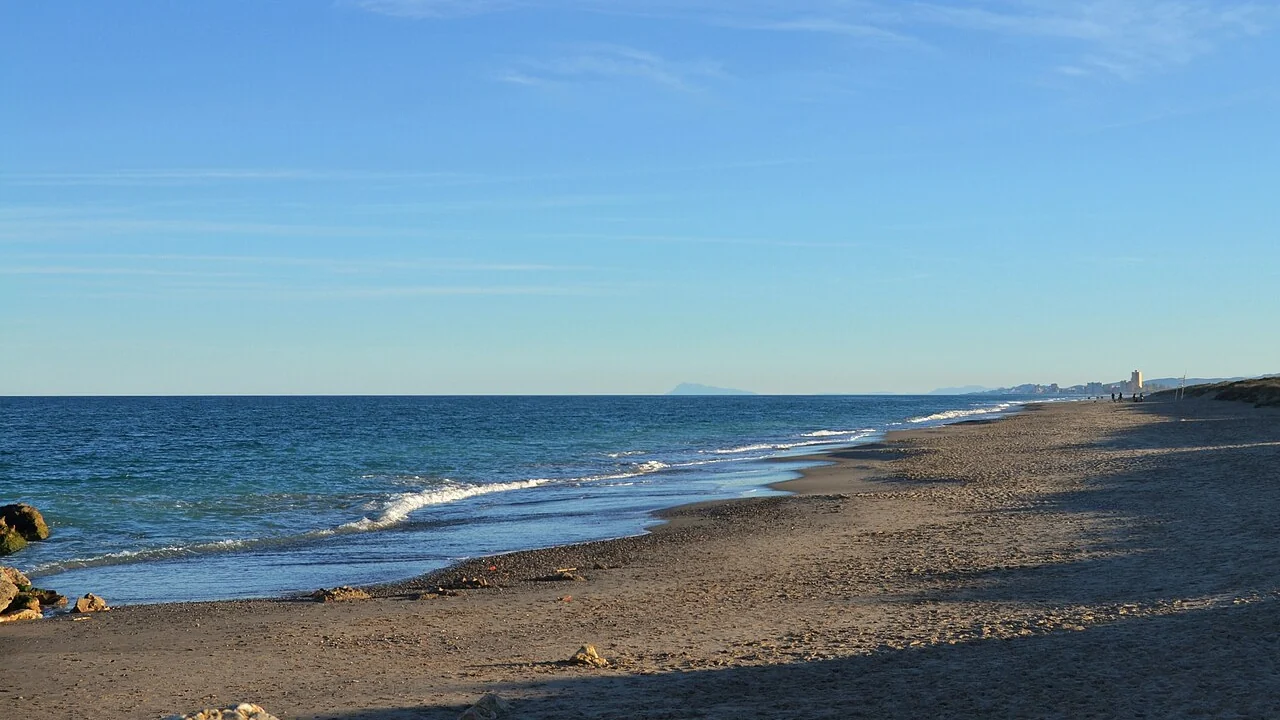
Photo: Joanbanjo, CC BY-SA 4.0
Patacona and Malvarrosa: the city beaches
La Patacona is the closest thing Valencia has to a city kite beach, though it sits in Alboraya rather than the city proper. The kite end is the northern one, up by the campsite and well away from the swimming crowds.
There is no enabled channel here either, which is what makes summer awkward. The beach is busy, the wind is often light, and the space you would need is full of people.
Autumn and winter are when Patacona is genuinely good. The crowds thin out, the frontal systems arrive, and the beach that was unusable in August turns into a reasonable session.
On Malvarrosa the kiting happens at the northern end, where the sand widens toward Patacona and puts some distance between you and the swimmers.
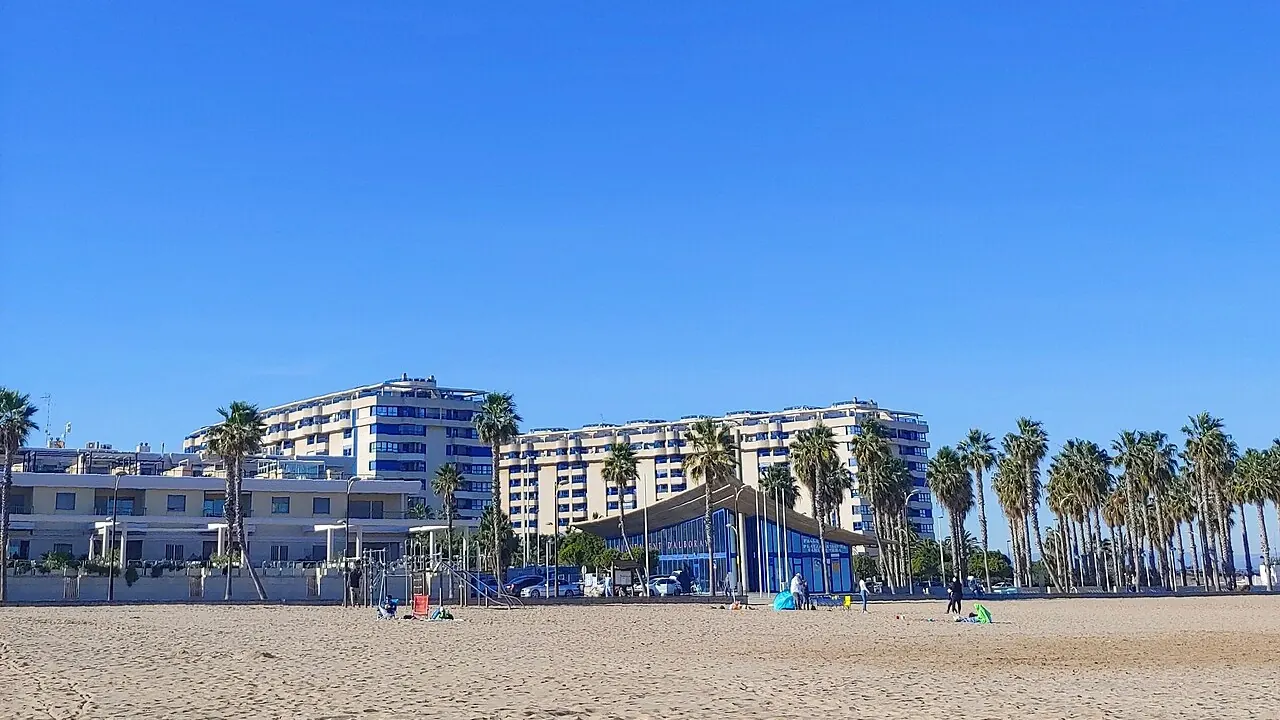
Photo: JaGa9480, CC BY-SA 4.0
Heading south: Gandia, Oliva and Les Deveses
When the city is underpowered, the coast further south usually is not. Gandia and Oliva are the standard escape, about an hour away by car, with far more beach per person than anything inside the city.
Oliva in particular picks up a clean thermal through spring and summer, and its beaches are wide and dune-backed, with room to lay lines out properly.
The spot regulars rate above all of these is Les Deveses, on the boundary between Denia and Oliva. It is the only beach on this stretch that faces north, which is why it still works in westerly and northwesterly wind when everywhere else is unusable, and it carries a reputation as the best kite beach in the Comunitat Valenciana. Matosurf's own Oliva/Denia spot guide goes deeper on the wind and conditions if you are planning a trip out there.
Be honest with yourself about the drive, though: check the Valencia transportation guide if you are not driving yourself. Les Deveses is roughly 100 km (about 62 mi) from Valencia, which makes it a day out rather than an after-work session.
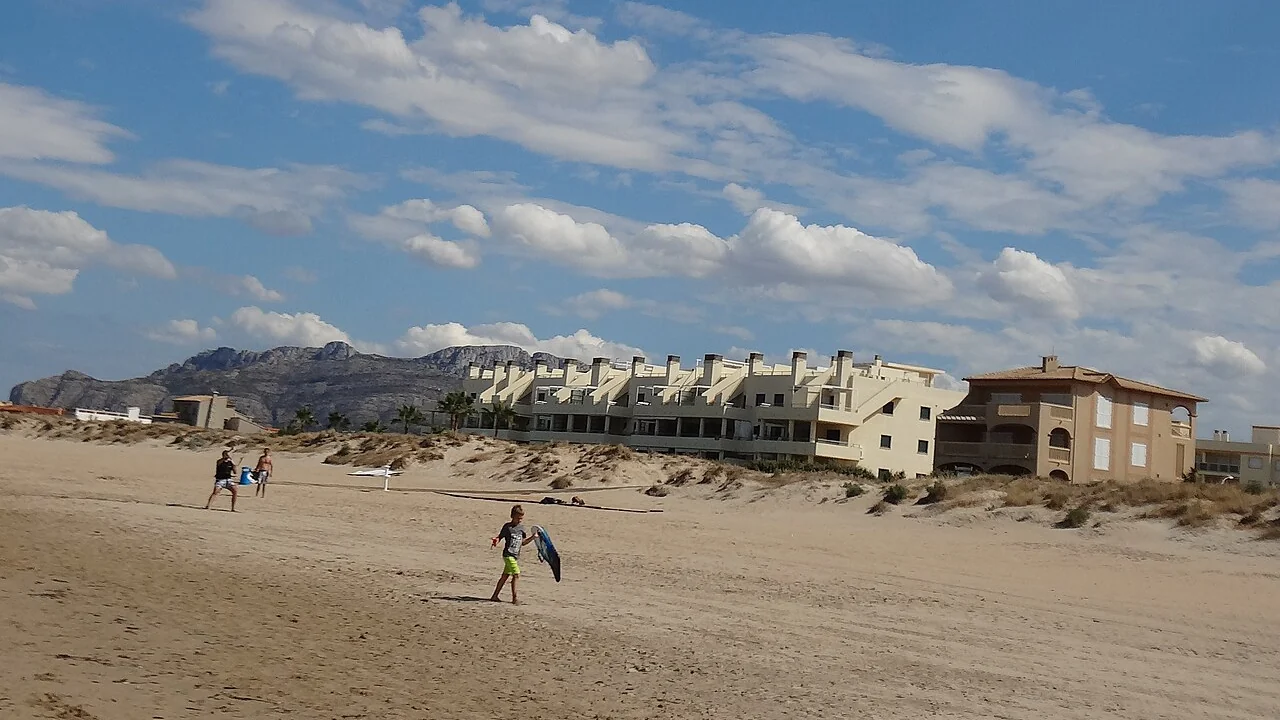
Photo: David Adam Kess, CC BY-SA 4.0
Heading north: the Ebro Delta
When neither the city nor the southern coast is delivering, some kitesurfers drive further, to the Ebro Delta around Sant Carles de la Ràpita and Deltebre. It sits roughly 170 to 190 km (about 106-118 mi) north of Valencia, about an hour and forty minutes to two hours by car, and it crosses into Tarragona province in Catalonia, so this is a day trip rather than an after-work session.
Trabucador, a narrow sandbar inside the Ebro Delta Natural Park, is the spring and summer spot. A southerly thermal fills in from April to September at 12 to 20 knots, and its shallow interior lagoon suits a beginner as well as it suits freestyle. From October to March the wind swings north and strengthens to 18 to 30 knots.
Riumar, about 18 km (about 11 mi) away on the river's north bank, is the Mestral () spot instead. A steady northwesterly blows cross-shore, strongest from September to April and building well into the 20s and sometimes the 30s of knots by the morning before it eases. The water is choppier than Trabucador's lagoon, so it suits an intermediate rider more than a first-timer, but between the two spots the Delta covers wind the Valencia coast rarely delivers.
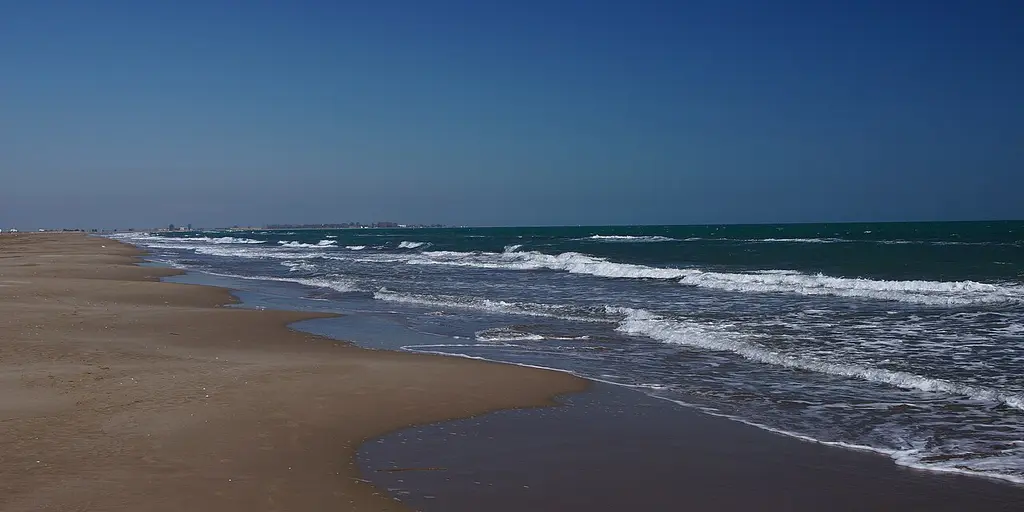
Photo: DagafeSQV, CC BY-SA 3.0
When to come
Spring and autumn are the best compromise. The thermals still run, the beaches are empty enough to use, and the summer restrictions on where you may fly have either not started or have finished.
Summer is the thermal season proper, roughly May to September, but it is also when the beaches are fullest and the zoning is most rigorously enforced. Plan around the afternoon Garbí and expect company.
Winter is the quietest and often the windiest, driven by fronts rather than thermals, but the sea is cold. Water temperatures on this coast sit around 14 to 15 degrees at the late-winter low, against roughly 26 to 27 in late summer.
Check the AEMET beach forecast rather than a generic app before committing to a session, and remember that a city-centre forecast does not describe El Perellonet.
What to bring
Most people riding here get through the year on a three-kite quiver in the 7, 9 and 12 metre (about 39 ft) range, with the middle sizes doing most of the work. A thermal that tops out in the teens of knots rewards a bigger kite than a Tarifa quiver would.
A twin-tip covers almost everything, because this is a flat-water and chop coast rather than a wave one. A foil is genuinely useful rather than a luxury, since it turns a lot of marginal days into rideable ones.
For wetsuits, boardshorts or a shorty will do in high summer, a 3/2 covers spring and autumn, and a 4/3 with boots is sensible in winter.
Bring your insurance paperwork. In the buoyed channel it is not a formality, it is a condition of using it.
Learning here
Valencia is a reasonable place to learn, mostly because the water is warm, shallow and rarely carries serious swell. The constraint is not the conditions, it is space: lessons have to happen where kiting is permitted.
The established option is KiteZone at El Perellonet, which has been teaching on that beach since 2001 and works to the IKO syllabus alongside the Spanish sailing federation's system.
Book through a school rather than teaching yourself from videos on a public beach. Beyond the obvious safety argument, a school is operating inside the permitted zone and you, on your own, are not.
Ask directly about the safety cover for your session rather than assuming a rescue boat is on the water. It varies by school and by day.
Rules and etiquette
Never fly over the beach or over people. This coast is busy well outside July, and a dropped kite among sunbathers is exactly how access gets withdrawn for everybody.
Respect the seasonal zoning. Summer restricts kiting to designated areas, and those areas are marked for a reason.
Drones are regulated separately, and flying one over a natural park such as the Albufera without permission is an expensive mistake.
The community here is small and the beaches are shared. A rider who launches carelessly in front of a family gets remembered.
After the session
Valencia's advantage over a dedicated kite town is what happens once the wind drops. You can be off the water and eating properly within half an hour.
For paella, the traditional restaurants sit along the Malvarrosa seafront and the Paseo Neptuno rather than on Patacona, which is a common mix-up. Our guide to the city's paella restaurants sorts the genuine ones from the tourist traps.
Closer to hand, a chiringuito () on the sand will feed you well enough afterwards, and it is where most of the post-session debrief happens anyway.
If you have a windless day to fill, there is plenty else going on in the city, and the beaches themselves are worth a slow morning.
Thinking about basing yourself here?
A coast with a dependable summer thermal, warm water most of the year and a real city behind it is a rare combination. If you are weighing up a move to Valencia, we can talk it through.
Contact us
About the author
Michael Bastin
Founder, ValenciaMove - Valencia since 2016
Michael has lived in Valencia since 2016 and helps people move here.
Buy Michael a coffeeNeed help with your move?
Contact us. We handle visa, admin, and housing so you can focus on the exciting part.