
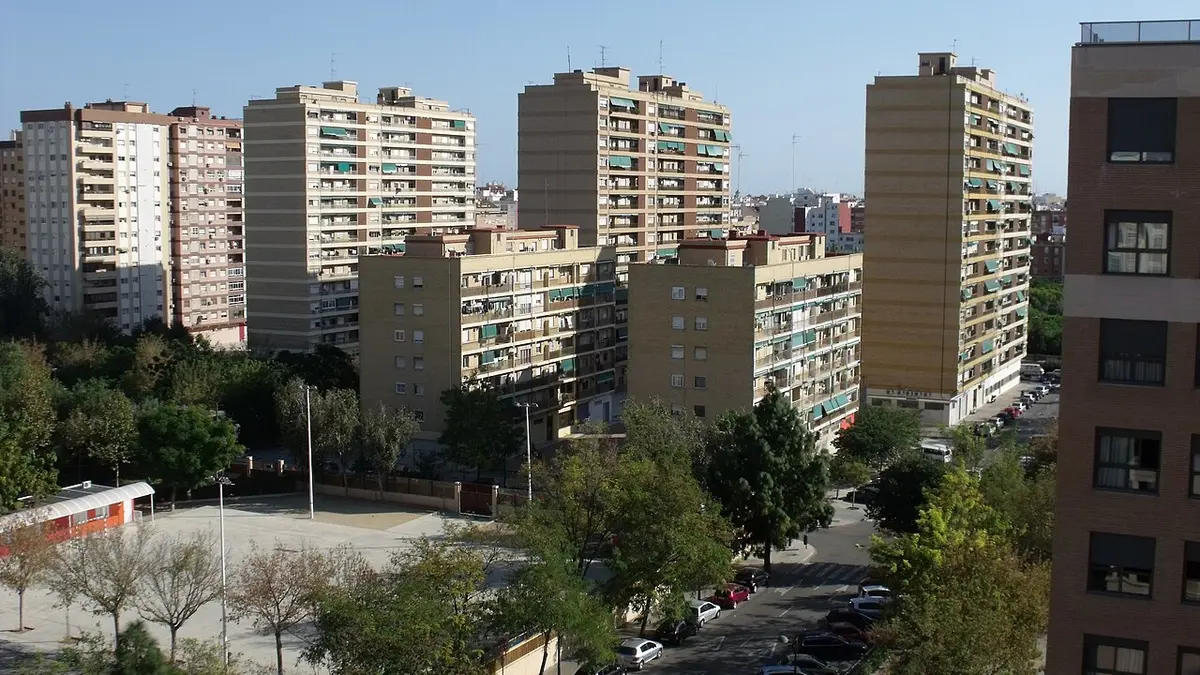
Photo: B25es, CC BY-SA 3.0
Living in Sant Pau (Nou Campanar), Valencia: a neighborhood guide
Campanar's largest barrio, the modern high-rise area better known as Nou Campanar
Living in Sant Pau
Sant Pau () is by far the largest barrio in the Campanar district: 389.8 hectares on the north-west edge of the city, from the old Turia riverbed in the south to the CV-30 ring road in the north, with Avinguda de les Corts Valencianes roughly along its eastern side and the municipality of Paterna to the west. Most people know its newer half as Nou Campanar.
In Castilian it is San Pablo. The name does not come from a church in the barrio. Local histories trace it to the Molí de Sant Pau, a mill on the Rascanya irrigation channel west of Campanar village, near today's Hospital Nou d'Octubre, which paid its dues to the Jesuit college of Sant Pau in the city. The rural area around the mill took its name; the mill itself has gone.
Sant Pau was a farming district of Campanar and became part of Valencia with it in 1897. It stayed largely rural until the last decades of the 20th century, when the high-rise blocks, parks and wide avenues of Nou Campanar went up on the old fields.
That growth is still visible in the numbers. According to the Ajuntament's municipal register, 5,858 people lived in Sant Pau in 2001 and 19,098 on 1 January 2025, which makes it the most populous barrio in the district today.
Transport: the barrio is too large for one answer. Campanar and Beniferri, on metro lines 1 and 2, sit near its eastern side, Nou d'Octubre on lines 3, 5 and 9 is across the old riverbed to the south, and EMT buses cover the rest. Check the walk from the exact street before you sign.
Trade-offs: flats are newer and bigger than in the older barrios, many with pools and garages, but the area is built around the car and the centre is a bus or metro ride away. For a village atmosphere, Campanar's old core is next door to the east.
What rent costs in Sant Pau (September 2026)
Sant Pau asks 21 EUR per m² a month on Fotocasa's rent index for September 2026, above the 18 EUR the city of Valencia averages. At that rate a 70 m² two-bedroom lists at around 1,470 EUR a month, before you negotiate. These are asking prices on new listings, not what sitting tenants pay.
Asking prices here are 1.4% above a year earlier, against 7% for the city as a whole.
This is the figure for the barrio itself. The Campanar district it belongs to reads 20 EUR on the same index.
Sant Pau is big enough that the figure above blends two markets: newer blocks with pools and garages in Nou Campanar, which let above it, and older stock nearer the riverbed and the hospital, which lets below it.
Our renting guide explains what landlords ask for and what the fianza and agency fee add on signing day, and the upfront cost calculator runs the maths for any rent.
Public and concertado schools in this neighbourhood
The Conselleria's school guide doesn't allow direct links to an individual school's page, so each card below gives you the school's official code instead. Open the guide, paste the code into the search box and the school's page comes up. Like many Spanish public administration websites, it takes a little patience.
CEIP Cami de l'Horta
Camí Viejo de Paterna S/N
CEIP Francisco Giner de los Ríos
Plaça Grup Parpalló S/N
Centre Privat Escuelas San José (i. Polit.)
Avinguda de Les Corts Valencianes 1
Centre Privat Niño Jesús
Carrer San Clemente 13
Centre Privat Sagrada Familia-Hhdc
Carrer Padre Barranco 40
Where Sant Pau Sits in Valencia
What Living in Sant Pau Is Really Like
Pros: What Residents Love
- Newer flats, many with pools and garages
- Wide avenues and large parks
- Parking is easier than in central barrios
- Hospitals and large shopping centres close by
Cons: What to Know First
- Far from the centre on foot
- Built around the car
- Metro stations only at the edges
- Little street life in the newest blocks
Typical Properties in Sant Pau
Local Amenities
Transport
Metro lines 1 and 2 at Campanar and Beniferri, lines 3, 5 and 9 at Nou d'Octubre
Health
Hospital Nou d'Octubre
Name
From the Molí de Sant Pau, an old mill
Population
19,098 residents on 389.8 hectares (padrón, 1 January 2025)
More neighborhoods
Campanar
Spacious flats, good schools, and the Turia Gardens on your doorstep - family-friendly Valencia without giving up the metro.
Explore CampanarLes Tendetes
A compact Campanar barrio on the north bank of the Turia gardens, named after its old village shops
Explore Les TendetesBenicalap
The northern budget growth area - lower rents, big new park, regeneration on the way
Explore BenicalapThinking about moving to Sant Pau?
Get in touch with our Valencia relocation team. We will help you find the right apartment, navigate the paperwork, and get settled faster.

Resident in Valencia since 2016. Founder of BeTranslated. 25+ years in translation, interpretation and multilingual SEO.
Reviewed 5 September 2026 by Michael Bastin