

Valencia still shops at the mercado (). The city council runs a network of covered municipal markets, one to every couple of barrios, and most of them open six mornings a week with the same fishmongers and greengrocers who have been there for decades. Add the Sunday flea market and a handful of weekly street markets and you have most of the food shopping a household needs without a supermarket.
This guide covers the four markets every newcomer hears about, what each is actually for, the neighbourhood markets that do the daily work, how a market shop functions once you are at the counter, and what a week's shopping costs with a source you can check.
Mercado Central: the big one
The Mercado Central on Plaça del Mercat, opposite the Llotja in Ciutat Vella, is the largest fresh-food market in the city and one of the largest in Europe under one roof. The building went up between 1914 and 1928, designed by Alejandro Soler March and Francisco Guardia Vial and finished under Enrique Viedma, and was opened by Alfonso XIII. The ceramic tiles, the stained glass and the dome are the reason tourists come; the fish hall is the reason locals do.
It opens Monday to Saturday from 7:30 to 15:00 and closes on Sundays and public holidays. Come before 10:00 if you want to shop rather than shuffle. Buy here what the barrio markets do not carry: the widest fish counter in the city, cured meats and cheeses from all over Spain, spices and dried goods, and the rice, saffron and paprika for a paella. On Mondays an outdoor mercado extraordinario sets up around it from 9:00 to 14:00 selling clothes, plants and household goods.

Mercado de Ruzafa: the weekly shop
The Mercado de Ruzafa on Plaça del Baró de Cortes is the market people mean when they say they do their shopping at the market. It is a working neighbourhood hall in a striped 1950s building, with greengrocers, butchers, fishmongers and a long row of stalls serving the Latin American and North African households of Russafa, which is where you go for plantain, yuca, coriander by the bunch and cuts of meat no supermarket stocks.
Hours are Monday to Saturday from 7:30, closing at 15:00 on Saturdays and, during the energy-efficiency works of 2026, at 14:00 on weekdays. Like the Central, it has an outdoor extraordinary market on Mondays from 9:00 to 14:00. Many stalls deliver, which matters if you live on a fourth floor without a lift.

Photo: Joanbanjo, CC BY-SA 4.0
Mercat de Mossén Sorell: the one that opens in the afternoon
The Mercat de Mossén Sorell stands on Plaça de Mossén Sorell in El Carmen, in the middle of the old town. It has been rebuilt as a glass and steel pavilion with a skylit central space the council uses for cultural events, and the glazing is deliberate: you can see the stalls from the street before you decide to go in. It is small, so it works as a daily top-up rather than a weekly shop, which suits a barrio of narrow flats and people who buy for two days at a time.
The timetable is what makes it worth knowing. It opens Monday to Friday from 7:30 to 15:30 and Saturday from 7:30 to 16:00, and it is one of the very few markets in the city that also opens in the evening: Thursday and Friday from 17:00 to 20:30, with the Friday evening dropped in August. Saturday brings its own outdoor extraordinary market alongside it, 9:00 to 14:00. If you work until six, this and the Mercat d'Algirós on Carrer de Sant Felip Neri, open until 20:00 on Fridays outside June to September, are realistically the only two markets you can shop at after work.
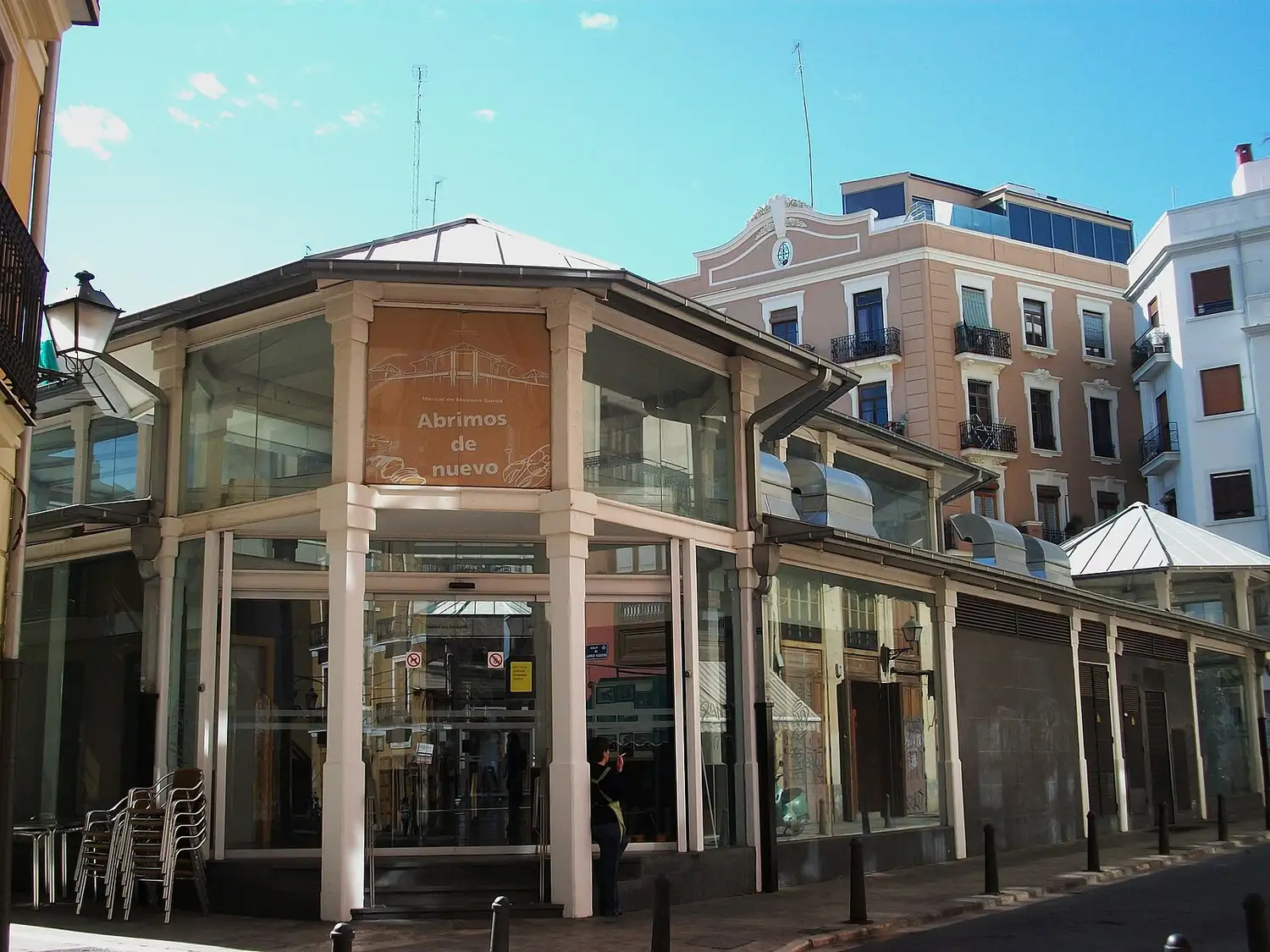
Photo: Joanbanjo, CC BY-SA 3.0
Mercat del Cabanyal: the one the traders run themselves
The Mercat del Cabanyal on Carrer de Justo Vilar, a few streets back from the sea in El Cabanyal, has been trading for over half a century and is the odd one out among the city's markets: it is self-managed by its own traders' association rather than run directly by the council. It shows in small ways. It has its own website and its own parking, and an agricultural cooperative sells from outside the building, so the produce on that particular stall comes from the grower rather than through a wholesaler.
Hours are Monday to Saturday, 7:30 to 15:00, and Thursday is the day to go. The outdoor extraordinary market takes over the surrounding streets from 9:00 to 14:00, or to 15:00 on the eve of a public holiday, so you get the fish counters and the clothes and household stalls in one trip. Several stalls deliver. It is a short walk from the beach, which makes it easy to fold into a morning by the sea rather than a trip of its own.

Photo: Joanbanjo, CC BY-SA 4.0
The barrio markets: where the daily shopping happens
Beyond the ones whose names people know, the city council runs more than a dozen municipal markets, and the one nearest your flat is the one you will end up using. Rojas Clemente in Extramurs, Algirós (which stands in Albors despite the name), Benicalap, Jerusalem, Torrefiel, Castilla, Benimàmet, Natzaret and Jesús-Patraix in Patraix: all follow the same pattern of Monday to Saturday mornings, roughly 7:30 to 14:30 or 15:00, and all sell the same fresh categories the Central does, with shorter queues and lower rents.
Most barrios also have a weekly open-air street market, the mercadillo, on a fixed morning, selling clothes, shoes, fabric and household goods rather than food. The council sets the day barrio by barrio: Algirós on Monday, Cabanyal on Thursday, Benimaclet on Friday around the Plaça de Benimaclet and the streets off it, each running 9:00 to 14:00, or to 15:00 on the eve of a public holiday. If you are choosing where to live, a covered market within walking distance is a real quality-of-life difference, and the neighbourhood guide notes which barrios have one.
Mercado de Colón: not a market any more
The Mercado de Colón on Carrer de Jorge Juan, in the Eixample, is the other modernista market building, designed by Francisco Mora Berenguer and built between 1914 and 1916 for the new bourgeois district around it. It stopped being a food market decades ago. What you find under the iron roof now is horchaterías, cafés, restaurants and a few gourmet shops, open every day from around 7:00 in the morning to 1:30 at night, with each business setting its own hours.
So do not come here for a weekly shop. Come for a horchata and fartons in the afternoon, a coffee on the way to Colón street, or a drink in the evening. It is worth knowing the difference before you arrive with a shopping trolley.

Photo: Diego Delso, CC BY-SA 3.0
Plaça Redonda: haberdashery, and a Sunday rummage in the middle of town
A minute behind the Mercado Central, tucked in behind the church of Santa Caterina, a circular courtyard opens out, ringed by two floors of balconies and lined at ground level with stalls. Plaça Redonda is officially a municipal market and sells no food whatsoever. What it sells is the old mercería trade: lace, thread, buttons, embroidery, aprons and bibs, alongside ceramics, craftwork, souvenirs and, improbably, a bird shop.
It keeps shop hours rather than market hours, Monday to Saturday from 10:00 to 20:00, which makes it the one market here you can visit on an afternoon without planning around it. On Sundays and public holidays from 8:00 to 14:00 an extraordinary market fills the circle with stamps, coins, out-of-print records, old books, trading cards and albums. If you want a Sunday rummage without the trip out to Beteró for the Rastro, this is the version you can walk to.
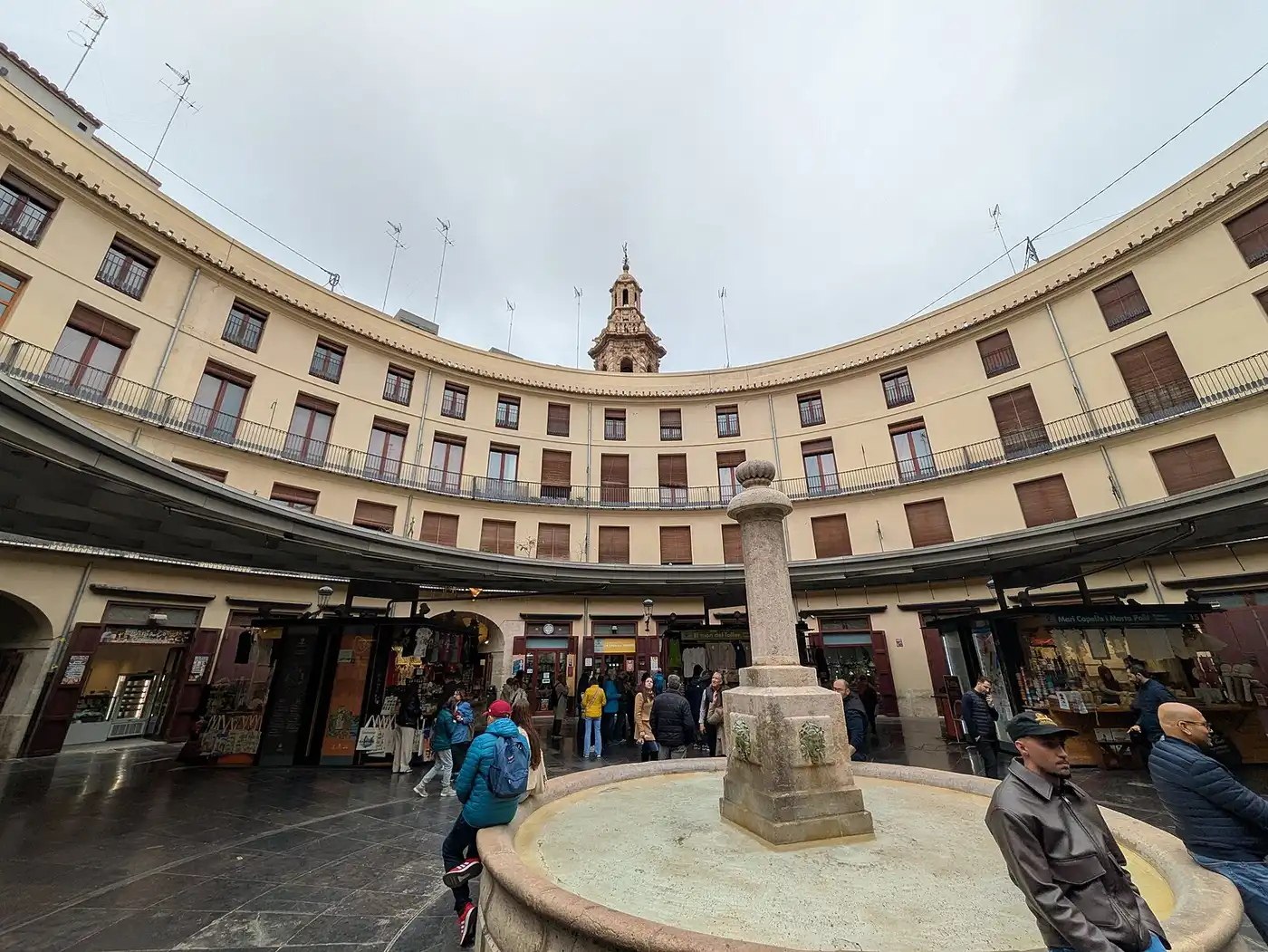
Photo: Artvill, CC BY-SA 4.0
The Rastro: the Sunday flea market

The Rastro on a Sunday morning, photographed at its old site by the Mestalla. It has since moved to Avinguda dels Tarongers; the stock has not changed.
Photo: Dorieo, CC BY-SA 4.0
The Rastro () is the city's second-hand and flea market, held on Sundays and public holidays from 9:00 to 14:00. For years it set up around the Mestalla stadium; it now occupies Avinguda dels Tarongers next to the Amelia Chiner park in Beteró, by the university campuses, with a tram stop of the same name at the gate. The council publishes the stall map.
It is where you furnish a first flat: chairs, lamps, tools, bikes, records, kitchenware, old cameras, and a large amount of nothing in particular. Haggling is normal and expected. Go early, bring cash, and check anything electrical before you pay.
How a market shop works
Every stall is a separate business, so you pay at each one, and the etiquette of the queue is the first thing to learn. There is often no line: people stand around the counter, and when you arrive you ask ¿quién es el último? (), who is last. Someone answers, you remember their face, and you go after them.
When the next person arrives and asks, you are the last. Busy stalls at the Central and Ruzafa use a ticket dispenser instead, so take a number and watch the display.
You do not handle the produce yourself: you tell the stallholder what you want and how much, and they choose it, often asking whether it is for today or for later in the week and picking the ripeness to match. Quantities are in kilos and fractions of one. Un cuarto is 250 grams, medio kilo is 500, and the very Spanish un cuarto y mitad () is 375 grams, the amount of ham or cheese a household buys for a few days. Expect ¿algo más?, anything else, after each item, and say ya está when you are done.
Cards are accepted at most stalls now, but cash is faster and a few of the older ones still prefer it. Bring your own bags or a shopping trolley; most people over forty pull one. Fish is gutted and filleted on request at no extra charge, meat is cut to order, and a stallholder who knows you will put things aside if you ask. Saturday morning is the busiest time; a weekday at 9:00 is the calmest.
What a week's shopping costs
The most reliable figure is the consumer organisation OCU's annual supermarket study. Its 2025 edition put the average household's yearly basket at 6,259 euros, or roughly 120 euros a week, with a gap of 1,132 euros a year between the cheapest and dearest shop in the same city. The Comunitat Valenciana came out among the cheaper regions, and Torrent, in the metropolitan area, was one of the cheapest towns in the study.
Markets are not systematically cheaper than supermarkets; what they do is make seasonal produce cheap and everything out of season expensive, which is the opposite of a supermarket's flat pricing. Oranges from December to April, tomatoes and peppers in summer, artichokes in winter: buy what the huerta is producing that month and the market wins; insist on strawberries in November and it loses. Fish and meat are usually better quality for a similar price rather than cheaper.
What to buy in which month
The huerta produce guide lists what is in season around the city month by month, and the Valencia food guide covers what to do with it. Three things to buy at the market that a supermarket does not do well: the rice for paella by the kilo from a sack, the tigernuts for horchata in autumn, and the vegetables for an all i pebre or an arròs al forn, which a stallholder will assemble for you if you tell them the dish.
Choosing a barrio to live in?
Whether there is a covered market within walking distance is the kind of detail that decides how a neighbourhood feels a year in. If you are weighing up where to settle, we can talk it through alongside the visa and the paperwork.
Contact us
About the author
Michael Bastin
Founder, ValenciaMove - Valencia since 2016
Michael has lived in Valencia since 2016 and helps people move here.
Buy Michael a coffeeNeed help with your move?
Contact us. We handle visa, admin, and housing so you can focus on the exciting part.