
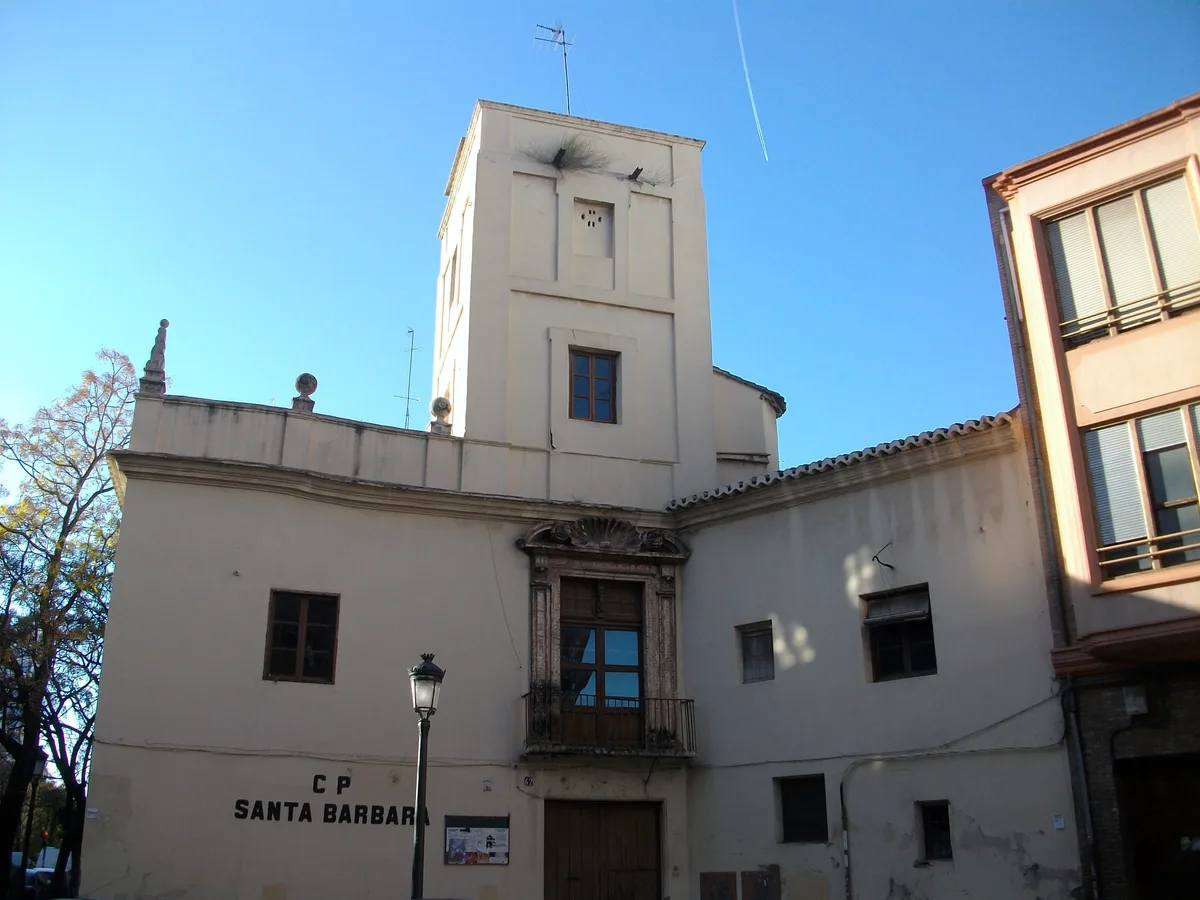
Photo: Joanbanjo, CC BY-SA 3.0
Living in L'Olivereta: a Valencia neighborhood guide
The west-side residential district - quiet, family-oriented, fast metro to the airport
Living in L'Olivereta
L'Olivereta () is the west-side residential corridor, bordered by Mislata (the working-class western municipality) and bisected by major arteries that feed the airport, with the Patraix sub-barrio of Vara de Quart as its southern neighbour. The barrio doesn't get the tourist traffic of the centre - what you find instead is local Valencian life: weekday markets, neighbourhood cafés, and a quieter pace.
L'Olivereta has the same name in Valencian and Castilian. Olivereta is the Valencian word for a small olive grove, and the name is usually taken to recall the olive trees that grew here before the city spread west. According to the Ajuntament's municipal register, its five barrios had 52,319 residents on 1 January 2025.
The standout practical feature: airport access. Metro line 5 runs from Aeroport directly through L'Olivereta (stations Avinguda del Cid and Nou d'Octubre). For frequent travellers, freelancers with international clients, or families with relatives abroad, that 25-minute door-to-airport time is worth the trade against central location.
Rents are notably lower than central for the same size of flat. The buildings skew 1970s-1990s with lifts and parking, and the streets are calmer with less scooter traffic than the centre. Local commerce is strong but neighbourhood-focused: butchers, bakeries, hardware stores rather than coffee-roastery destinations.
Trade-offs: the dining and nightlife scene is sparse compared to Ruzafa or El Carmen. International schools are 15-25 minutes by car. The look-and-feel is more practical than charming. Best fits: families, retirees, professionals who travel weekly, anyone happy to take the metro to a weekend night out.
The L'Olivereta district also takes in Nou Moles, its largest barrio, between the Avinguda del Cid and the Turia gardens, small Soternes on the boundary with Mislata, and Tres Forques, home to the Hospital General and the Parc de l'Oest. On the Xirivella boundary sit La Fontsanta, built to rehouse families after the 1957 flood, and small, dense La Llum.
What rent costs in L'Olivereta (September 2026)
L'Olivereta asks 17 EUR per m² a month on Fotocasa's rent index for September 2026, below the 18 EUR the city of Valencia averages. At that rate a 70 m² (about 753 sq ft) two-bedroom lists at around 1,190 EUR a month, before you negotiate. These are asking prices on new listings, not what sitting tenants pay.
Asking prices here are 17.4% above a year earlier, against 16.2% for the city as a whole.
One figure covers the whole L'Olivereta district here, which also takes in Nou Moles, Soternes, Tres Forques, La Fontsanta and La Llum. The barrios inside it price differently street by street, so read it as the district average rather than a quote for any one of them.
L'Olivereta prices as a district of family flats, not of investors. The stock is 1970s to 1990s mid-rise with lifts and parking, the tenants are households who stay for years, and turnover is low enough that a good three-bedroom rarely sits on a portal for long. What moves the figure is the airport metro line rather than any cafe scene: flats within a few minutes of Nou d'Octubre or Avinguda del Cid station let faster and ask a little more than the blocks deeper inside the district.
Our renting guide explains what landlords ask for and what the fianza and agency fee add on signing day, and the upfront cost calculator runs the maths for any rent.
Living in the L'Olivereta district
Getting around
Nou d'Octubre and Avinguda del Cid sit on the western corridor served by lines 3, 5 and 9. Avinguda del Cid is the district's bus spine and runs straight into the centre.
The corridor is fast: central Valencia is around 10 minutes by metro from most of the district.
What sets it apart
L'Olivereta is the most consistently affordable inner-western district, built out in dense 1960s and 1970s blocks for the industrial expansion of that period. Nou Moles is by far the largest of its five barrios.
There is essentially no tourism here, which shows in the street life: local bars, local markets and Spanish as the default language on the pavement.
Who it suits
Long-stay renters and families who prioritise price and metro speed over charm and are comfortable in a fully Spanish-speaking neighbourhood.
It is a practical choice rather than a romantic one, and the honest trade-off is a streetscape with very little architectural interest.
Barrios in L'Olivereta
Every barrio inside this district has its own guide. Rent, transport and character vary a lot from one street grid to the next, so start with the one closest to where you actually want to live.
Nou Moles
The largest barrio of L'Olivereta, whose name means the new millstones
Explore Nou MolesSoternes
A small L'Olivereta barrio on the Mislata boundary that began as a hamlet around a hermitage
Explore SoternesTres Forques
A L'Olivereta barrio with the Hospital General and the Parc de l'Oest
Explore Tres ForquesLa Fontsanta
A compact L'Olivereta barrio built in the late 1950s to rehouse families who lost their homes in the 1957 flood
Explore La FontsantaLa Llum
A small, dense L'Olivereta barrio of social housing on the Xirivella boundary
Explore La LlumPublic and concertado schools
Active public and concertado schools in this district, per the Conselleria d'Educació register.
The Conselleria's school guide doesn't allow direct links to an individual school's page, so each card below gives you the school's official code instead. Open the guide, paste the code into the search box and the school's page comes up. Like many Spanish public administration websites, it takes a little patience.
CEIP 8 de Març
Carrer María Zambrano 1
CEIP 9 d'Octubre
Carrer Democràcia 32
CEIP Doctor Barcia Goyanes
Carrer Olimpia Arozena Torres 23
CEIP Gaspar Gil Polo
Carrer Miguel Paredes 5
CEIP Rafael Altamira
Carrer Quart de Les Valls 2
CEIP Raquel Paya
Carrer Músico Ayllon 41
CEIP Sector Aéreo
Carrer Santa Cruz de Tenerife 1
IES Cid Campeador
Carrer Guillem Despuig 8
IES Número 26
Carrer Casa de la Misericordia 34
Centre Privat Claret Fuensanta
Plaça Murcia 9
Centre Privat Jesús María-Fuensanta
Plaça Murcia 10
Centre Privat la Purísima-Franciscanas
Avinguda Tres Cruces 49
Centre Privat Nuestra Señora de Fátima
Carrer Jumilla 6
Centre Privat Pureza de María-Cid
Avinguda del Cid 142
Centre Privat Santa María
Avinguda Tres Cruces 10
Centre Privat Som Escola
Carrer Archena 6
Public health centres (centros de salud) near this neighbourhood
Public primary-care centres of the Valencian health service. Distances are straight-line to the edge of the neighbourhood, not walking routes.
Centro de Salud Nou Moles
Veinticinco de Abril S/N, 46018 Valencia
Health department: Hospital General
Centro de Salud Tres Forques
Avda. Tres Forques 98, 46018 Valencia
Health department: Hospital General
Which centre you are assigned to depends on your home address, so check it with the Generalitat's centre search before you register.
Generalitat health centre searchSource: Generalitat Valenciana open data (CC BY).
Where L'Olivereta Sits in Valencia
What Living in L'Olivereta Is Really Like
Pros: What Residents Love
- Direct metro to airport - 25 min door to terminal
- Rents about 20% below central Eixample for similar flat size
- Calmer streets, less scooter and tourist traffic
- Family-sized flats with lifts and parking common
- Local market culture - butchers, bakeries, hardware stores
Cons: What to Know First
- Limited nightlife and destination dining
- International schools require a 15-25 min commute
- Less character than older barrios
- Quieter weekend feel - fewer cafés open Sunday
Typical Properties in L'Olivereta
Local Amenities
Airport
Metro line 5 direct to Aeroport - 25 min door-to-terminal
Transport
Metro line 5 (Avinguda del Cid, Nou d'Octubre), EMT bus lines to centre
Daily life
Local mercados, Mercadona, Consum, neighbourhood butchers and bakeries
Green space
Parque del Oeste, Parque de la Rambleta within walking distance
Population
52,319 residents in its five barrios (padrón, 1 January 2025)
Neighbouring towns, just across the boundary
More neighborhoods
Nou Moles
The largest barrio of L'Olivereta, whose name means the new millstones
Explore Nou MolesTres Forques
A L'Olivereta barrio with the Hospital General and the Parc de l'Oest
Explore Tres ForquesLa Fontsanta
A compact L'Olivereta barrio built in the late 1950s to rehouse families who lost their homes in the 1957 flood
Explore La FontsantaThinking about moving to L'Olivereta?
Get in touch with our Valencia relocation team. We will help you find the right apartment, navigate the paperwork, and get settled faster.

Resident in Valencia since 2016. Founder of BeTranslated. 25+ years in translation, interpretation and multilingual SEO.
Reviewed 5 September 2026 by Michael Bastin